
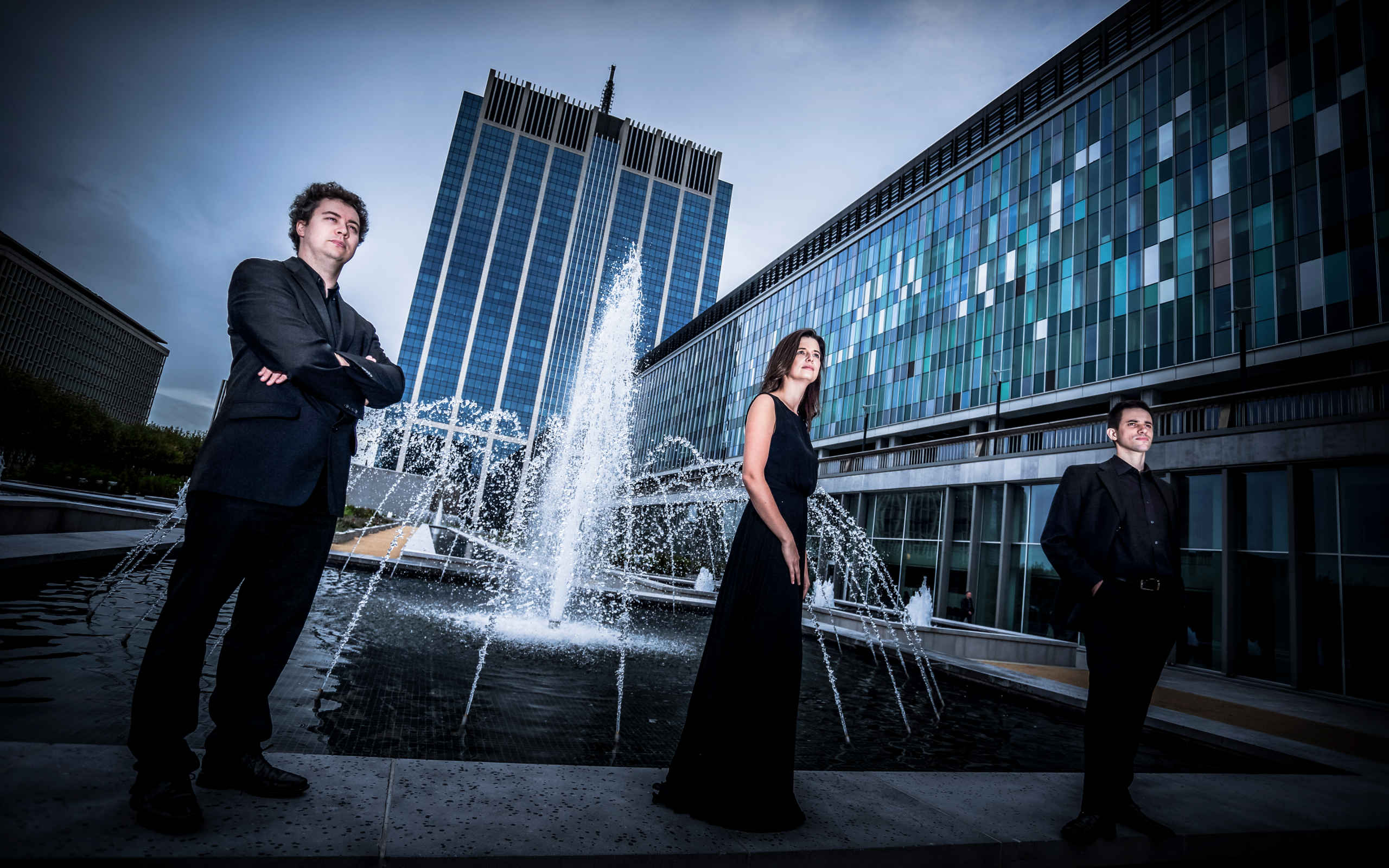
It is summer, and that means time for Festival Midis-Minimes. On Friday, 20th and 21st-century music typically echoes through the concert hall of the Brussels conservatory. While Belgium and France were still competing against each other on the football field, they stood side by side fraternally this afternoon. Trio Khaldei, also franco-belge in origin, performed as a determined peacemaker of the day.
Combining well-known and lesser-known works is a leitmotif in the programming of Trio Khaldei. Both pianist Barbara Baltussen and violinist Pieter Jansen emphasized this in this interview published last year on the website of Klassiek Centraal. Not empty words, as also became clear during the concert that the piano trio gave yesterday afternoon in the framework of Festival Midis-Minimes. A well-attended concert hall of the Royal Conservatory Brussels first heard the Trio, opus 5 by Antwerp native Frits Celis, only to then savour "one of the most innovative and colourful works of the chamber music repertoire". In any case, a bold claim by the festival organizers, but one that rings true: Ravel's only piano trio (1914), hastily completed just before he joined the military, is indeed one of the absolute pearls of the last century. Even more than through the ingenious structure, this versatile four-movement work would let a refreshing new wind blow through the genre. "Il n'y en a pas beaucoup dans la musique qui lui puissent être comparé", wrote Jean Marnold (1859-1935) a year after publication. And the musicographe continued: "Nul pathos, nul intellectualisme abstrait dans cette musique pure, dont Mozart n'a pas dépassé la spontanée maîtrise, l'aisance ni le souffle ailé." Even though this genuine encomium also involved some chauvinism, this work of considerable scope for the French composer is an unparalleled achievement.
Penetrating / unreal
But Trio Khaldei considers it very important to also play Belgian repertoire. And so the ensemble let Ravel wait a moment, while a much less frequently heard piece by Frits Celis appeared on the music stands. Celis wrote his opus 5 as a late twenty-something in 1958 and belongs to a fine selection of early works. His work as a teacher, music director and especially (opera) conductor meant that composing took a back seat for a long time. "I started as a true romantic (sic)", the composer reflected in 1994 in the journal Muziek & Woord. "My first compositions followed the fixed forms and genres of previous centuries and sounded purely tonal." According to today's performers, the one-movement piano trio possesses a strong rhythmic drive and clear sense of structure, but above all a beautiful, extensive colour palette. It is precisely that latter quality that ensures a successful union with Ravel's work. Over the past years, Trio Khaldei has become a great advocate of this music, and gave once again a very compelling interpretation of it. The study section in which the main theme was presented soon gave way to a penetrating intensity that never really subsided completely, even though there was careful switching back and forth several times from a delicate piano to an energetic forte and back. The timing was also handled with meticulous care. The puzzle pieces thus fitted together nicely or created particularly rich sonorities. The fiery conclusion was exemplary in that respect. After the concert, I hear from Barbara Baltussen that it had been a while since the trio last performed this music. And yes, the desire to play this was certainly audible.
You can listen to Celis and the Trio Khaldei under this review quite comfortably, while reading about the lasting exploits of the trio in Ravel. For the ensemble made more than a good showing there as well. Subtlety at the keyboard during the dreamy opening of the opening movement (Modéré) was answered by two men who likewise showed their softest side. In the restrained and generally contemplative continuation, a spontaneous self-assurance resonated simultaneously. And the articulation was clear and precise in every part. Quite breathtaking was especially the way the music faded away. To such an extent that the question arose: have I ever heard a more delicate smorzando? There was no time to ponder, however. For the playful scherzo was already making its entrance. Pantoum, as Ravel titled the second movement, is a Malay verse form that received a particularly successful yet extremely demanding musical translation here. But both the complex piano part and the various string techniques proved to be merely a stepping stone for the Trio Khaldei towards a dynamic interpretation that only became somewhat less flawless at the end. Ravel strikes a wholly different tone in the Passacaille: a largo in Baroque style, yet nonetheless bewildering in character – might the composer have been inspired by the slow interlude from Beethoven's Geistertrio? It's quite possible. What is certain is that the nuanced phrasings occasionally assumed unreal proportions. Like the moment when the piano suddenly fell silent, and the strings had the playing field to themselves. The audience fell silent, including the children who can experience something very special for free at Midis-Minimes. The energetic finale was for the Trio Khaldei one more time to labor and give their all (Animé). For her the signal to shine or to strike the keys decisively. For them a thriller – both literally and figuratively – in which smooth bow work came in handy. And together they held the alternating tempi taut. An overwhelming pedal point on a monumental piano trio.
Thanks to the collaboration between Midis-Minimes and the Zomer van Sint-Pieter, you can catch almost every concert the next day at the Leuven sister festival as well – or what other word to use for tickets at a handful of euros! Three times unfortunately, but due to conflicting schedules this was not possible for the Trio Khaldei. Let's look forward to next year for another forty-five beautifully sounding minutes …
- WHAT: Frits Celis (°1929), Trio, opus 5 || Maurice Ravel (1875-1937), Pianotrio in a
- WHO: Trio Khaldei [Barbara Baltussen (piano), Pieter Jansen (violin), Francis Mourey (cello)]
- WHERE: Koninklijk Conservatorium Brussel (i.k.v. Festival Midis-Minimes)
- WHEN: Friday 13 July 2018
- PHOTO: © Nicolas Draps