
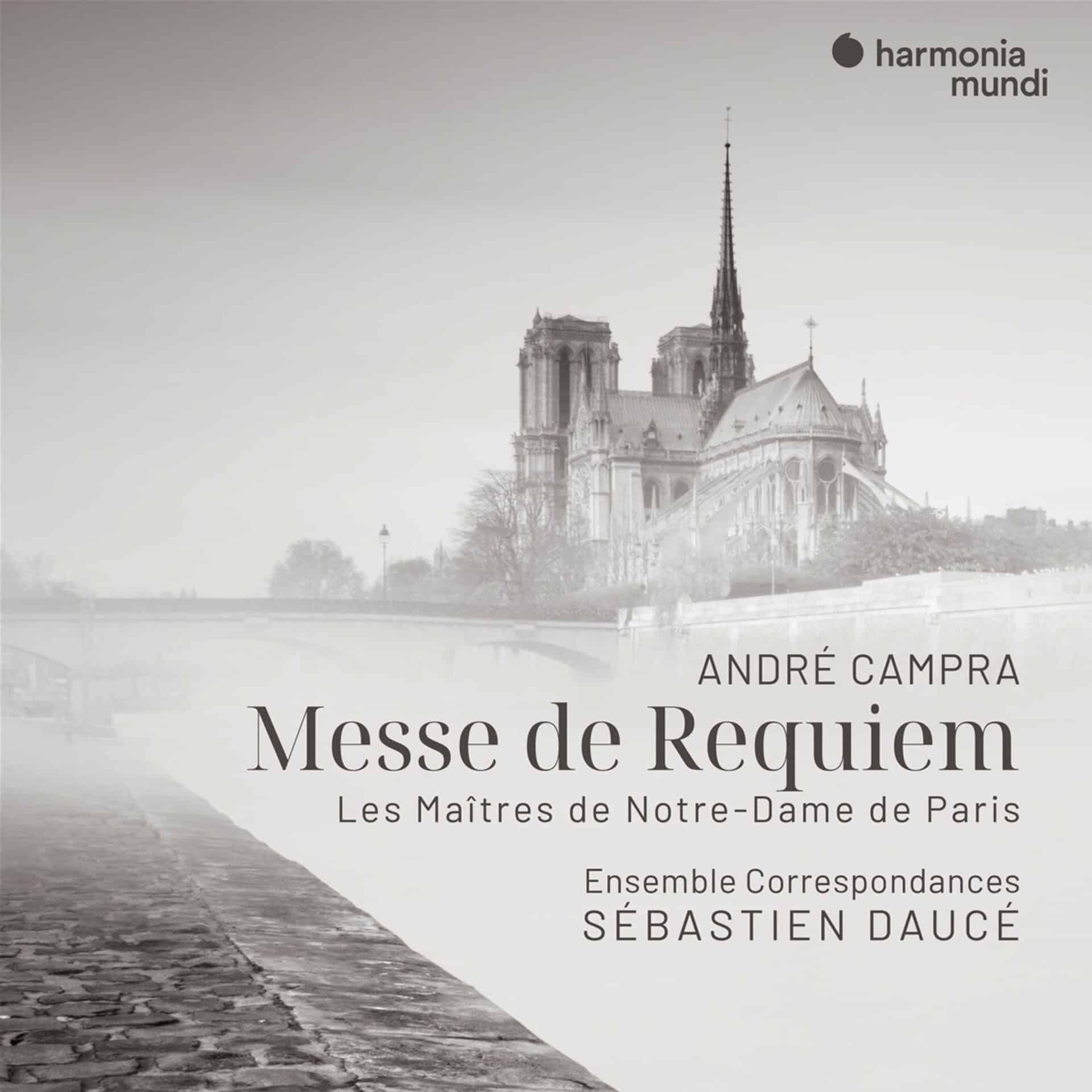
The last maître de musique connected to Notre-Dame in the seventeenth century is undoubtedly the most well-known or, if you will, most striking in our perception: André Campra (1660-1744). He received his musical training at the choir school of the cathedral of Saint-Saveur in Aix-en-Provence and held his first positions as maître de musique in various cathedrals in southern France (Toulon, Arles, Toulouse), before succeeding Jean Mignon on 21 June 1694 as head of the maîtrise of Parisian Notre-Dame. But once established in Paris, he was especially drawn to what was happening in the opera, which soon inspired him to compose his first opera, L'Europe galante, which premiered in 1697 at the Académie Royale de Musique and became a resounding success and consequently led to a large number of performances.
Incompatible
But this had a downside: the canons of Notre-Dame found that attraction to the opera house, so irresistible for Campra, incompatible with the dignity of his duties within the cathedral's walls, which resulted in him having to leave the field in November 1700. Nevertheless, he remained deeply connected to the many religious communities that the capital possessed. They gave him many composition commissions, notably those of the Jesuits, which he willingly accepted.
But in 1723 a new challenge awaited him: the position of sous-maître attached to the Chapelle Royale (there were four in total). He remained so until his death in 1744, leaving more than thirty grand motets.
Different hypotheses
Campra composed specifically for Notre-Dame a five-part polyphonic mass: Ad majorem Dei gloriam, published in 1699. In the same year he dedicated his second book of petits motets (Motets à I, II et III voix et instruments avec la basse continue) to Cardinal de Noailles, the Archbishop of Paris; the first motet, with the same name, Campra had already dedicated in 1695 to Charles de la Grange-Trianon, canon of Notre-Dame. But his most famous religious work remains the Messe des morts (or Messe de Requiem). Although the circumstances surrounding the work are unclear and may well remain so, there are various hypotheses that assign the work to each period of Campra's working life, from Aix-en-Provence, where he received his training, to the Chapelle Royale, via the cathedrals of Saint-Trophime in Arles, Saint-Étienne in Toulouse and of course finally Notre-Dame in Paris.
As the Domine Jesu Christe from the Requiem demonstrates, the oratorio follows the Roman liturgy rather than the rite of the Gallican church, which was especially used in the cathedrals in the northern part of France and notably Notre-Dame. The suggestion of Maurice Barthélem, author of André Campra 1660-1674, étude biographique et musicologique, that the Requiem may have been composed for a commemorative service on 23 November 1695 at Notre-Dame following the death of Archbishop François de Harlay de Champvallon, four months earlier, therefore seems untenable. Then there is the Chapelle Royale, where Campra was sous-maître from 1723, sometimes presented as the most likely environment for the creation of the work, but this can be ruled out: although the liturgy of the Chapelle indeed followed the Roman rite, the ceremony, at least in this period, excluded Masses for the Dead 'en musique' and 'en symphonie' from the outset.
We must therefore look at other hypotheses, of which the one in the brand new edition of the Requiem edited by Louis Castelain (Versailles 2024) seems most convincing. Although we cannot completely rule out its origin at the end of the composer's period in Toulouse – he left the local cathedral in 1694 – the trail to Paris remains most plausible, and more precisely the period after his dismissal by the chapter of Notre-Dame.
Between 1700 and 1722 he had no permanent position with a religious institution, but he did work regularly with the Jesuits. This religious community, which generally followed the Roman rite, preferred to use in its ceremonial services musical forces such as we also find in Campra's Messe des morts: a group of soloists dominated by lower voices, a five-part choir and a four-part orchestra (strings and flutes) 'à la française', an instrumentation that recalls that frequently used by Marc-Antoine Charpentier (1643-1704) in works he composed between 1688 and 1698 for the same Jesuits. But other Parisian religious institutions also gladly called upon Campra's creative services, whose reputation in the capital was firmly established at that time. Between 1700 and 1721 the Mercure galant describes six 'extraordinary' ceremonies in which Campra participated at the invitation of various ecclesiastical patrons. The first of these is certainly intriguing. On 13 March 1700, a funeral service was held in the Église des Mathurins, located on what is now the rue de Cluny, in memory of Louis Boucherat, Chancellor of France, who had died on 2 September 1699. In the Mercure galant of March 1700 (pp. 188-190) the following can be read about this:
On Saturday the 13th of this month, the Community of Printers & Booksellers of Paris had a solemn Service celebrated for the late Mr Chancellor Boucherat, as Protector of Letters & Sciences, in the Church of the Fathers of the Redemption of Captives, commonly called Mathurins. It was hung with black cloth up to the vaults, with a representation elevated on a platform of several steps, & surrounded by quantities of candles bearing the Arms of Boucherat, all under a high Canopy suspended. Mr the General of the Order celebrated the Mass, which was answered by a Choir of the best Musicians, under the direction of Mr Campra, Canon of Saint-Jean-le-Rond, and Master of the Music of Notre-Dame. The Relations of Mr Chancellor were present there, with a great number of Persons of Quality.
It is likely that Campra, who had a few more months to serve in his position at Notre-Dame – he was replaced in November 1700 by Jean-François Lallouette – conducted a Requiem of his own hand. Like most religious orders, despite all recent tensions between Paris and Rome, the Mathurins generally used the liturgical books sanctioned by Rome. The churches that held the other five celebrations indicated by Mercure and in which Campra was involved – festive events that were traditionally celebrated with a Te Deum – also belonged to congregations (Theatines, Oratorians, Jesuits and Discalced Augustinians) that primarily followed the Roman rite.
Great renown
Campra's Messe des morts enjoyed great renown in the eighteenth century, though primarily in the provinces. The work belonged to one of those iconic compositions that were regularly performed at extraordinary ceremonies, together with the Messe des morts of another former Provençal choir singer, Jean Gilles (1668-1705). Then there was the Te Deum of Michel-Richard de Lalande (1657-1726) which served particularly at celebrations around thanksgiving and joy.
Campra's Requiem does not appear to have been performed by the Concert Spirituel, an institution founded in Paris in 1725, in contrast to Gilles' Requiem, which was held in high esteem there until the 1770s and appeared multiple times on the music stands. On the other hand, Campra's Requiem enjoyed a great reputation in the composer's native region, and more generally in the southeastern part of France. Evidence of this dates back to the second half of the eighteenth century, a period in which the regional press developed strongly and thereby offers a true treasure of information about musical life in the provinces in the last days of the Ancien Régime.
Choir school
Since its foundation Notre-Dame has attracted the leading musicians of the time. Under these vaults the first polyphonic pieces were born in the late twelfth century, and singing has always enriched the numerous services held there. It gave the cathedral a lustre that extended its reputation far beyond the French capital. Many celebrated singers, organists, choir directors (maîtres de chapelle or de musique) and composers received their training at or served in the choir school (maîtrise), one of the oldest and most prestigious in the realm at that time – the earliest records dating from 1326. Until the French Revolution, musicians of all kinds contributed to the rich musical heritage of the cathedral, maintaining the cantoral traditions and the often complex techniques of (frequently also spontaneously improvised) Gregorian chant (chant du sur le livre) in honor.