
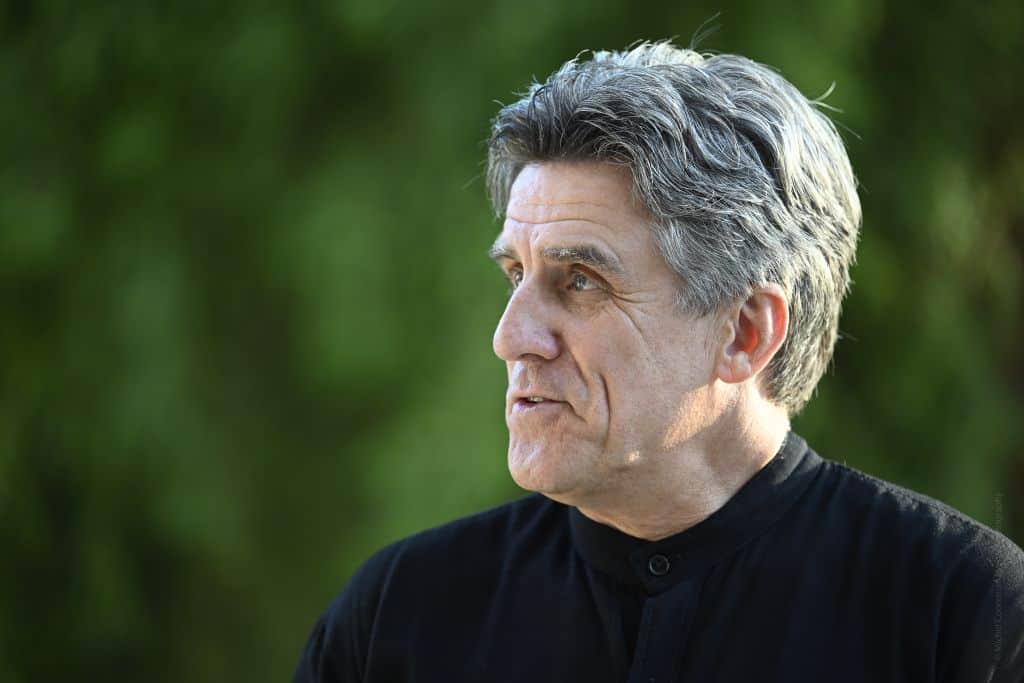
Composer and conductor Dirk Brossé is in great demand and works more abroad than in Belgium, but in March he will conduct his 'Artesia Revisited' four times, starting on Thursday 14 March at Concertgebouw Brugge, Saturday 16 March at CC Zwanenberg, Heist-op-den-Berg, Friday 22 March at Muziekcentrum De Bijloke Gent and on Saturday 23 March at CC De Factorij Zaventem.
In 1995, 'Artesia' premiered, the first symphony by the then 32-year-old Dirk Brossé. He called it a universal symphony. A cross-cultural vision of peace in which the classically trained orchestra musicians of Symfonieorkest Vlaanderen shared the stage with ethnic musicians. He described 'Artesia' as a fictional place – a universe where people, from a deep respect for one another, live together peacefully. 'Artesia' was performed more than thirty times at the time, even in China and Japan. Meanwhile, we are almost three decades further on.
'Artesia Revisited' pierces like a ray of light through these dark and sinister times. In his own eclectic way, composer Dirk Brossé places his inner world in a sound universe full of compassion. With the addition of ethnic instruments, you as a listener travel the world without physically going anywhere. The technical complexity of his composition requires supreme mastery. The lyrical beauty and finesse of the music is done justice by Symfonieorkest Vlaanderen together with the ethnic musicians.
–You are a collector of rare and old instruments.
I own quite a few. That's correct.
–At some point there was also the ambition to do something with them.
That grew. At one point there was one instrument, a pre-Columbian flute, which I incorporated into my composition 'La soledad Americo Latina'. Work for the official opening of the World Exhibition in Sevilla in 1992. My collection grew larger and larger and then I composed a symphony in which all the instruments I had at the time found a place. That symphony was given the name 'Artesia' and we are now going to perform it four times again.
–Does composing put you into a kind of creative meditation?
Absolutely. It's not like an accountant, with all due respect, doing his work. You have to be inspired. You can look for that inspiration or kindle it. There is a certain spiritual, intellectual or emotional state of mind needed to be able to compose.
–The classically trained orchestra musicians of Symfonieorkest Vlaanderen shared the stage with ethnic musicians at the time. A surprising combination, warmly received by the audience. Next month there is a revival, with an addition, an epilogue.
'Artesia' was a plea for a multicultural society. Now thirty years later, I look at it differently. In that span of time, the world has evolved enormously. After we performed the original work, a kind of post scriptum emerged. That post scriptum consists of two new compositions that I have made very accessible. They are a supplement and also a reaction to what the world looks like today.
–Originally you described 'Artesia' as an imaginary place where people live together peacefully. Currently, some 100 wars are said to be fought worldwide. Has that hopeful sentiment now been tempered by mild old age wisdom?
I think so. But perhaps I worked from naïveté thirty years ago. I did speak of an imaginary world then. The world is on fire today. There are, as you say, an enormous number of war zones. But it wasn't better before. People have always fought conflicts. Always tried to dominate other people: for reasons of skin colour, geographical, political or ethnic, what ever! In that respect, there is nothing new under the sun.
–There is a feeling of geopolitical insecurity in society.
What has changed today is, one: the scale has expanded and two: all news comes into our living rooms. The world has become a village. That's why we have the feeling that there are more conflicts than ever. What may well be new in my thinking, now that I have indeed grown older, is that my imaginary world is going to remain an imaginary world!
–Peace is not based solely on a world without the sound of weapons, but on the will to dialogue and the search for permanent solutions.
There may well be municipalities or cities in which we, with the necessary tolerance, have managed to live together. Looking at the big picture, I think we have failed. Look at what is happening in the Middle East. If we go back in history: it is brothers who are slaughtering each other there.
–We can only react with horror to that!
Today I must indeed establish that the imaginary world of which I dreamed – and would one day become reality – is not achievable. We have failed to establish that multicultural world. But it remains burning relevant to tell my imaginary story.
–Symfonieorkest Vlaanderen consists of a fixed group. I suspect it was a puzzle to rehearse with the other instrumentalists who come from just about everywhere?
That is correct. The musicians from back then have returned to their home countries, are out of circulation or no longer perform. I had to find all new people. That was not easy, but I found them. Indeed, it is very confronting. There are two worlds: bringing together the classical world with the ethnic world. Not only in terms of sounds but also in terms of musician training. Our musicians are trained to perfectly render what is written on their sheet music. While those ethnic instrumentalists, most of them don't read notes, no sheet music, they play from their feelings. To make those two worlds align with each other and play together, that is indeed no easy task. But we managed to do it.
-May I call them exotic nomads? What you are striving for is cohesion in diversity.
Cohesion in diversity and I also want to demonstrate that there are no differences in music cultures. We, from our Western classical music culture, have very often thought, and some still think, that our Western music culture is the most advanced, the highest in thought and the most refined music culture on earth! That is not true. I am of course a child of that classical music. I love tremendously everything we have produced in that Western music culture. But it is not the case that we possess the only high-quality music culture that the earth is rich in.
-Making unexpected cross-connections with other cultures in an extremely
rich sound palette. As an artist, are you a traveler who constantly discovers new worlds?
Exactly. Absolutely. When I look at Indian music, how refined it is. That is incredible. Or an Aboriginal playing his didgeridoo. There is not much to it, it is sometimes called inferior. Until you learn to decode the code. That applies to art in general. I always compare it with Japanese No-theater, which is a very high-quality refined form of theater. But if you don't know the code you cannot appreciate it. Every hand movement, every silence, only when you know what all this means does it reach you. It is like listening to a language you don't understand. That is also the case with other music cultures: Indian raga music, that is of incredible refinement. It testifies to a great deal of intellectual work. It is not written down but collectively transmitted from one generation to the next. Those artists are phenomenal performers. If you don't know the code, you only hear tinkling, but if you can decode the code you think 'O my God what a wealth of sounds'.
-Instruments of diverse cultural origin and background. Although we don't speak the language, as a listener you still connect with the music and culture. You describe it yourself as a 'universal symphony'. A cross-cultural vision.
That is indeed the case. The more you know about certain music, the more you can appreciate it. That is also true with our Western classical music. I know quite a few people who enjoy classical music incredibly and know nothing about it. If five individuals listen to a piece of music, from the expert to the absolute novice… Each of those five people will enjoy it, but each in a different way. That is also the strength of music. I myself, for example, listen to music very analytically: I listen to the tonal colors, to the harmonies. I unconsciously ask myself: how did they arrive at that result, how was that made? Sometimes I envy people who know nothing about it and simply let the music come to them and enjoy it intensely.
-Your ambition as a composer is to convey emotion and inspire.
To convey emotion, in the case of 'Artesia Revisited' it is also to convey a message, to inspire people. It is an experience, they must be stimulated and moved. By now I know what the impact is of a certain key, a certain rhythmic figure, a certain tone color. It is communication and must touch. Without words something is told, what you would never say with words. Therein lies also the incredible and timeless power of music.
-The tragic and beautiful thing about 'Artesia Revisited' is that despite everything that goes wrong in the world there is always a spark of hope that keeps smoldering.
Hope is very important in the world. Hope is a feeling that keeps us upright. If you have cancer you hope that you will be cured. The relatives of those held hostage by Hamas hope that their loved ones will return safe and sound. Hope is a powerful sentiment that gives us strength and energy from one day to the next.
-'Artesia' had thirty performances, even in China and Japan, will that be the case this time as well.
I do not rule that out. It is an absolutely groundbreaking work. To my knowledge, I was the first composer to work with so many ethnic instruments and a classical orchestra. Over the past thirty years I have been copied here and there, which I don't mind at all. In any case, it is something universal. The philosophy and the music are timeless. I hope that we can also bring performances to other continents than Western Europe.
- PHOTOS: © Michel Correman