
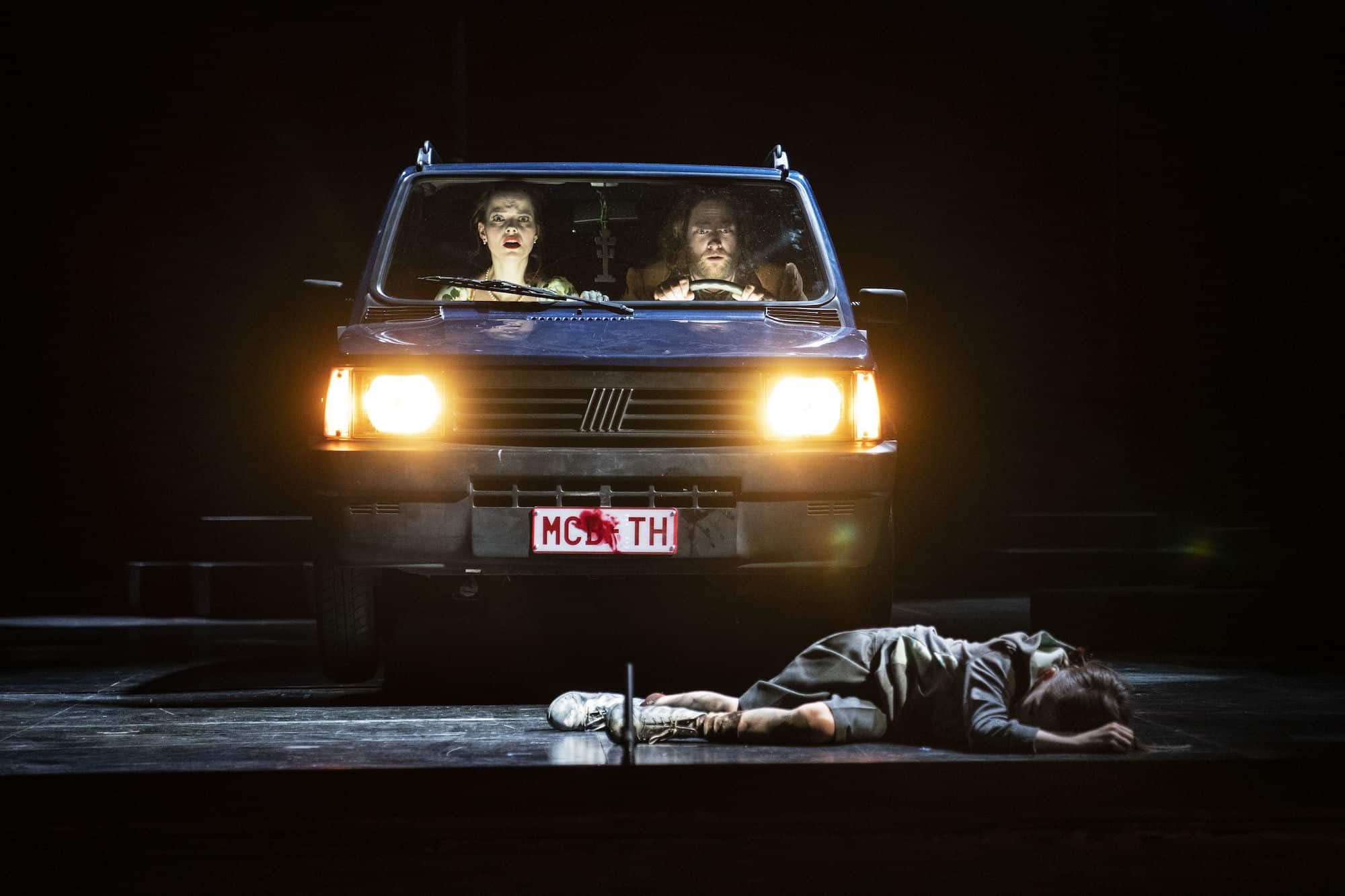
Does this title refer to Macbeth, the fantastic opera by Giuseppe Verdi based on Shakespeare's chilling story of power? Indeed it does, but in a version adapted for young audiences. A very successful version at that. The libretto is "incredibly freely based on Shakespeare" and the music is "also enormously freely based on Giuseppe Verdi", as promised by the title page of the programme booklet. And that is entirely accurate. Very free, yet not betrayed and recognizable. A feat in itself in a production by Opera Vlaanderen and Muziektheater Transparant.
When the curtain rises, two blindingly bright headlights shine from the pitch-black stage into the auditorium. Mr and Mrs Macbeth return drunk from a party. In the forest they hit a suddenly appearing child. They commit hit-and-run. No murder of a king then, but still an act that equally provokes revenge and retribution. The friends of the hit child take care of that. They torment the restless conscience of the Macbeths, like the fortune-telling witches in Verdi's opera. Fantastically conceived, and moreover tapping into current reality, is the spreading of news of a missing child. The hit child appears in the performance with a somewhat shadowy presence that sometimes makes one wonder if it is really dead. It makes the whole thing exciting and above all gives the opportunity to have it appear as the ghost of Banco (from the "real" Verdi opera) at the banquet where the Macbeths have invited all the children. Out of guilt, they pamper them with pancakes. But the children won't be so easily unnerved… The sleepwalking scene of Lady Macbeth is grandiosely staged, with a nice "doctor" and again ironic hints at 'real life'. Ultimately, the hit child is recovering in the hospital and the Macbeths visit him to ask for and receive forgiveness. Revenge and anger thus ultimately lead to a happy ending.
Coherent whole
An adaptation of an existing libretto stands or falls by its text adjustments. Librettist Tom Goossens deserves all praise for that. The selected passages that reduce the opera to a shorter length digestible for young audiences result in a coherent whole. In this version, Macbeth has no ambition for the crown, but to become director of a school. His wife plays a convincing instigator in this – as in Verdi's opera – who descends into madness and must be cured of sleepwalking. The closing scene of the opera, with the scene of the Scottish rebels and the forest of Birnam that "comes into motion", the librettist cleverly circumvents by giving the forest from the beginning a place in the story. Goossens occasionally uses funny distorted words, "benogenblikkelijkebangerikkelijk" for example. Or "we houden een wraakernij". Sometimes the text rhymes, sometimes the sounds are slightly dialectal and phonetic. Only the grand aria of Lady Macbeth in the sleepwalking scene Una macchia è qui tuttora - the (blood) stain cannot be washed away – he has retained in Italian. Respect for the original? Everything is perfectly balanced, the adjustments come across as acceptable and fitting in the story. Moreover, the musical adaptation – with the witches' motif as the most recurring musical theme – goes nicely with the text. The choir plays a leading role in the piece. It is fantastic what the children's choir of Opera Vlaanderen does. It acts and sings as if their lives depend on it: smoothly, alertly, spontaneously, naturally. The part of Mr Macbeth is a pure spoken part, imaginatively performed by Bart Dobbelaere. Zofia Hanna portrays Mrs Macbeth with a fierce soprano voice: not too beautiful – "oei mijn stem klinkt slecht" (as Verdi also wanted...) - but acted with great panache. "Fleanceke", as the hit child is called, is once again a nice reference to the original version, where Fleance is the name of Banco's son.
Hints at current affairs
The set is appropriately dark and sober. Large black blocks can represent just about anything, both trees and a castle or a large bed with headboards. Like an ordinary children's building block set – with the possibility of knocking over, stacking, moving to create various objects. Set changes are therefore quick and never cumbersome. Small details point to the care taken, such as the soap dispenser next to the door of Fleanceke's hospital room in the final scene. Carefully placed lighting accents do the rest. Tom Goossens ensures an adaptation in which hints at current affairs come across naturally. The reference to a moral with the message for drunk drivers and responsibility towards children in hit-and-run is clear. But the moral message is not stuck on as a pedantic reproach, rather naturally worked into the story. Or as the introductory text in the programme booklet says: "Once again, he grasps the Zeitgeist of young people better than anyone, who must call adults to account". A performance for and by young people that makes enjoying also thinking (or vice versa?).
- WHAT: BANKET! De Wraak Op De Macbeths
- LIBRETTO/DIRECTION: Tom Goossens
- MUSIC: Mathias Coppens (adaptation and composition based on Giuseppe Verdi)
- VOICES: Zofia Hanna, Bart Dobbelaere and Children's Choir Opera Vlaanderen conducted by Hendrik Derolez
- ORCHESTRA: deCompagnie conducted by Michiel Delanghe
- WHERE: Opera Vlaanderen, Theater 't Eilandje, Antwerpen
- WHEN: Saturday 30-3-2019
- PHOTO: © Thomas Dhanens