
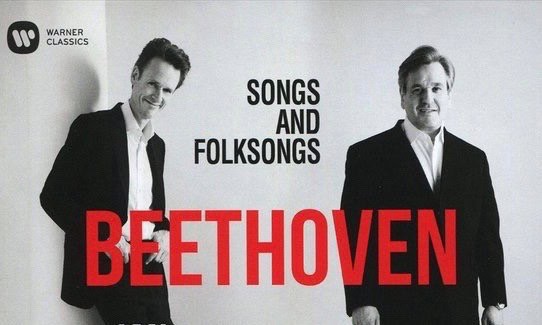
Every self-respecting musician made a contribution to Ludwig van Beethoven's two hundred and fiftieth birthday in 2020. Tenor Ian Bostridge also released a cd with a mixed song recital dedicated to the composer. With his choice of Antonio Pappano as pianist, he realized a perfect match. At the same time, the respected conductor was also able to display his excellent but somewhat underexposed talent as a pianist.
The fact that the Beethoven year has just passed should certainly not be a reason to overlook this cd. It gives yet another opportunity to enjoy the very distinctive, bright, beautiful timbre of the British tenor. Bostridge is undoubtedly one of the best song interpreters of our time. He proves it here once again. The recording opens with the short cycle An die ferne Geliebte, a cycle that transcends the salon quality of most of Beethoven's songs. Music and text permeate each other as it will subsequently become characteristic of Schubert's songs. This happens to be one of tenor Ian Bostridge's strong points, who lets his voice bend very flexibly to place accents on certain words like Sonne or Wolken, or accelerates the singing according to the impatience of the loving heart. Sometimes in this cycle he becomes a little affected, which is not at all the case in the rest of the recital, but who can sing Meine Tränen (third song) so sadly, or offer the songs so passionately as the ultimate love gift to the "distant beloved"? The piano also makes a nice connection from one song to the next, and in this Pappano proves himself immediately as a sensitive accompanist. He too is a master of the poetry and variation that place these Beethoven songs among the great art of song. Bostridge is also an ideal storyteller, as in the popular song Adelaide or the amusing Flohlied. But he is above all masterful in expressing intimate and melancholic emotions, so Adelaide becomes movingly beautiful as reverie and longing. Also Nur wer die Sehnsucht kennt we hear in a typical Bostridge interpretation: not for nothing does he choose this song in different versions, each time he gives so much substance in such a correct tone! Now the pain comes through more strongly, then again resignation, as in Adelaïde or in the cycle An die ferne Geliebte. Beethoven often composes his songs in the context of some love affair gone wrong.
Innocent folk song quality is then characteristic of the choice Bostridge makes from Irish and Scottish folk songs. Singer and piano are joined here by violin and cello as partners. It is a portion of pure musicianship from all performers. As a playful finale, Bostridge then sings the amusing trifle Die Marmotte.
Beethoven lives in musical consciousness and in music history as a man of extraordinary proportions, grandiose in everything he composes, but the search for love that never really came to fulfillment and led to considerable torments and wounds is certainly traceable in his often underappreciated songs. Ian Bostridge and Antonio Pappano provide a sublime contribution to a better appreciation of Beethoven's song oeuvre. So we return to the remark with which we concluded the Beethoven song cd with Matthias Goerne and Jan Lisiecki in June 2020: There is still room for another top-level song singer to do justice to Ludwig van Beethoven's song repertoire. Let us now understand this as an insinuation towards Ian Bostridge.
WHAT: Ludwig van Beethoven Songs and Folksongs
WHO: Ian Bostridge, tenor, Antonio Pappano, piano, Vilde Frang, violin, Nicolas Altstaedt, cello
PUBLISHER: Warner Classics 0190295276430