
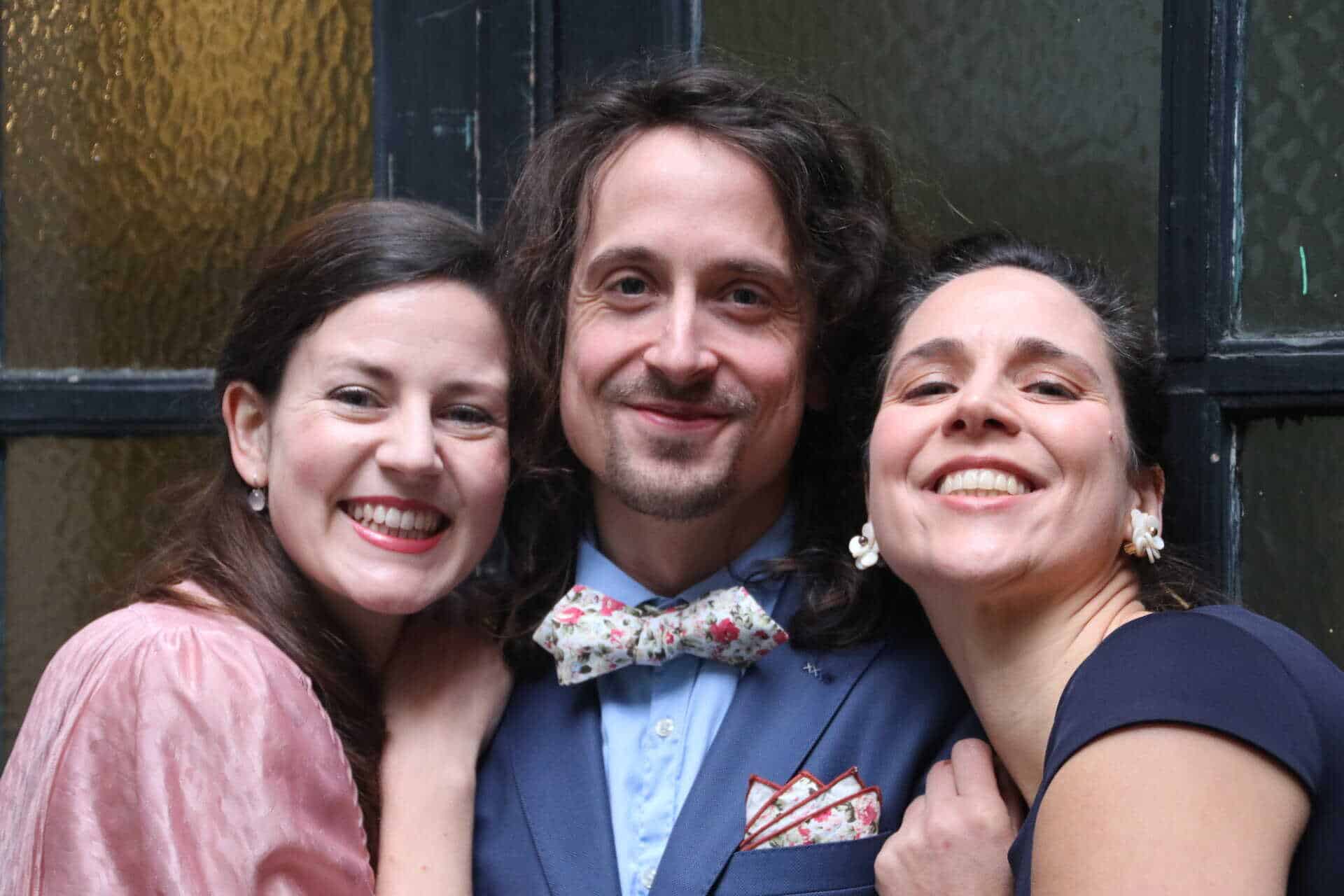
In a world that's spinning out of control, geopolitical turmoil, a Trump who is becoming increasingly bold, protests in Iran against the oppressive rule of ayatollah Khameini, etc… etc… it is a comfort to be able to immerse yourself for a moment in a concert called 'Get Happy', a real pick-me-up. Music as a connecting force that transcends differences.
We don't think about it enough, but we should cherish our blessings. It turned out to be an impressive musical trip again: exuberant, bubbling, full of energy. Sopranos Lissa Meyvis and Alexandra Franck, accompanied by classical pianist Lester Van Look feel at home on the stage as if in a toy shop. With boldness and originality they weave diverse styles together into a tasteful, imaginative musical journey in a refined sound harmony. The whole is garnished here and there with a witticism and some philosophical reflections.
Lissa Meyvis strikes first with the number 'Happy days are here again', music Milton Ager, lyrics Jack Yellen. Let us describe it as wishful thinking. A number from 1929 that hasn't worn out and still hasn't lost any of its relevance.
Next, a duet 'Peas in a Pod' by Grey Garden & Scott Frankel, to be interpreted as two hands on a belly. A song from the musical 'Grey Gardens'. Lester Van Loock provides a spirited piano accompaniment.
Now it's Alexandra Franck's turn to shine in the jazzy sung number 'Get Happy' a composition by Harold Arlen written in 1930. It only became hugely popular in 1950 through Judy Garland's version in the film 'Summer Stock'.
The 'Cat Duet' Duetto buffo di due gatti by Gioachino Rossini is a popular work for two sopranos. Both ladies throw themselves completely into the catty bickering scales up and down, playful and challenging. Everything is taken from the cat arsenal: growling, hissing, clawing, meowing… Delightful.
'Mein Herr Marquis' the famous cheerful aria, known as the laughing song, from the operetta 'Die Fledermaus' by Johan Strauss II is another perfect fit for Lissa Meyvis. With the greatest ease she immerses herself from one situation and atmosphere into another. Maid Adèle visits the party of her boss in disguise, who doesn't recognize her. Her mimicry and body language are enchanting and bring a smile to your face.
'Eifersuchtsduet' from 'Die Dreigroscheroper' by Kurt Weill is a well-known number in which the rivalry between the characters Polly Peachum and Lucy Brown over the gangster Mackie Messer is brought to a head, a moment of quarrel and humor. Lissa and Alexandra bicker away. No easy opponents!
The next number 'Maybe this Time' from the film 'Cabaret' breathes a completely different atmosphere: intimate, hopeful: "Lady peaceful, lady happy, that's all I want to be'. Lissa brings it in a very touching, deeply felt way.
Alexandra then seeks her fortune in the opera world with the aria of the courtesan Magda 'Chi il bel sogno di Doretta' by Gioachino Puccini. The intro is a cadenza for piano after which the main character from 'Ondine' sings her love dream… a romantic, simple love, away from her debauched life in Paris.
Time for instrumental work. Lester Van Loock plays the sparkling impressionistic 'Ondine' from 'Gaspard de la Nuit' by Maurice Ravel, described as one of the most difficult piano scores: a waterfall of sounds.
From the legacy of Charles Aznavour, Lissa Meyvis sings the beautiful 'Sa jeunesse'.
This chanson takes a philosophical turn: we often don't realize what we have until we lose it! Full of melancholy with a beautiful piano intro.
Alexandra performs a Dutch-language version of 'Send in the Clowns' by Stephen Sondheim song from the musical 'A Little Night Music' from 1973, an adaptation of Ingmar Bergman's film 'Smiles of a Summer Night'. A ballad in which the main character muses on the irony and disappointments of her life.
Part one is concluded with the duet 'Don't Rain on My Parade' from Funny Girl, a battle song, a powerful message about determination and the pursuit of success.
After the intermission, soprano Alexandra Franck starts with a number by Mack Gordon and Harry Warren 'At Last', an iconic love song that also has a long history. It was first brought to light by the orchestra of Gllenn Miller in 1941.
Alexandra and Lissa immerse themselves briefly in a mini identity crisis in the number 'I'm a Person Too' from Leonard Bernstein's song cycle 'I hate music: A Circle of Five Kid Songs' written for soprano with piano accompaniment. Children's songs that express Bernstein's feelings about music in a lighthearted, yet touching way.
Lissa surprises with a beautiful little song on a text by Annie M.G. Schmidt 'Hedgehogs Lullaby' a fanciful exploration of the animal kingdom.
Keyboard virtuoso Lester Van Loock unleashes a second fiendishly difficult piano work 'Prelude op.32 no.12' by Sergei Rachmaninoff. The piece is known for its flowing arpeggios. A beautiful interpretation again. He seeks the freedom that the composer put into his score.
Another duet 'Sull'aria' from 'Le nozze di Figaro' by Mozart, we witness a conspiracy: Suzanne and the Countess draw up a love letter to trap Figaro. With sensuality and a good dose of charisma this becomes a gem of conspiracy.
Alexandra brings in a heartfelt manner 'I'm here' a composition by Brenda Russell & Allee Willis, a powerful song from the musical and film 'The Color Purple'. It is a central song that tells the transformation from victim to triumphant woman.
It is a treat to hear 'Ah, qu'il est beau le soleil' by wordsmith Toon Hermans. Lissa Meyvis knows how to work with it and lets the song sparkle vocally with mimical subtlety and vocal expression.
'Und ob die Wolke sie verhülle' from the opera 'Der Freischütz' by Carl Maria von Weber. The grandeur of nature is described and the mysterious power of evil.
As the penultimate song, Alexandra and Lissa sing 'Die Schwestern' by Johannes Brahms with a cheerful playful melody and harmonies. Here too the text is experienced with body and mime and ending with 'Happy Days' and 'Get Happy'.
The circle is complete. Mission accomplished.