
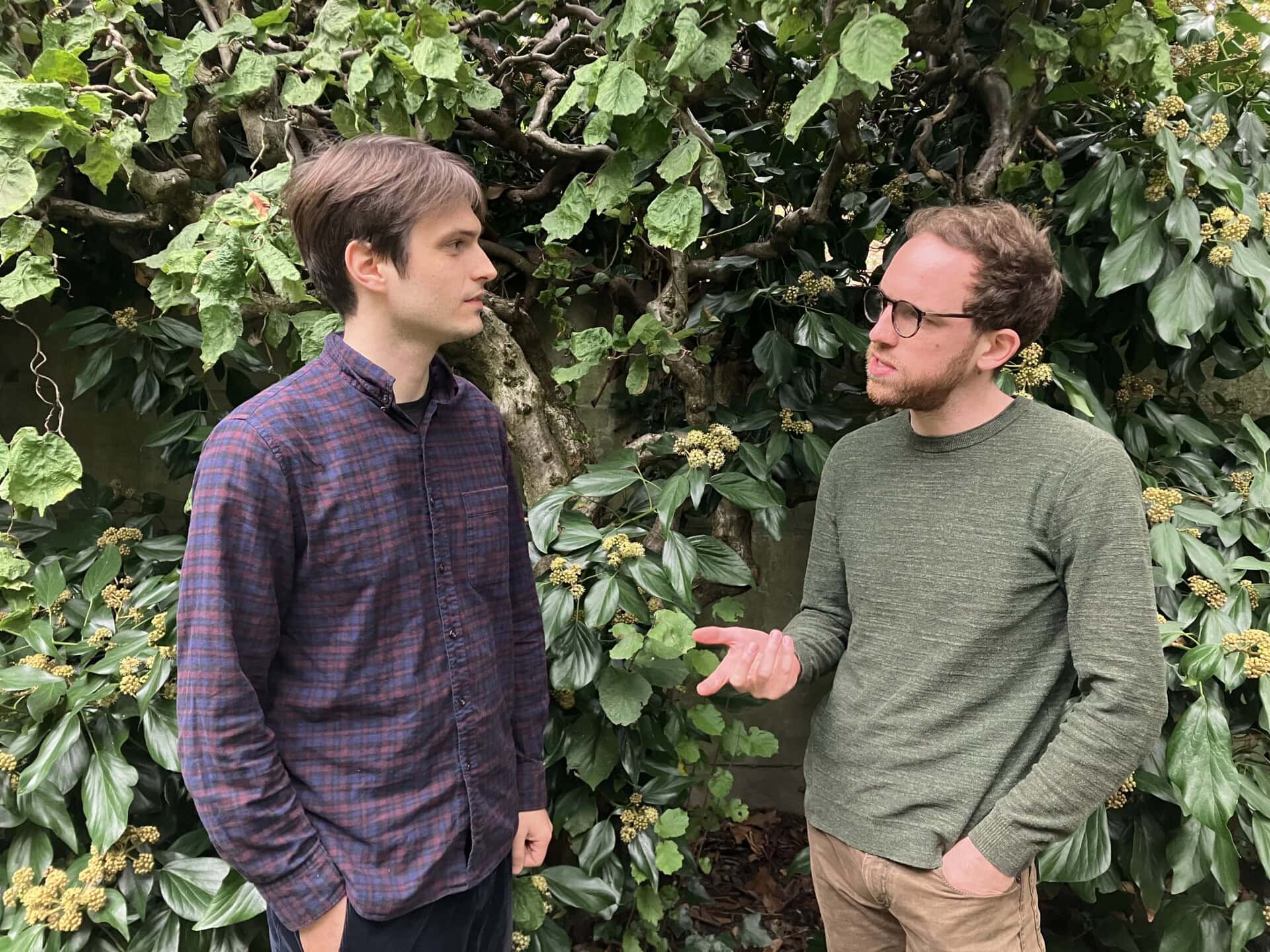
The afternoon concert during the themed day 'Screams of Despair' of Leuven's Festival 20·21 promises to be a unique and intense experience. Both for the audience and for the performer. Young pianist Brecht Valckenaers, this year's artist in residence, tackles the fifth sonata by Galina Oestvolskaja, which demands the utmost from the performer. Moreover, he also combines it with a selection of preludes and fugues by Dmitri Sjostakovitsj. Together with musicologist Elias Van Dyck, he explains why this is literally a feat of strength.
Galina Oestvolskaja (1919-2006), born and raised in Leningrad/Sint-Petersburg, liked to emphasize that she and her compositions were 'unique'. She often felt misunderstood, while at the same time proclaiming that her music 'simply could not be understood'. Much of what musicologists wrote about her music was, according to her, simply not true. 'I ask everyone who truly loves my music to refrain from any theoretical analysis.'
Yet Elias Van Dyck did precisely that for his master's thesis (Alle meine Kräfte – Extreme luidheid in Galina Oestvolskaja's vijfde en zesde pianosonate, 2020) in musicology: analyzing her piano sonatas. Moreover, he scratched beyond the religious or spiritual layer that almost always hangs over the image of Oestvolskaja. 'Well,' says Elias Van Dyck, 'she also said that anyone who wanted to say something about her music had to suffer as she suffered while composing. I don't know if I've suffered enough according to her. (laughs) Perhaps her reluctance had to do with the context in which musicologists in the Soviet Union were often the mouthpiece of the regime. I mainly wanted to demonstrate that with fairly traditional means, a meaningful analysis of the fifth and sixth piano sonatas is still possible. While the Oestvolskaja reception, in my opinion, does not go further than the observation that her music is often extremely loud, and then switches to some kind of religious imagery, I tried to dig deeper.'
Thus, in the fifth sonata, he brought to light a deliberate development with a symmetrical structure. In the sixth sonata, he even discerned a golden ratio. If the composer was not consciously aware of that structure and it slipped in intuitively, that only testifies to her genius.
Extreme loudness
But unconscious underlying structure or not, Oestvolskaja is thus primarily associated with 'extreme loudness'. Her nickname, 'the woman with the hammer', which she owes to several compositions in which a hammer literally belongs to the instrumentation, is however too limiting to characterize her work. Elias also clearly demonstrates this in his analysis of the fifth and sixth sonatas. For loudness turns out to be a very dynamic phenomenon with the Russian composer, varying from a single forte to a sixfold one, with soft passages in between.
What is 'loud'? Elias: 'Volume has to do with proportions. At a certain point you hit a physical limit, of your instrument but also of yourself. You can keep hammering away on your piano as hard as you want, ultimately you hit a ceiling. And even then Oestvolskaja still makes a distinction between ffff (4x), fffff (5x) and ffffff (6x), also with or without accent, espressivo or espressivissimo to play. Then you can start to wonder what those differences ultimately mean and whether the audience still hears them.'
Brecht: 'Although the resulting loudness is of course of great importance, I find the intention or mindset with which you play at least as important. A teacher once told me that the most important difference between pianissimo and piano is that with the first you really have to make an effort to whisper, while with the second you play somewhat more comfortably soft. Similarly, a fortissimo in decibels can sometimes be played softer than a forte, as long as the intensity with which you play it is higher. Moreover, when you press a key or play a cluster (a blend of closely adjacent tones, vja), it will sound louder in decibels in a lower register due to the structure of the piano than when you press it at the same speed in a higher register. As a result, passages that are 'only' fff in the lower register may sound louder than passages in ffffff in the middle register – but the intensity in your mindset in the latter case is of course many times higher.'
Torture
Having to play with full force and continuously with all fingers together or with knuckles, fists, forearms or elbows: it is no wonder that words like 'crucifixion' and 'torture' occasionally fall during the performance of Oestvolskaja's work. The risk of injuries (bleeding knuckles,...) is not excluded.
'You therefore have to hold back when practicing', confirms Brecht. 'Playing with the knuckles of your hand really does hurt. Sometimes I wonder to what extent physical pain should be part of the performance. Some passages, for example, you can play even louder and with less pain when you use your fist instead of your knuckles. But don't you remove an essential element of the composition that way? It's a difficult balance. Moreover, after the fifth sonata by Oestvolskaja at my concert in Leuven I still have to play other works, and my fingers therefore still need to function well. No, I haven't quite figured out yet how I'm going to approach it.'
Elias gives the young pianist little hope: 'I think the pain is part of it. The ritual, the staging is part of the performance. It's almost a performance art piece. That's why you need to experience this music as a listener live: you need to see and feel the difference between more and even more and still more. Physicality is also essential. It's music that requires all the attention from both the performer and the listener.'
Oppressive power
According to Elias, Oestvolskaja presented herself to the performer as an 'oppressive power'. It is the pianist who must feel the pain that the composer seeks. She also had a clear image of how her work should sound and was very categorical about it. Yet Brecht is not afraid of failing to meet the composer's demands, and not only because she has since passed away.
'Of course I've listened to recordings by Alexei Lubimov, Reinbert de Leeuw and other pianists, but you don't imitate. That's impossible anyway, because the ultimate sound is merely the result of an inner intention that you can't possibly adopt exactly. Of course you strive for a performance that matches what the composer had in mind. But from my experience with musicians who perform my own work, I'm convinced that it's more important that the performer has a general feel for the composer's style – for example in terms of timing or phrasing – than that every smallest detail is played exactly as written.'
Euphoric feeling
Although the pianist is both aggressor and victim in the performance of Oestvolskaja's compositions, perhaps some consolation: the battering of the instrument can also take on a therapeutic dimension, according to Elias' master's thesis. 'Finally the pianist can let loose the pent-up frustrations of years of wrestling with the keyboard. (...) The pianist finds pleasure in the almost euphoric feeling of his body working at full force.'
'Well said', smiles the pianist who still faces the ordeal ahead. 'In any case, it will be an intense experience.'
For the instrument too, Oestvolskaja's score is destructive. 'The piano can go out of tune. If it doesn't, I probably haven't played intensely enough', grins Brecht. 'And since I'll play my 70-minute concert straight through without a break, that detuning will probably carry through into the subsequent preludes and fugues by Shostakovich. There won't be a tuner or extra piano available. But I'm not worried that the audience will come complain about it afterwards.'
Oestvolskaja versus Shostakovich
That Brecht opted to combine Galina Oestvolskaja with her teacher Dmitri Shostakovich seems obvious. And yet not entirely, or not at all.
In the essay The Collaborator and the Recluse: Composing in the USSR, which Elias wrote for the festival, he points out that Oestvolskaja and Shostakovich (1906-1975) stand for two different attitudes towards the Soviet regime and how it treated its artists. 'Shostakovich, as the most prominent Soviet composer, could hardly do anything but continue to play a public role', he explains. 'Every symphony of his was seen as a political statement. Because of that status and the lip service he had to pay to the regime, he inevitably lost part of his integrity. In particular, the moment when he finally became a party member after long hesitation was a great disappointment to Galina Oestvolskaja, who had studied with him.'
'From the end of the 1940s until the 1960s they were very close, possibly even romantically – that will remain a mystery. Later Oestvolskaja only spoke very negatively about Shostakovich. The personal aspect certainly played a role, but above all the fact that in her view he capitulated to the regime. Yet we must not forget that he risked his neck multiple times to help fellow musicians, within the limited room for maneuver he had. With his music too, he wanted to prick the conscience of his fellow citizens where possible. The 13th symphony, which was an indictment of the widespread antisemitism in the Soviet Union, is a striking example of this.'
Unlike Shostakovich's work, Oestvolskaja's did not reach the major concert halls as easily or frequently in the Soviet Union. 'It's unclear whether that was because she was being thwarted, whether as a woman or otherwise, or because she didn't even try', says Elias. 'I'm inclined to think that the latter also certainly played a role. She tried at all costs to preserve her personal integrity and sacrificed her own career for it. While she went on to teach at a kind of second-rate conservatory in Saint Petersburg, she continued to compose.'
Cry of protest
From a Western European perspective, it's easy to interpret the loud outbursts in her compositions as 'a cry of protest against the suffocating Soviet regime', Elias realizes. 'Yet I wonder whether she would have fundamentally written different music had she lived here. The Soviet context could certainly have intensified her desire to be left alone, but I suspect that had more universal roots. Indeed, from her childhood memories it emerges that she already wanted to be alone then, hidden under the piano, alone with the sound of music.'
If her music is an unmistakable cry of protest, then according to the musicologist, it is not only an expression of resistance against the Soviet Union and repression. 'The yoke she seems to want to free herself from is that of society itself', he writes in his master's thesis. With her loudness, she wanted to 'delineate and protect her own piece of personal space against the public domain'.
Primordial Russian
Finally: was Oestvolskaja right that her music was so unique? 'She certainly had a unique voice that is difficult to compare with anything. But music is never completely separate from history', says the musicologist. 'No matter what she may claim, relationships with the music of predecessors or contemporaries are always there.'
'In any case, her music is primordial Russian. You can hear the tradition of Orthodox chants resonating in it, but Sjostakovitsj is also an important figure for this observation. Her piano concerto, an early work, clearly bears the marks of her teacher. But with later work you might wonder if it isn't the other way around. Sjostakovitsj himself admitted: I did not influence you, you influenced me. He also quoted her in his own compositions. Repeatedly he spoke about her with praise: "You are a phenomenon, I am a talent."'
The theme day Screams of Despair of Festival 20:21 offers the unique and not to be missed opportunity to hear both the work of a talent and that of a phenomenon, performed by a talented and perhaps even phenomenal pianist.
______________
• Screams of Despair, the theme day of Festival 20:21, takes place on Sunday 12 October. Elias Van Dyck gives an introduction at 13.15 and also wrote a worthwhile essay for the programme booklet. Concert 1 by Brecht Valckenaers at 14.00 in 30 CC.
• Also for Concert 2 at 16.30, New European Ensemble, Christianne Stotijn and Tijl Faveyts bring vocal and orchestral works by Galina Oestvolskaja and Dmitri Sjostakovitsj.
• In Concert 3 at 20.00 at Luca Campus Lemmens, Brussels Philharmonic performs Sjostakovitsj's 15th Symphony and together with Lukáš Vondráček and Andrei Kavalinski his Concerto No. 1 for piano, trumpet and string orchestra.
• Brecht Valckenaers performs on Monday 20 October at 20.30 at Luca Campus Lemmens together with Jan Michiels also the concert Selbstporträt mit Ligeti und Nancarrow (und Valckenaers ist auch dabei).
• An extended version of this interview also appeared on the blog of Vrouw aan de Piano.