
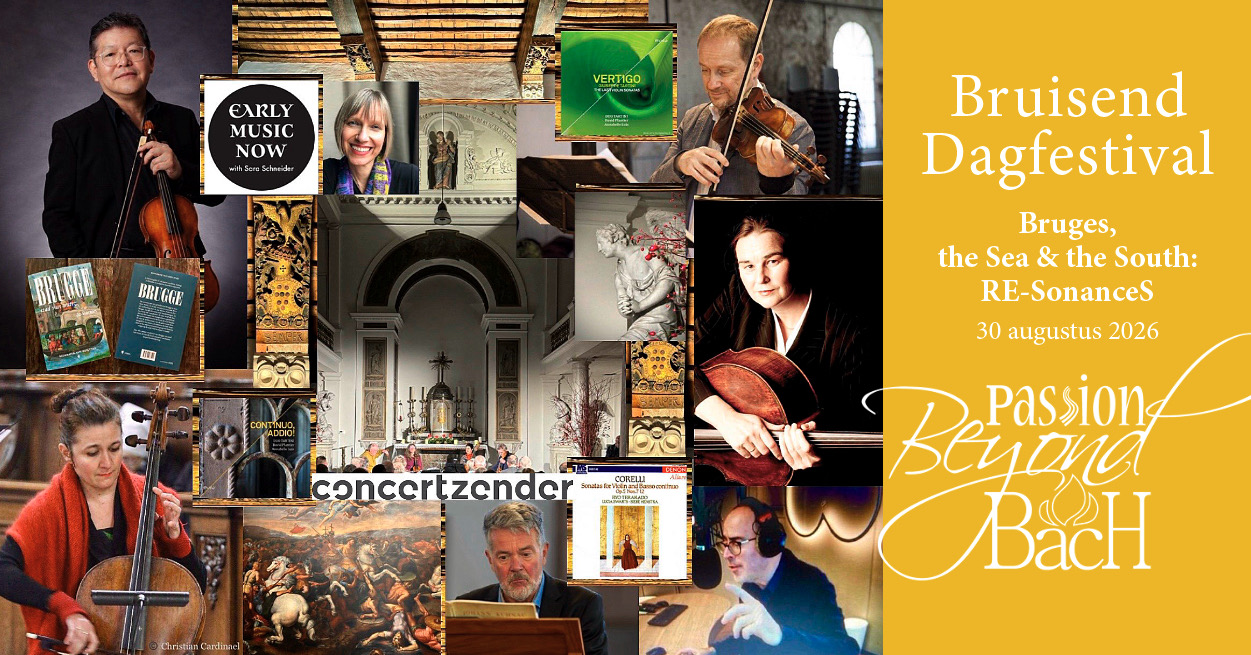
On Sunday, August 30, Stadspaleis Hof Bladelin in Brugge will be the setting for the first edition of a new day festival: Bruges, the Sea & the South: RE-SonanceS. A festival that connects music, history, art and heritage. And frankly: the location could hardly have been chosen better.
Hof Bladelin was built in 1435 and is one of three preserved medieval city palaces in Brugge. But the building is more than an impressive historical backdrop. In 1466, Piero de' Medici established a bank branch there. To this day, the spaces, symbols and stories testify to that special connection between Brugge and Florence.
From this historical connection, the starting point for this festival also emerged.
The question that seems to hover over the day is simple: what connects Florence and Brugge? Anna Maria Luisa de' Medici, Raphaël, Corelli, Vivaldi and Tartini with a Bruges city palace?
Fortunately, the answer is not a three-hour academic lecture.
Rather, a day in which guides, musicians, an artist and engaging conversations together tell one great story. A story about Italy and Flanders, about beauty and craftsmanship, about music and heritage, and about the way cultures have been inspiring each other for centuries.
From Bruges to Florence
The afternoon begins at 14:00 with Bruges e Firenze: Arte e Bellezza.
Jo Berten and Wouter Delaere take the audience along the Italian traces still visible in Brugge. First through the historic Italian quarter, then through Hof Bladelin itself, where the influence of the Medici, the Renaissance and trade history are still tangibly present.
That might seem like a detail to those who think early music is primarily something you should listen to. But that is precisely the charm of this initiative. You first get the story, the place and the historical context. Then the music can continue the story.
At 15:45, Bart Stouten, known from Klara and as an author, will be in conversation with Bruges artist Virginie Vandeputte, a former student of The Florence Academy of Art. Their conversation focuses on Florence, craftsmanship and beauty. Not only about the Florence of the Renaissance, but also about the living craftsmanship that is still passed down from generation to generation today.
Running as a red thread throughout the day is also the story of Anna Maria Luisa de' Medici, the last heir of the famous dynasty. Through her, a fascinating network of art, music and culture unfolds that connected Florence with the rest of Europe.
Maestro Corelli - Una Follia!
At 16:45, three internationally renowned musicians take over: Baroque violinist Ryo Terakado, cellist Lucia Swarts and harpsichordist Siebe Henstra.
These are names that early music enthusiasts barely need an introduction to. Terakado has more than a hundred CD recordings to his name and is regarded as an authority in historical performance practice. Swarts and Henstra are both associated with the world-renowned Dutch Bachvereniging.
Together they bring music by Arcangelo Corelli, the composer who in his time was known as Il Nuovo Orfeo, the new Orpheus.
And when one says Corelli, one can hardly avoid La Follia.
The famous twelfth violin sonata developed into one of the most beloved variation sequences of the Baroque. During this concert, it forms the inevitable highlight of a program that places Corelli's elegance, power and influence at the center.
Prior to the concert, Bart Stouten will also be in conversation with American radio presenter Sara Schneider, a respected voice within the international early music world and presenter of Early Music Now. Together they explore the cultural world in which Anna Maria Luisa de' Medici, Corelli and their contemporaries lived.
And then evening falls
As if that weren't enough, at 20:15 a second concert follows. By candlelight this time.
Festa Virtuosa per Violino e Violoncello brings the renowned Duo Tartini to Brugge: violinist David Plantier and cellist Annabelle Luis.
With fiery Italian expressivity, they take the audience along music by Veracini, Platti, Castrucci, Nardini, Tartini and even Domenico Scarlatti. The program shows how the great Italian violin school spread from cities such as Rome, Florence, Padua, Naples and Venice across Europe.
Here too, a brief conversation with Sara Schneider provides additional context, so that the music once again becomes part of a larger story.
More than a concert day
And that perhaps makes clearest what RE-SonanceS aims to be.
Not a festival where two concerts are simply placed side by side.
Rather, an attempt to make a historic place speak again.
Hof Bladelin is not merely a backdrop here, but a full-fledged lead role. The former Medici bank room, the Renaissance influences, the Roman Hall and the neoclassical chapel together form the frame in which the music comes to life again.
That aligns perfectly with the broader philosophy of Early Music – Last Minute, the initiative from which this festival emerged. Early music is not presented in isolation here, but connected with heritage, history, artists and audience.
Because music often gains even more meaning when you also get to know the places, stories and people connected to it.
Bruges, the Sea & the South: RE-SonanceS is a first edition. The organizers hope to continue it in the coming years. It is clearly a project carried by passion, collaboration and love for music and heritage.
On August 30, then, no ordinary concert day in Brugge.
Rather a small journey.
From Brugge to Florence. From the Medici to Corelli. From heritage to living music. From a walk through Italian Brugge to a concert hall by candlelight. And above all: from history to experience.
more info and tickets at: Bruges, the Sea & the South: RE-SonanceS | Passion Beyond Bach