
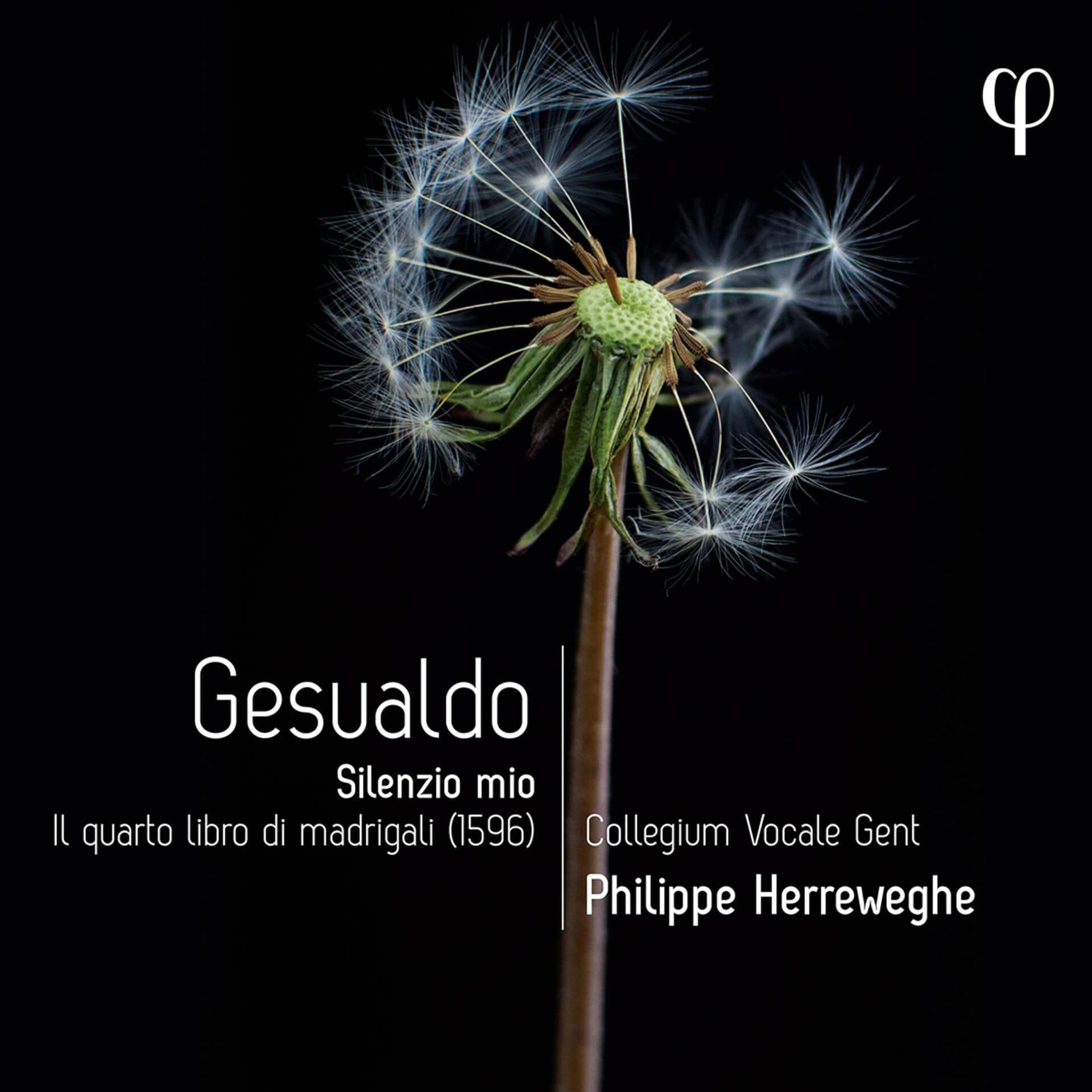
The madrigals of Gesualdo are particularly difficult to realize from a vocal technical standpoint, and this is compounded by the great stylistic differences among them. Only an absolutely top-tier choir under an equally distinguished conductor is capable of doing full justice to this music. And that is the Collegium Vocale Gent led by Philippe Herreweghe.
The years 1595 and 1596 could be considered a turning point for Gesualdo from a stylistic perspective. During that period, beginning with the Libro Terzo, or Book III, a true transformation took place in Gesualdo's madrigal art in the Italian city of Ferrara, closely connected to a completely different selection of poetic texts than before. This once again demonstrates how much the bloodthirsty 'prince of Venosa' valued the importance of the text and its associated textual treatment. At the same time, it marked a farewell to the predominantly pastoral and elegant characteristics of the first two books.
Did this farewell have something to do with that bloody prehistory? The misery began in 1590, when the twenty-four-year-old Carlo Gesualdo (1566-1613), prince of Venosa located near Naples, found his wife Donna Maria d'Avalos, daughter of the marquis of Pescara, in bed with Fabrizio Carafa, the duke of Andria. Caught in the act, then. Minutes later, both adulterers lay in their own blood, killed in a frenzy by Gesualdo and his servants. A true crime of passion, then. Gesualdo put their mutilated bodies on display in front of his palace so that everyone could see them. Shortly afterwards, Gesualdo fled, more fearful of family revenge than of legal proceedings.
The massacre did not go unnoticed elsewhere and even found its way into verse. Torquate Tasso and in his wake several Italian poets including Marino and Cortese did not tire of recounting it.
There is also a story that Gesualdo killed his second son, purely and simply because he doubted his paternity. To complete the gruesome picture, there is the possible murder of Gesualdo's father-in-law, when he sought revenge. However, neither of these matters is recorded in the official registers. Questionable, then. But what is clear is that one did not trifle with Gesualdo.
Gesualdo left for Ferrara in 1594, an important stopover for many composers and musicians. In that city, everything revolved around music in its many forms, but he was particularly attracted to the madrigal art that was experiencing a true flourishing period there. The widower soon found a new life companion there, Leonara d'Este, the niece of Duke Alfonso II. They married, which in itself is rather remarkable, since she must have become acquainted with the psychotic shadow sides of the composer at that time. Nor could it have escaped her notice that Gesualdo had done away with his wife four years earlier.
The marriage to Leonara was certainly a source of musical inspiration, for an impressive production emerged in Ferrara. And those tragic events? There is also no conclusive evidence of their influence on Gesualdo's composing. What is clear is that from Madrigal Book III (1595) onwards, the atmosphere becomes darker, the mood sometimes quite gloomy, touching on the macabre and morbid. It is music that follows the text chosen by Gesualdo. The intensity of expression increases, the compositional model gains in complexity. All of this fits within a creative vision that demonstrates greater layering, with melodic lines placed side by side that suggest they are driven by the text. Another important aspect is Gesualdo's truly masterly treatment of 'chiaroscuro', which we know particularly from painting. That this so extraordinary madrigal art also possesses an architecture built purely on intellectual ingenuity is evident from the perfect symmetry that Gesualdo achieves, both in form and in content.
In Book IV (1596), the stylistic break in these five-voice madrigals continues even further, with strongly heightened contrast work serving as an important anchor, manifesting itself particularly in a chilling underworld with its death rituals, hallucinations, and tempestuous spiritual turmoil.
It cannot be otherwise than that it must have been experienced as unbearable at that time, for these madrigals contain so much pain, violence and death locked within them through all those razor-sharp dissonances and restless chromaticism that often only resolves later and unpredictably. Gesualdo thereby created new music in the true sense of the word, powerfully depicted from the text at hand (which almost compels the listener to familiarize themselves with that text in order to optimally grasp the emotional world intended by the composer).
The Collegium Vocale Gent, which has grown together with this so exquisite and unique repertoire over the years, has been led since its inception (1970) by co-founder and motivator Philippe Herreweghe (*1947). It has directed itself particularly towards sonic beauty in its highest form. Not only does the balance between the different voices testify to this, but also how they blend and the way Herreweghe guides his singers in voice-leading through the complex textures. The recording is precisely as it should be: dynamically well-proportioned in this church acoustics, but also sonorous and transparent. The rather modest playing time of less than three-quarters of an hour is probably due to the chronology determined by Herreweghe (who also runs his own music label), in this case a deviating one within this series. With so much deeply penetrating beauty in prospect, this should be no obstacle whatsoever.