
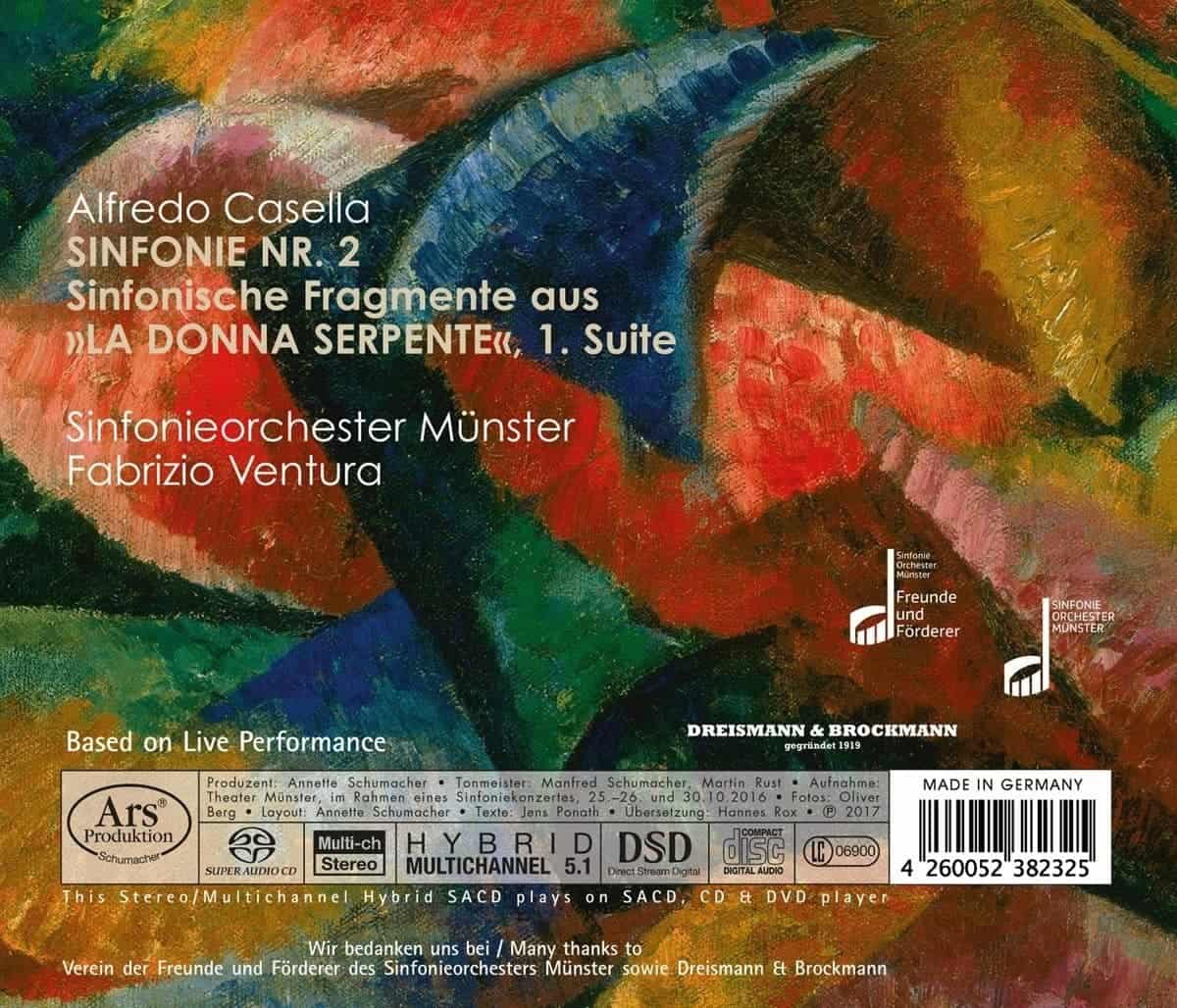
The name Alfredo Casella probably doesn't ring a bell immediately. The oeuvre of the Italian composer is rather underexposed. The man often has to take a back seat to his contemporaries: Stravinsky, Mahler and Debussy and his avant-garde compatriots such as Berio and Nono. When the Sinfonieorchester Münster performed his work live, that was the ideal opportunity to appreciate his compositions and release them on CD. Unfortunately, the recording leaves something to be desired.
The orchestra begins quite sloppily with the symphony in C minor. In the opening measures, with threatening pedal tones for the brass section, you can still justify this. Once the full orchestra enters, however, the music descends into terrible chaos. Especially the strings flow incoherently through the first movement. The hoped-for threat that this chaos is supposed to convey can only be expressed intermittently by the brass. Overall, it's mostly a mess. The orchestra interprets its music perhaps a bit too impressionistically. The different orchestral groups seem intent on each putting as much emotion as possible into their own parts, but precisely because of that it doesn't come fully to expression in the orchestra's ensemble playing. A tighter performance, where you let certain instruments reinforce musical accents, would do this orchestral work good.
Yet the confusion does not seem to be solely a fault of the musicians. The recording may have been made in the 'super audio cd' format, but too often it all sounds rather flat. Certainly the varied percussion setup suffers from this. All too often the percussion is tucked away behind the rest of the orchestral block. That is particularly unfortunate, because it is precisely through the percussion that the work sometimes takes on the airs of other late Romantic masterworks such as the 1812 Overture by Tsjaikovski. So we get a glimpse of the expressive power that could have radiated from the work at the end of the Allegro molto vivace. Moreover, it is not only the balance between the orchestral groups that is substandard, the dynamics also do not come fully into their own. The music seems to be overly normalized, as a result of which the extremes are too limited. Especially in passages that are supposed to sound loud, much energy is lost as a result.
That last point is particularly unfortunate. In the later sections, the orchestra does its utmost to set things right. At the end of the third movement, they play with silence. It is precisely in those few moments of rest that they drive up the tension in a fantastic way. They race through the finale but here much of the expressivity is unfortunately lost in the recording. The epilogue ultimately comes across best. The Sinfonieorchester drags you through the mysterious beginning of the Adagio mistico. Although of course they are lucky that this movement doesn't need to rely on great expression. In the closing measures of the work, which really should have sounded bombastic through the speakers, it all becomes too tame again.
The suite from Casella's opera La donna serpente suffers from the same problem. The first Andante movement is probably the best piece on this CD. Here the orchestra again evokes a mysterious atmosphere and does so especially by drawing tension from rest and silence. As soon as in the Allegro moderato and the war march the volume knob would need to be turned up again, the dynamics problems rear their head once more. You would almost literally have to stand next to the volume knob to constantly adjust it.
Although the Sinfonieorchester Münster, albeit after a false start, did its utmost to appreciate Casella's work, they were constrained for an hour by an overzealous sound technician. A pity, because the only people you make happy with this kind of flattened recordings are your neighbors.
- WHO: Sinfonieorchester Münster conducted by Fabrizio Ventura
- WHAT: Casella – Sinfonie nr. 2 in c, La donna serpente (suite)
- RELEASE: Ars produktion
- PHOTO: Album cover, Boccioni - Dinamismo di un corpo umano