
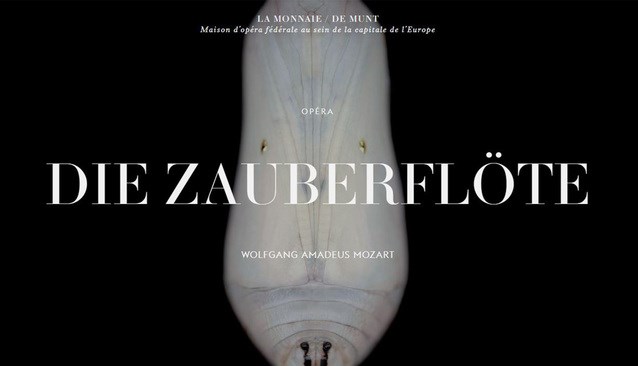
Two generations of Klassiek Centraal staff members watched together how Mozart's best-known opera, and indeed the best-known of all operas throughout history, would be given form by Italian theater maker Romeo Castellucci. The opinions run parallel and yet so different that we found it compelling to present both. First you read the vision of young reviewer Jasper Croonen, then that of Ludwig Van Mechelen.
Jasper Croonen: Sugary fairy tale becomes emotional hammer blow
As expected, Romeo Castellucci made Die Zauberflöte entirely his own thing. Or how a sugary fairy tale suddenly became an emotional hammer blow.
Actually, we can, for once, be brief about the music. What a phenomenal cast. With Gábor Bretz as a fantastic Sarastro, Georg Nigl playing Papageno with an Austrian accent in a witty interpretation, and Sabine Devielhe delivering an impressive Queen of the Night. Each and every one incredible, yet overshadowed by conductor Antonello Manacorda. A master storyteller, the ultimate guide for the Munt orchestra. A conductor who perfectly understands when the musicians must be submissive, but who on the other hand extracts the most bombastic tutti's from them. As far as I'm concerned, the star of the evening.
But then there is of course that other great star. It was clear for months that this would be the big Romeo Castellucci show. He stands in the spotlight for an entire autumn in Brussels, and Die Zauberflöte was the start of the long red carpet that promises to be the cultural autumn for the Italian. He certainly has the attention.
Story full of jump cuts
The most famous opera from the Western canon was at times an unrecognizable story. Castellucci cut freely in the original text. No sprechstimme, that especially, but there are plenty of drastic changes to the story. Through this cut-and-paste work, the director demands a great deal from his audience. A viewer who doesn't know the story inside and out will undoubtedly scratch their head at the strange jump cuts the story takes.
That confusion is only further compounded by Castellucci's staging. In both acts, the characters are visually interchangeable. Before the intermission in a snow-white set that plays with symmetry and flirts with eighteenth-century opera tradition. After the intermission, Tamino's trials continue in a drab bureaucratic space where everyone wears the same overall.
Nose to the facts
And it is especially that second act that will resonate for a long time. Not so much because of the staging, no one is that much of a fan of beige. Rather because of the second story that Schikaneder's libretto weaves through. Five blind women and five male burn victims embody the struggle between darkness and light. OK, the dialogues sound somewhat contrived because the extras are not performing in their native language. The woven texts last quite long, and are rather direct. But it is certainly gripping.
The connection between the two stories is immediately clear, but it takes a very long time for the puzzle pieces to finally fall into place. The finale of the Mozart fairy tale is almost anticlimactic because you've been pushed nose-first into reality. Is this what catharsis feels like?
If you want to see a centuries-old cheerful song play about a young couple, you'd better stay home. Because if you were hoping for a classical Magic Flute, you're sorely disappointed. But did you actually ever expect that from Romeo Castellucci?
[embed]https://www.youtube.com/watch?time_continue=4&v=EQvgt2OVKdY[/embed]
Mozart's Die Zauberflöte borrowed by Romeo Castellucci?
Mixed feelings, that's how I went to De Munt for Mozart's crowd-pleaser, the wonderful opera where simplicity and seriousness, light and darkness, superficiality and depth, spontaneous and platonic love are intertwined in a fairy-tale story set to the most beautiful music.
Why were those feelings mixed? Not because of the cast, not because of the conductor, but yes, because of the director, the famous – or is it the notorious? – Italian theater maker Romeo Castellucci.
Mozart's music (partly) respected, Schikaneder's story lost, Castellucci bends everything to his will
The feelings were justified mixed and they remained so. Where did that fairy-tale story go? Where was the coherence in the story? Where is the respect for Schikaneder, the man who wrote the libretto and came up with the idea for this opera and immediately persuaded Mozart to go for it? Why that enormously reduced role of Papagena? Why was there so much cutting not only in the dialogues that were completely eliminated, but also in the music?
Can you even call this performance of Die Zauberflöte Die Zauberflöte? A bit yes, largely no. A bit yes for the execution of the musical part: what was heard was pure Mozart with a strong orchestra that partly played period instruments, a choir that sparkled and a host of excellent singers. Largely no because the director reduces the story to its basics (if you can call this the basics), cuts a lot, transforms the first part into a mirror story that takes place in a kind of luxury cabaret and a second part that very confrontationally brings light and darkness in a literal sense hard onto the stage. The high-minded religiously inspired event in and around the Temple of Wisdom, the director bends into the story of women who have gone blind – they are the 'night' and men disfigured by fire - they are the 'light' who extensively tell their story of their disability.
Okay, so it's still about light and darkness that is overcome by people, in this case the blind and those mutilated by fire, because they overcame in their personal case the darkness by choosing life, just as those who were almost consumed by fire managed it with courage and continue to live. They overcame the primal forces of nature as it were. In itself a very strong element to make a gripping theatre piece about, but does it really fit in Die Zauberflöte? Did those mothers milking cows really need to be there to show that it's about the bond between mother and child?
Honestly, I expected booing, but that didn't come, only polite applause. The enthusiasm was lacking and yes, we understand that. The people were all too strongly impressed by the difficult to grasp cabaret with young female dancers in bare breasts (not disturbing in itself and softly erotic); the many ostrich feathers and everything in white for part one and then the difficult to grasp confrontational for part two. Knowing myself, I would normally have been very angry, but because the direction did bring strong elements, such as 'the mirror of man' into view even if that doesn't really fit the story or the vision of the dramas of light and dark, I decide that this production that stands outside all proportions may have its own existence. An existence of a kind of theatrical work that uses the music of Die Zauberflöte to confront the world with mirror images and drama. May I conclude by stating that it was then actually not the opera of Mozart and Schikaneder but the story of Castelliucci set to music by Mozart.
The singers, orchestra, choir & conductor
With all the attention that Castellucci demands, you almost forget what an exceptionally strong ensemble of outstanding singers, ideal voices and interpreters for Mozart's Zauberflöte were brought together and (despite?) the staging made it a musical feast, accompanied by an orchestra out of this world, a choir that sometimes sang strikingly in perfect balance and a conductor who completely understood and interpreted the score with all his soul. From our seat we could see him at work in detail, not only the handiwork, but also the facial expressions, the lip-syncing of the singing. He gave very followable tempi that allowed for breathing pauses and gave the refined musicality even more colour. Musically? Indisputably the very highest quality.
- WHAT: Die Zauberflöte by Wolfgang Amadeus Mozart
- WHERE & WHEN:
- PHOTOS: © DeMunt
- CAST: Musical Direction Antonello Manacorda (18, 20, 21, 25, 27, 28, 02, 03)
Ben Glassberg (23, 26, 30)
Direction, Set Design, Costumes, Lighting Romeo Castellucci
Choreography Cindy Van Acker
Algorithmic Architecture Michael Hansmeyer
Additional Dialogues Claudia Castellucci
Artistic Collaboration Silvia Costa
Dramaturgy Piersandra Di Matteo, Antonio Cuenca Ruiz
Choir Director Martino Faggiani
Singers:
Sarastro: Gábor Bretz - Tijl Faveyts (20, 23, 26, 28, 02)
Tamino: Ed Lyon - Reinoud Van Mechelen (20, 23, 26, 28, 02)
Sprecher: Dietrich Henschel
Queen of the Night: Sabine Devieilhe - Jodie Devos (20, 26, 28, 02)
Pamina: Sophie Karthäuser - Ilse Eerens (20, 23, 26, 28, 02)
First Lady: Tineke Van Ingelgem
Second Lady: Angélique Noldus
Third Lady: Esther Kuiper
Papageno: Georg Nigl
Papagena: Elena Galitskaya
Monostatos, A Moor: Elmar Gilbertsson
First Priest / Second Armored Man: Guillaume Antoine
Second Priest / First Armored Man: Yves Saelens
Three Boys: Axel Basyurt, Sofia Royo Csóka, Alejandro Enriquez, Tobias Van Haeperen, Elfie Salauddin Crémer, Aya TanakaDancers
Stéphanie Bayle, Maria De Duenas Lopez, Laure Lescoffy, Serena Malacco, Alexane Poggi, Francesca Ruggerini, Stefania Tansini, Daniela Zaghini, Timothé Ballo, Hippolyte Bouhouo, Louis-Clément Da Costa, Emmanuel Diela Nkita, Aurélien Dougé, Johann Fourrière, Paul Girard, Nuhacet Guerra, Guillaume Marie, Tidiani N'diaye, Xavier PerezAmateur Actors
Dorien Cornelis, Joyce De Ceulaerde, Monique Van Den Abbeel, Katty Kloek, Lorena Dürnholz, Jan Van Bastelaere, Michiel Buseyne, Johnny Imbrechts, Yann Nuyts, Brecht StautActors
Sophy Ribrault, Cinzia Robbiati, Michael Alejandro Guevara, Gianfranco Poddighe, Boyan Delattre / Amos SuchekiSymphony Orchestra and Choir of De Munt
Choir Academy and Children's and Youth Choir of De Munt under the direction of Benoît GiauxProduction De Munt / La Monnaie
Co-production Opéra De Lille (2019)With the Support of Tax Shelter of the Belgian Federal Government, In Collaboration With Prospero Mm Productions Nv and Taxshelter.Be Powered By Ing