
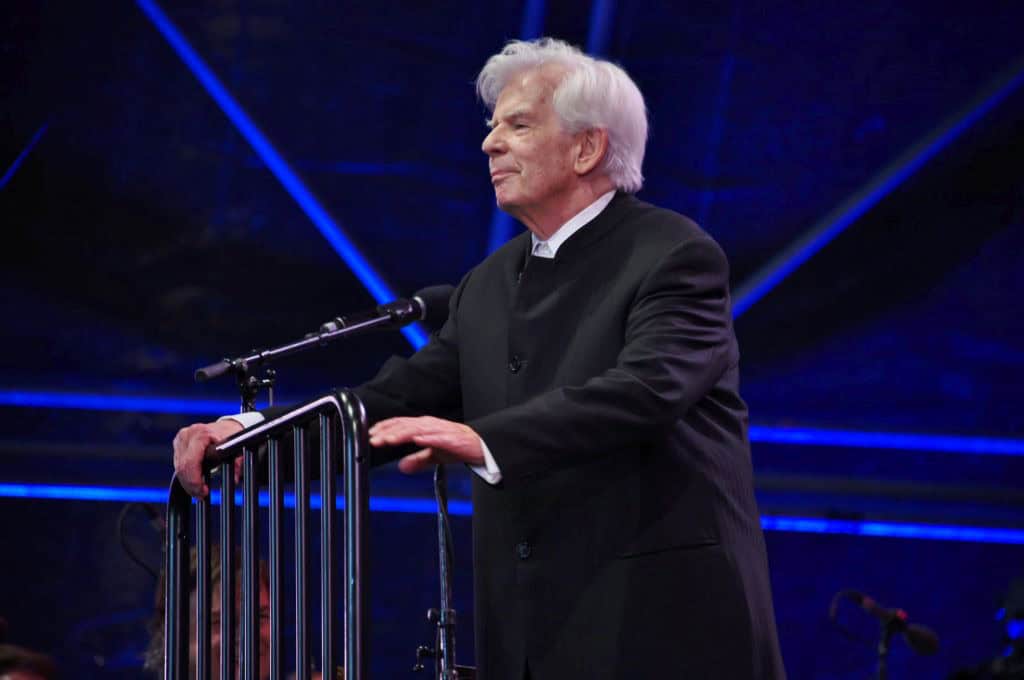
On September 6, 2025, two days before his 96th birthday, Christoph von Dohnányi passed away peacefully in Munich. With his passing, the music world loses not an ordinary conductor, but a monument of integrity and musical conscience – a grand master who throughout his life chose precision over pathos, content over effect, and the score over himself.
Roots in resistance and responsibility
Christoph von Dohnányi was born in 1929 in Berlin, into a family where art, intellect and morality were inseparably connected. His father Hans von Dohnányi and his uncle, theologian Dietrich Bonhoeffer, were active in German resistance against Hitler and were executed in the final days of the Third Reich. Christoph was only fifteen.
This early confrontation with ethics, violence and loss shaped his life philosophy — not in words, but in the quiet seriousness with which he approached his musical work. He rarely spoke about his family history, but those who listened carefully heard the moral undertone in everything he did: uncompromising, conscientious and selfless.
After a brief study of law, he eventually chose music. He studied at the Hochschule für Musik in Munich and later with his grandfather, the renowned composer Ernő von Dohnányi, in the United States. There he found the bridge between German profundity and international openness — a synthesis that shaped his musical thinking.
The conductor as thinker
At the age of twenty-seven, he became Generalmusikdirektor in Lübeck. It was the beginning of an impressive, but never loud career. From the outset, his style stood out: analytical, rational, clear. He did not stand above the orchestra, but within it — as a sound architect rather than showman, true to his creed that you must understand the score as if you had written it yourself.
At a time when conductors increasingly became media personalities, Dohnányi remained true to a more sober, yet more profound ideal: the conductor as thinker. No poses, but principles. No effect-seeking, but structure. No spectacle, but silence.
Oper Frankfurt: conservative in craft, progressive in spirit
Between 1968 and 1977, von Dohnányi led Oper Frankfurt, where he redefined musical theatre as a space for artistic innovation and public debate. He gave young directors such as Jürgen Flimm, Ruth Berghaus and Hans Neuenfels the opportunity to work innovatively, without losing sight of musical integrity. His approach was radically classical: the drive for innovation and respect for the score went hand in hand. Here he displayed his unique profile: conservative in craftsmanship, progressive in spirit.
Cleveland: European precision on American soil
From 1984 to 2002, von Dohnányi headed the Cleveland Orchestra, which he transformed into one of the most refined and respected orchestras in the United States. He brought European clarity, transparency and a chamber music spirit to the American soundscape.
His recordings of Brahms, Bartók, Beethoven, Bruckner and Mahler are praised to this day for their inner calm and structural clarity. With Dohnányi, the focus was not on programmatic emptiness, but on an aesthetic ethic — repeatedly and consistently.
Hamburg: integrity as guiding principle
From 2004 to 2010, he led the NDR Elbphilharmonie Orchester in Hamburg, where he established himself as a "Maestro mit Haltung". He actively advocated for the construction of the Elbphilharmonie, not as a prestige project, but as a social investment in art. He treated new music not as a niche, but as a norm — with the same seriousness as Mozart or Mahler. Here too, his approach remained unchanged: no flamboyant gestures, no populist self-promotion, but rational clarity and musical seriousness.
The man behind the music
Though he kept his private life out of the spotlight, Christoph von Dohnányi was also a father, husband and mentor. His son Justus is a renowned German actor. His second wife, soprano Anja Silja, was his fervent artistic companion during his opera period. With his third wife, violinist and arts manager Barbara Koller, he found peace and connection.
Those who met him – as I did with some students in Cologne – encountered a thoughtful, warm person: sharp-witted, without pretense. For many, an encounter with him remained an unforgettable moment: no grand words, but an honest, firm handshake, a gaze that listened, a silence that spoke.
A legacy of seriousness, calm and clarity
Dohnányi leaves no 'school' in the traditional sense. His influence is not measurable in imitation, but palpable as an attitude. He conducted as one ideally lives: with attention, with measure, and with the conviction that music is more than sound alone — a form of truth, a moral act.
His legacy is not spectacle, but a standard; not doctrine, but deep respect for the score, the orchestra and the listener. His recordings remain, and those who listen carefully still hear it: the concentrated calm before an entry, the invisible logic of a gesture, the perfection of a moment of silence.