
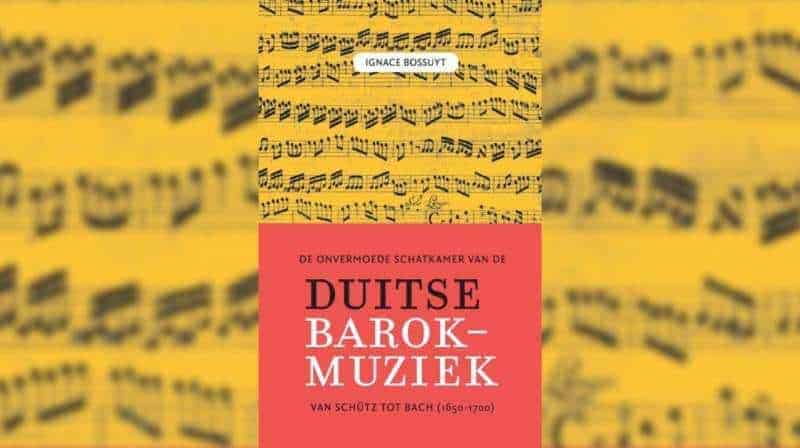
Ignace Bossuyt has already written extensively about music, and certainly about Baroque music. But what he has now accomplished surpasses what he previously did on Bach and others. Bach is represented in this work, but rather as a reference point. All the rest is about predecessors and contemporaries and the complete German Baroque music, because there is still much to be found there that we hardly know. It is The Unexpected Treasure Chest of German Baroque Music, says the title, and the book teaches us.
The professor emeritus at KU Leuven wanders through the entire German landscape from 1650 to 1700 and finds noteworthy composers in dozens of cities. He starts in 1650 in Dresden, finds Schütz there and arrives fifty years later in Bach's Leipzig. A hundred years lie between their birth years. What a remarkable musical journey. And Bossuyt remains Bossuyt: whichever composer he encounters, he explores him thoroughly, albeit with just one representative work. Usually this involves an unknown work and usually by quite a few lesser-known composers. Don't expect an encyclopedia or a course. The commentary is thorough, though. You need more than average musical interest to follow everything in detail. For each of the works discussed there are scores and texts (with translation!), because there is both instrumental and vocal work.
Other Masterworks
Perhaps the most important thing about the book is that it will expand your standard Baroque repertoire with many discoveries. Not more "masterworks", not even "minor" masterworks, but other ones, those outside the canon. And that other Leuven musicologist, Pieter Bergé, writes in his foreword to the book that this is ultimately what Bossuyt is after: "the enrichment of the listener." That listener can do that immediately, because a QR code at the beginning of almost every work leads him directly to the selected music fragments. An example? Ever heard of Andreas Christopher Clamer (1633-1701)? Hardly known, a Salzburger, he led the cathedral choristers there and published his only collection of instrumental music in 1682. Bossuyt picks his first Suite as a particularly fine example, and - how else can I put it - gives a musicology lesson.
Text and explanation in abundance: on cadences, on suites, on their dance parts and their names, on tempi and tonality, in short thorough, as you would expect from a professor emeritus. But don't be mistaken, he is your best guide in the exploration of a virtually unknown Baroque world. And besides Clamer there are 49 others of whom he, after a well-documented biography, discusses one composition. You've already heard of Scheidt, Froberger, von Biber, Pachelbel, but he selects works by them that will be discoveries for you. As with Johann Georg Conradi, once director of the Hamburg opera house. One opera of his has been preserved, Die schöne und getreue Ariadne, with "a grandiose solo scene of nine minutes", a favorite of the author who devotes twenty pages to him. Rightly so, because when you use the QR code and listen to the voice of Canadian soprano Karina Gauvin, you're sold. It is a recording from 2004 with the Boston Early Music Festival Orchestra and Chorus conducted by Paul O'Dette.
Great Master Johann Sebastiani
Bach himself is not entirely absent from the book. No, he very often refers to the great master when he encounters a work in which he finds kinship or even similarities in treatment or text interpretation. Besides, there is also a short chapter on a cousin of Bach, Johan Christoph, and about another family member, Johann Michael Bach, and he 'reviews' his chorale Herr, wenn ich nur dich habe. The book even includes a composer named Johann Sebastiani (sic). And he too wrote a St. Matthew Passion which Bossuyt analyzes extensively. The chronology and geographic journey through German Baroque ends with Johann Kuhnau, Bach's predecessor as cantor of the Thomaskirche in Leipzig.
It has become a thick book with plenty of extra information at the back. Not only can you learn more from the footnotes, bibliography and index of names and places. There is also a long list of listening examples on YouTube included in the book. For those who have more interest in Bach himself, there is an index of his cited works. This is followed by a discography and a reference to the website IMSLP.org, for consulting scores: "a true goldmine with both original prints and manuscripts and modern editions. An extensive explanation of the terminology used cannot be missing from an author who previously wrote the educational book Van noten en tonen. Wegwijs in muzikale begrippen. So let yourself be unashamedly guided on those untrodden Baroque paths by this eminent expert, and expand your own musical knowledge with at least a couple of works from that "unexpected treasure chest".
- WHAT: The Unexpected Treasure Chest of German Baroque Music. From Schütz to Bach (1650-1700)
- WHO: Ignace Bossuyt
- EDITION: Sterck & De Vreese, Gorredijk, 2021, 432 p.
- BOOK PRESENTATION: online streaming by Concertgebouw Brugge on June 6, 2021 at 11:00 by Ignace Bossuyt (speaker) and Korneel Bernolet (harpsichord). Read the program here and how you can participate.