
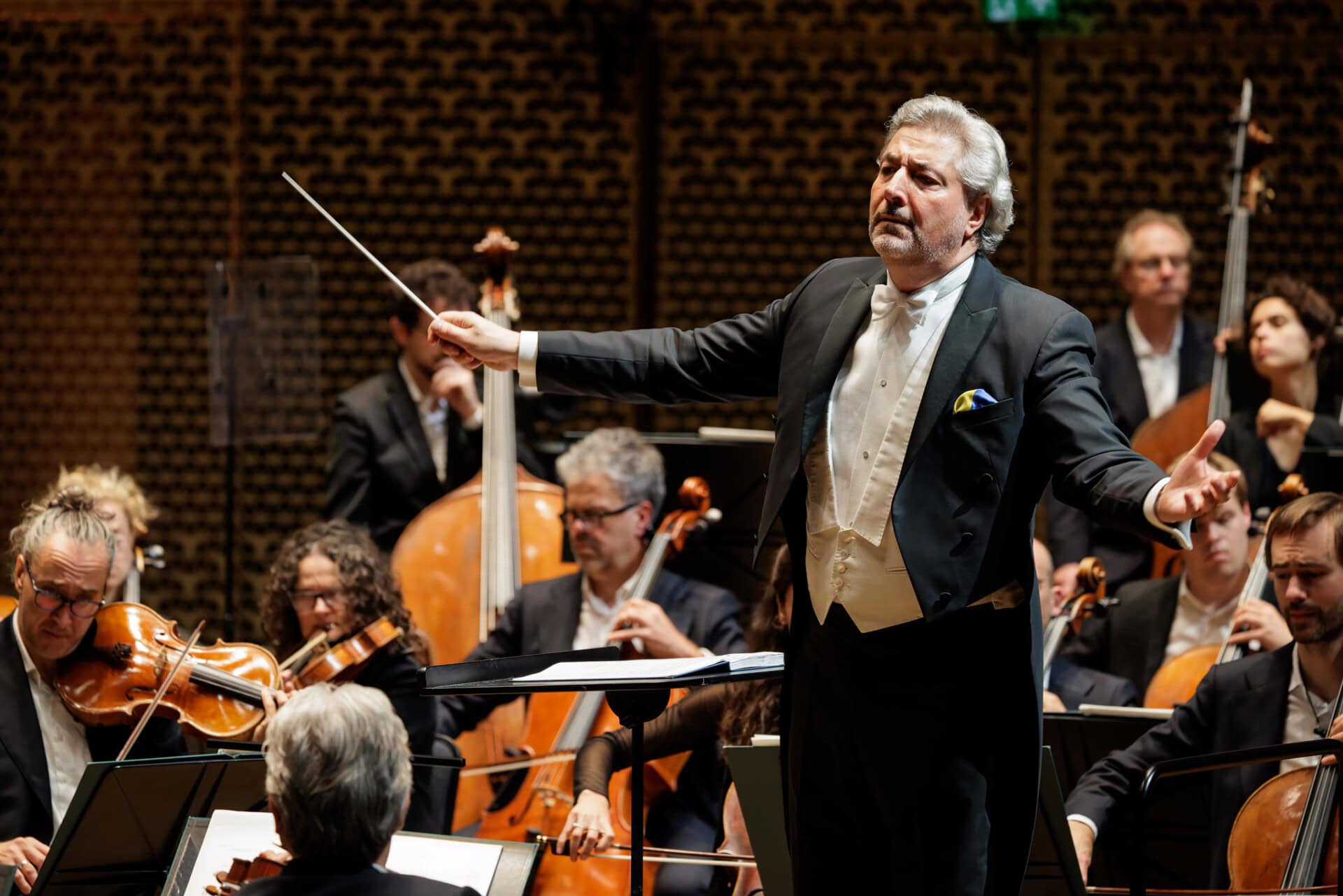
A concert that opens with the resounding romanticism of Grieg and ends in the stark cynicism of Shostakovich – that is not casual programming, but a deliberate journey through the human emotional landscape. With this combination of Grieg and Shostakovich, Daniel Raiskin continued his exploration of composers who approach emotion and truth each in their own way.
Daniel Raiskin led the Residentie Orkest with a firm hand, driven by intelligence, concentration and a flawless dramatic arc. Pianist Antti Siirala took his place at the grand piano not as a virtuoso on call, but as a painter of sound, as a poet of subtle movement. Together they offered on Saturday 11 October in Amare, The Hague, a recital that shone through detail, nuance and psychological depth.
This evening was part of the successful format RO Now, in which works from the great repertoire are presented in an accessible and fresh way. Pianist, presenter and storyteller Christiaan Kuyvenhoven provided the introductions, with listening fragments and an interview with Raiskin, which offered context and depth without being didactic.
A plea for pure emotion
The Piano Concerto by Edvard Grieg (1843-1907) is one of the most beloved in the Romantic repertoire, yet at the same time a work that easily lapses into bombast or decorative display. Not so this evening.
From the famous timpani stroke, Antti Siirala set the tone: this was not to be a pianistic lightning show, but a search for authenticity. The strength of his playing lay in its simplicity – clear as glacier water, without frills, but with an incredible ear for sonic balance and phrasing. The piano sang, spoke, roared and whispered.
The first movement, Allegro molto moderato, received a solid development in which Raiskin positioned the orchestra as an equal conversational partner. The brass sounded noble without pathos, and the woodwinds – particularly the flute and oboe – gave colour to the Norwegian character of the work. Siirala's interpretation recalled rather the poetic clarity of Dinu Lipatti than virtuoso pianists: restrained poetry above effect. In the cadenza Siirala went deeper: less as a statement, more as a meditation.
The Adagio was an oasis of rest. Siirala's touch had something of a harpist: velvety soft, with a natural breathing movement. The Residentie Orkest supported this with warm strings and an almost chamber music intimacy.
What struck one was the intense, engaged string sound and the presence of a remarkably large number of young faces in the orchestra – a combination that provided fresh energy and a special dynamic.
In the final section that carries the rhythmically dancing Norwegian folk character, the duo Raiskin–Siirala managed to keep rhythm and melody in perfect balance. No folklore as façade, but a celebration of rhythmic energy and inner joy. The syncopations danced, the woodwinds sparkled, Siirala remained light-footed and focused.
No virtuosity for virtuosity's sake – but virtuosity in the service of expressiveness. A rarity.
Conflict as a mask
Where Grieg still shows human emotion in open light, Dmitri Shostakovich (1906-1975) draws that same human being into the shadow. After the candid lyricism of Grieg, that Shostakovich sounded indeed like a cold mirror: the same humanity, but now distorted by fear and bitter irony.
His Sixth Symphony is a strange creature: not a classical four-movement structure, but a slow, introspective Largo, followed by two short, biting fast movements. As a listener you become disoriented – and that is precisely the intention. Composed in 1939, the symphony balances between personal introspection and public camouflage – music under the watchful eye of the Soviet state.
Before the performance, Kuyvenhoven spoke about Raiskin's youth in Saint Petersburg and his personal connection to Shostakovich's music. Raiskin recalled how his father, who wrote a book about the composer and did not miss a single premiere from the Seventh Symphony onwards, described the deep tragedy and mockery in this music. That human dimension gave added weight to the performance.
The Largo, which takes up almost half the symphony, is like a bank of mist in which forms emerge and disappear again. Raiskin knew how to weave tension from silence like no other. The slow build-up, with sparse woodwinds, sombre cellos and double basses, breathed an atmosphere of detachment, of suppressed pain. The flute and bassoon solos sounded like lost voices in an empty city. Not grand tragedy, but an introspective monologue.
During this section the tension in the hall was palpable – the audience held its breath, swept along by the penetrating intensity of the orchestra.
The Residentie Orkest excelled here in colour and control: the transparency in the orchestration was fully utilized, the tension sat in every held breath. Raiskin kept the phrasing tight, but with room to breathe – as if he did not want to proclaim Shostakovich's loneliness, but gently allowed it.
Then the unexpected shift: the Allegro, nervous and grotesque, with frantic rhythms and mocking motifs. The bassoons and clarinets danced almost roguishly over a droning foundation. Raiskin kept the tempo brisk, sharp – like a shadow of Prokofiev, but with a deeper sarcasm.
And then the Presto, an outburst of rhythmic violence: march-like, almost circus-like, with a brass sound that was simultaneously festive and cruel. What sounds like cheerfulness is, however, pure irony – music as a smile that conceals. The Residentie Orkest showed itself here at its best: rhythmically razor-sharp, the tutti like sonic granite, but nowhere hollow. The final measures, in which the music disappears from sight like a moving train, were breathtakingly hallucinatory.
The orchestra gave its all – not only technically, but also emotionally. They played with a rare combination of precision and urgency, as if Raiskin did not conduct this Russian tragedy but lived it through.
Where empathy and intellect converge
What makes a performance truly successful? Not perfection, but authenticity. And that was precisely what characterized this evening. Daniel Raiskin has a gift for psychological layering: his conducting is less aimed at effect, more at undercurrents.
Antti Siirala proved once again why he ranks among the great European pianists of his generation. His playing is never ostentatious, always selfless, always inspired. The Residentie Orkest, finally, played at a level that testified to internal cohesion, transparency and suppleness.
Afterwards, one could continue and savor the experience in the foyer with a complimentary drink, while a small live band lightly continued the mood – not a break with the intensity of the concert, but precisely the right balance to get back on solid ground. Amare proved itself to be a meeting place where music, audience and city truly find each other.
The reconciliation of silence and struggle
Some concert evenings continue to resonate – not because they were loud, but because they hit home. This concert, with its contrast between Grieg's pure emotion and Shostakovich's refined pretense, was one such evening.
It was an evening in which music was not merely performed, but unfolded – like an inner landscape that gradually reveals itself to those who truly listen. When the final echoes of Shostakovich faded, what remained was not silence but a charged clarity – as if the music were still breathing.
The Residentie Orkest seriously surprised me with this program through its commitment, dynamism and rich sound. This was certainly not the last time I was there.