
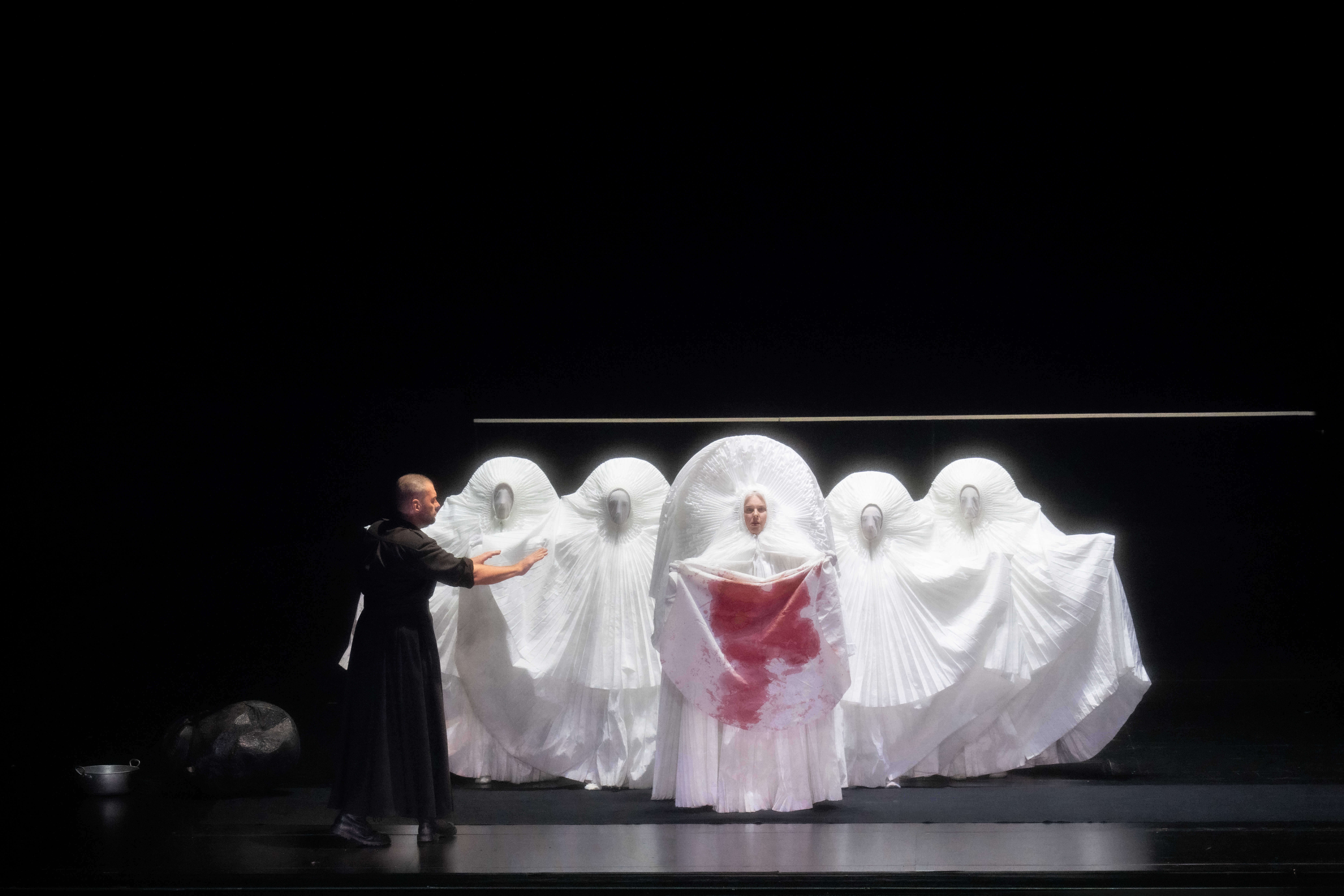
Where Das Rheingold (1869) ended with the creation of Walhalla, Die Walküre (1870) brought us directly back to earth. According to director Romeo Castellucci, this opera is the most human in the Wagner tetralogy. But, is this really the case?
Together with music director Alain Altinoglu, Bas Gábor Bretz (Wotan), contralto Marie-Nicole Lemieux (Fricka) and the extensive cast, Wagner's first day of Der Ring des Nibelungen (1853-1874) and the struggle for divine life, comes into motion.
Divine greed versus human desire
Das Rheingold and its sequel are two sides of the same coin. In the first, divine greed sets the beginning of the end in motion. It seems as if the ring stands for an absolute aversion to emotion and feeling. Wotan alludes to this in Die Walküre as well. His confession about the existence of the ring to Brünnhilde (soprano Ingela Brimberg), his beloved daughter and Valkyrie, emphasizes how all this is fatal – the gods will perish. The magical ring gold remains cursed.
Die Walküre is not only about greed versus altruism - in this opera production, Castellucci repeatedly drew the parallel between Wotan and Buddha – but also about duty versus desire. The human actors, the twins Siegmund (tenor Peter Wedd) and Sieglinde (soprano Nadja Stefanoff), are the result of Wotan's lust. This to the disgrace of Fricka, fantastically performed by Lemieux, who is the goddess of marriage. There is something repulsive about the enamored twins: the blood bond on one hand, but also the fact that Sieglinde is (unhappily) married to another on the other. With our contemporary view of marriage, this gives the production a special perspective. For Fricka, it is clear: the Wälsungen must atone – this for her honor as a goddess, but also as a woman. The theme of the tormented supreme goddess who lets her rage fall on the consequence (the twins), and not on the unfaithful one (Wotan) is a motif as old as the world (hello, Hera)!
The entire production is thus a collision between these philosophical motifs. This makes it emotionally more accessible than Das Rheingold. The gods clash with humans, and between them sits a third player: the Valkyrie Brünnhilde. She is the split between the two worlds. She is the core of the opera (concentrated in a character): conflicts with honor, loyalty, emotions and the consequences of life.
Hojotoho!
The production by De Munt and Castellucci had the challenge of translating his mobile, playful – but also symbolic – style from the sublime Das Rheingold to the conflictual Die Walküre. Did this succeed? For this reviewer, it has been largely well translated in this production. There is only a rare moment when it could have paused for me. This to let the vocal technique take precedence: during the Ride of the Valkyries. The reason: this well-known moment in the opera - when brought with an excellent selection of Valkyries -, does not need more, but less. And let me certainly emphasize: these seemed in terms of color and vocal technique each in their own strength and at the same time they also tingled in unison. This was a goosebumps moment. Brava, Valkyries!
Of this production it can be said that the female voices formed a powerful whole – like a mist with different rainbow hues. Lemieux as Fricka, in her brief moment of rage and divine divinity, was a vocal masterpiece. Her Fricka's demands continued to resonate. Stefanoff as Sieglinde – who is really just a plaything of fate – has an amazingly smooth wave from high to low, allowing her various timbres to shine. Brimberg as Brünnhilde has done justice to the role - both vocally and dramatically. Her full, dark voice is perfect for the iron-strong, yet emotionally stirred, Rhine maiden. From Brünnhilde you expect a powerful storm voice. This was immediately felt in "Hojotoho!" - her Valkyrie cry. But, at the end, at her moment of destiny, there is precisely that fragility. Brimberg brought the complete picture with her voice.
I certainly do not wish to shortchange the men – they were powerful performers – but Die Walküre was now the battleground for many female tour de forces. The production was from top to bottom a spectacle to behold. I wish Siegfried the same success story from the start. Bravo!
- WHAT: Die Walküre (1870) by Richard Wagner
- WHO: Alain Altinoglu (conductor), Romeo Castellucci (director), Christian Longchamp (dramaturg), Peter Wedd, Ante Jerkunica Gábor Bretz, Nadja Stefanoff, Ingela Brimberg, Marie-Nicole Lemieux, Karen Vermeiren, Tineke van Ingelgem, Polly Leech, Lotte Verstaen, Katie Lowe, Marie-Andrée Bouchard-Lesieur, Iris van Wijnen, Christel Loetzsch, Symfonieorkest van de Munt
- WHERE: De Munt, Brussels
- WHEN: 21 January to 11 February 2024; viewed on 21 January 2024