
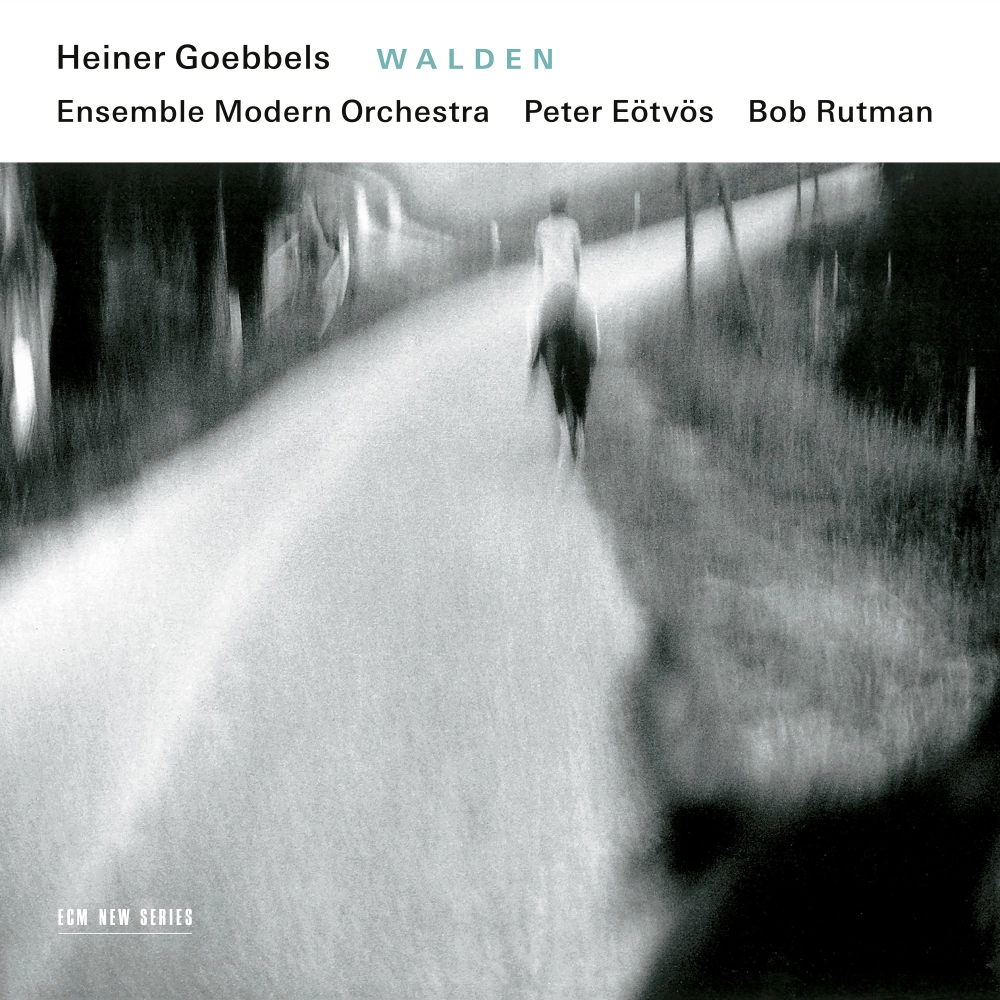
Walden was written in 1998 by Heiner Goebbels (°1952) for the Ensemble Modern Orchestra and makes use of the voice and presence of American performer Bob Rutman. The starting point is clear: fragments from "Walden" by Henry David Thoreau (1817-1862) – his account of solitude on the shores of Walden Pond, a plea for simplicity and withdrawal from the modern world that has become a classic. However, as Goebbels himself indicates, the relationship to that text is much less idyllic than in Thoreau: where the writer still expresses a form of transcendental faith in solitude, Goebbels' work revolves around the fault lines between solitude and the world, between individual self-determination and the inescapable pressure of the social and the technological. And it is precisely this ideal of peace and self-satisfied experience of nature that Goebbels immediately puts under tension. He brings Thoreau in, but doesn't leave him alone. It is exactly this unstable tension that flows as an undercurrent through the entire work.
Entirely unexpectedly, this CD landed in my mailbox to review, and in hindsight I'm not sorry about that, because despite the scorching heat outside, I was immediately drawn into an elusive sound world. What began as something that could still vaguely suggest nature or stillness quickly shifted to jazzy, rhythmically charged patterns in which any idyllic reading was undermined. Whoever expects a hushed sonic portrayal of forest and water here will be disappointed: Heiner Goebbels is simply the last composer to surrender to a literal or reassuring reading. Originally conceived as a counterweight to Surrogate Cities (1994), the work ultimately became equally multilayered and recalcitrant. You can hear that layering of sound worlds from the first minutes – Goebbels lays them like sediments over one another, orchestral eruptions that rub against the edge of contemporary symphonic idiom, alongside rhythmic patterns reminiscent of trip-hop or industrial music, and ambient-like passages that feel more cinematic than natural.
The Ensemble Modern is thereby not a classical accompanying orchestra, but an active, almost soloistic operating sonic apparatus. The musicians don't play in a homogeneous orchestral plane, but in sharply delineated clusters that constantly shift: fragile textures can suddenly turn into raw, almost mechanical outbursts. This makes the music physically present, more sculptural than linear. Peter Eötvös, as conductor, doesn't smooth out that multiplicity, but keeps it sharply cut: he lets tensions exist instead of resolving them, entrances sometimes seem deliberately to fall just beside each other, tempos shift slightly, and contrasts are not rounded off but exaggerated. The whole thereby gains a pronounced theatrical dimension, as if different scenes continuously overlap.
Central is Bob Rutman, who not only declaims Thoreau's text but also sings and uses throat singing, while playing his self-built instruments: the steel cello and bow chimes, ritual sound objects of resonant steel – cold and metallic – that open an almost physically audible sound space. His presence is not that of a classical soloist, but of a performative figure who, as it were, destabilizes the orchestra from within. The interaction between his metallic resonances and the orchestral texture in particular creates a field of tension in which sound continuously seems to collide and dissolve again. The orchestra can whisper or explode, but is repeatedly thrown off balance by Rutman's sound language. The result lies somewhere between ritual and science fiction.
For nine parts – from Where I Lived, and What I Lived For to The White Pond – that tension remains intact without the work descending into mere atmosphere creation. Especially in the opening sections, the ambient-like, cinematic textures still predominate; gradually, the rhythmically charged, almost trip-hop-like patterns take over, until Rutman's metallic sounds reclaim silence in the closing sections. What Goebbels does is not an illustration of Thoreau, but a radical reworking and destabilization of his idea of solitude into something unstable and contemporary.
The result is an hour of music that is difficult to classify, and therein lies its strength. Goebbels' Walden is not a restful nature experience, but an restless sound landscape in which Thoreau's idea of silence continuously clashes with the sounds of our far more complex world.