
The passage of 'Maestro Degand' on our television screens caused quite a stir within the classical music world. The programme was said to trivialise the notoriously difficult profession of conductor, making the public believe that anyone can learn to conduct without difficulty.
The entire setup was supposedly a put-up job, and the question was raised in various quarters whether the subsidy money from our VRT and our Belgian National Orchestra really had to be used to make the youthful dream of this or that actor come true. Wouldn't the invested funds be better spent on capturing a few real symphonic concerts, something that hasn't happened for years? (The annual Christmas concert in the Royal Palace, the prelude concert to the national holiday and the Queen Elisabeth Competition not to be overlooked.) Moreover, the Belgian National Orchestra should not, out of self-respect, trifle with a Holy Grail like Brahms' Fourth, certainly not for a plate of lentil soup and some extra media exposure.
Let us first clarify a few facts.
Stefaan Degand is not a complete layman when it comes to music. He has indeed received basic training, he is able to read notes and an orchestra score, and he was active as an amateur trombonist in one of the many brass and wind bands that our region has had for as long as anyone can remember.
An orchestra like the Belgian National Orchestra is indeed capable of playing a work like Brahms' 4th Symphony from beginning to end without a conductor. In that case, the concert master (the primus inter pares among the violinists) will primarily take on the role of conductor, and the musicians will try to keep things together through extra eye contact and extra gestures. That will work to some extent. Whether it will be truly audible and "suitable for human consumption" is another question.
And that brings us to the heart of the discussion: the question of whether a layman can conduct Brahms' Fourth is actually a non-question. Of course he can (it would even work with a shop mannequin as conductor) and of course he cannot! Compare it to the question of whether a layman could direct Hamlet at Het Toneelhuis. Shakespeare's text is outstanding in any case, there is enough expertise in-house to set up a set and the necessary technical support, and the actors would be able to put something together on stage - with some goodwill - amongst themselves. Again: whether it would be viewable and "suitable for human consumption" is another question.
Whether a layman can conduct a Brahms symphony with a professional orchestra was therefore not the essence of 'Maestro Degand', but rather a vehicle to give us an insight into the soul of this extraordinary man on the one hand, and on the other hand to make the workings of an orchestra and a conductor somewhat tangible to an audience that actually never gets to see inside it. And that is also immediately the great strength of the programme: the functioning of a large symphonic orchestra and especially the almost enigmatic role that the conductor plays in it are difficult to describe and understand for someone who has never worked in that world. 'Maestro Degand' succeeds very well in providing that insight and generated an emerging fascination with the world of classical music among part of the viewing and listening audience. Perhaps that renewed interest will lead the VRT to once again make room for the occasional classical concert in the broadcast schedule, and ultimately the entire classical music sector will benefit from 'Maestro Degand'?
Bram Nolf
Oboe Belgian National Orchestra
Oboe teacher LUCA School of Arts - Lemmens-instituut Leuven
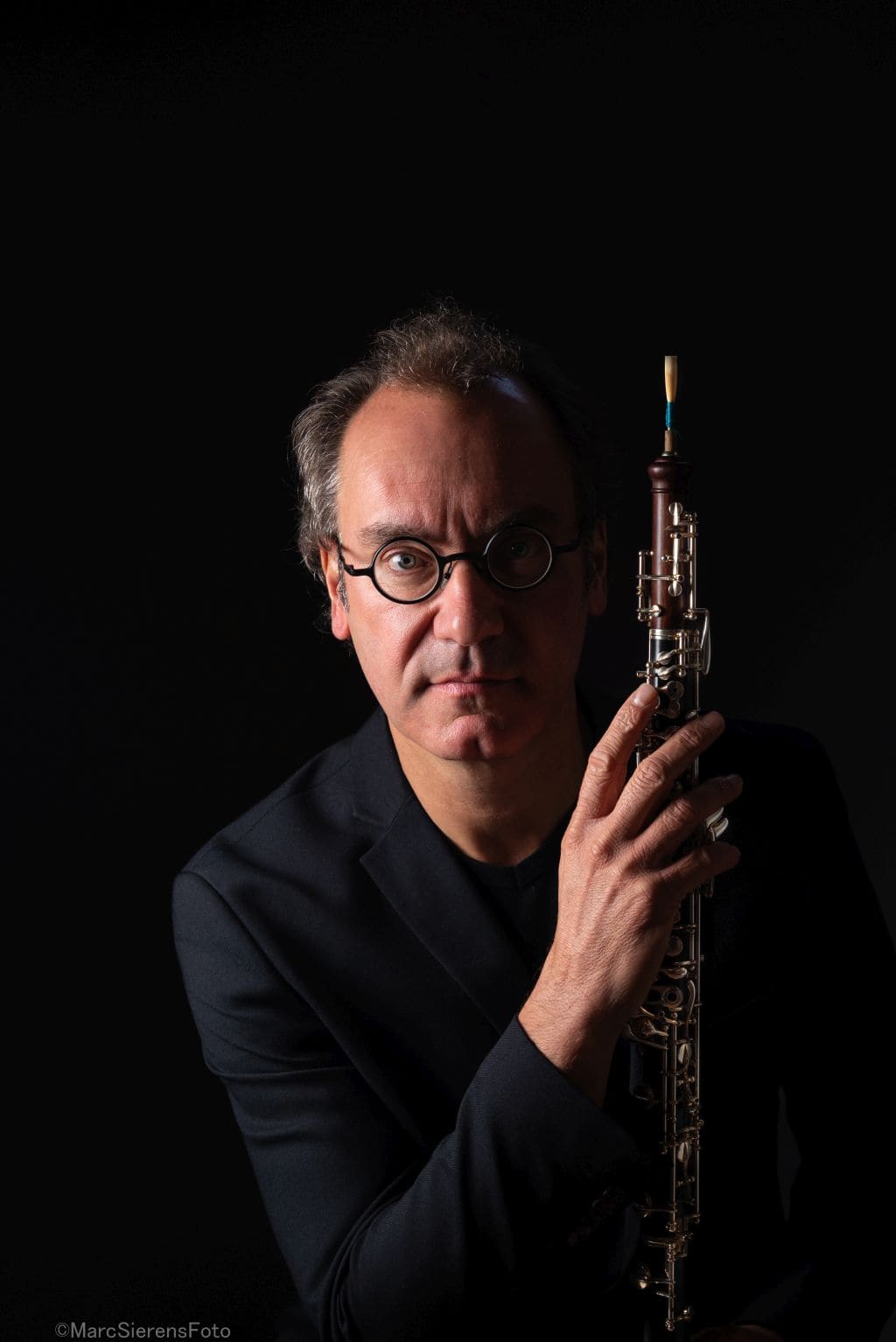
- PHOTO: Bram Nolf, © MarcSierens