
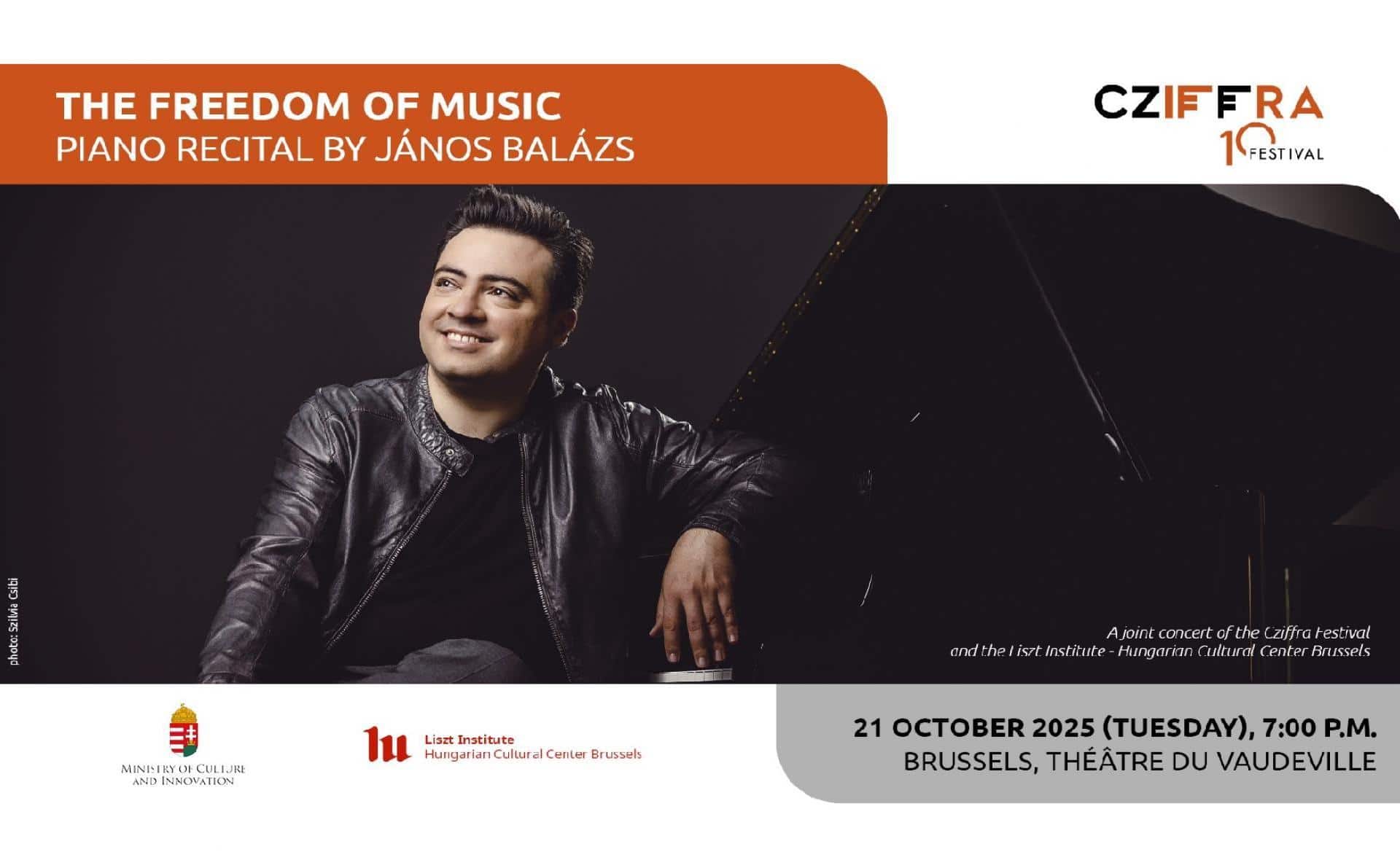
On Tuesday, October 21, pianist János Balázs gave an impressive recital at Brussels' Théâtre du Vaudeville under the title The Freedom of Music, organized by the Liszt Institute Brussels and the Cziffra Festival. In a carefully constructed program, he connected romantic grandeur with folk music roots and contemporary experiments. Freedom was invoked not only thematically, but sounded and felt in every note — musically, emotionally and intellectually.
The recital took place on a date steeped in symbolism: the eve of Franz Liszt's birthday and the commemoration of the Hungarian uprising of 1956. Two moments that, each in their own way, speak to the search for freedom — Liszt in his revolutionary musical expression, the uprising in the courage and imagination of a people who refused to be subdued. In the Théâtre du Vaudeville, this freedom became tangible: in every keystroke, every breath, every subtle nuance of Balázs' playing echoed a sense of artistic and human liberation.
That 19th-century Théâtre du Vaudeville, hidden in the elegant Galerie de la Reine, proved to be the perfect partner for this recital, a jewel of acoustic clarity. The warm wooden resonances and intimate scale of the hall allowed the sound to breathe without evaporating. Every pianissimo remained audible, every tonal shade found its place. It was a space that naturally invited listening — and freedom.
A pianist with a mission
János Balázs is no stranger to the international piano world. As a student of the Liszt Academy and artistic director of the Cziffra Festival, he stands firmly in the tradition of greats such as György Cziffra (1921-1994) and Franz Liszt (1811-1886). His playing is imbued with a deep connection to the Hungarian musical soul, yet avoids any folkloric cliché. He seeks dialogue between past and present, between score and improvisation, between technical mastery and expressive surrender.
From the opening measures, Balázs made it clear that he had not come to impress, but to tell a story. His touch was nuanced, his dynamics eloquent, his musicality instinctive. He played with a freedom that was never arbitrary: every sound served meaning.
Subtlety and intensity
The recital opened with Ballade No. 3 in A-flat major, Op. 47 by Frédéric Chopin (1810-1849), in which Balázs unfolded a richly layered narrative. He chose not a theatrical reading, but a poetic telling full of breath and movement. The opening sang with natural warmth, the transition to the scherzo section sparkled with lightness. In the great climax, there was no force for force's sake, but a conviction that grew from within. The return to the serene main key was like a memory of something that has passed but continues to resonate. Thus Chopin was not merely played, but relived.
This was followed by Liszt's Les jeux d'eaux à la Villa d'Este, in which Balázs brought the sparkling water figures to life with an almost impressionistic refinement. The transparency of his tone, combined with crystal-clear texture, revealed the religious dimension of the work — the "living water" became audible in an almost meditative silence.
Virtuosity with a smile
With the Blue Danube Paraphrases by Strauss–Cziffra–Balázs, he paid tribute to the virtuosic piano tradition in which humor, virtuosity and bravura come together. Balázs approached the work not as a lighthearted showstopper, but as a playful dialogue between Viennese elegance and Hungarian fire. The familiar waltz theme by Johann Strauss Jr. (1825-1899) took on a living character in his hands: sometimes airy and seductive, then brutal and overwhelming. The Cziffra-like bravura was enriched with Balázs' own contribution, allowing the paraphrase to grow into a free vision of musical joy.
Drama and devotion
In Isoldes Liebestod by Richard Wagner (1813-1883) in Liszt's arrangement, he reached one of the emotional highlights of the evening. The tension grew steadily, sustained by perfectly balanced pedal work. The melody seemed not to be played, but to rise from the piano like a meditation — a moving embodiment of transcendent love.
With Liszt's Après une Lecture de Dante as the centerpiece of the evening, Balázs demonstrated his mastery of narrative repertoire. He constructed the work as a spiritual journey with a powerful dramatic arc — from inferno to redemption — but also with a powerful yet restrained tone. His octaves were tight, his trills ethereal, the climaxes charged but never intrusive. Here the pianist sounded like a storyteller, the piano as interpreter of the human soul and struggle.
Hungarian voices of now
His own Improvisation on Hungarian Folk Songs formed the personal heart of the evening. Balázs let melodies bloom from silence, adorned them with unexpected harmonies and rhythmic, jazzy accents. Here he entered the realm in which Cziffra excelled: the free play where tradition and intuition converge. Balázs does not inherit that legacy as an imitator, but as an heir to his spirit: the courage to take risks, the art of letting go. The audience followed breathlessly. No longer an interpreter, but a true creator — in the moment, vulnerable and powerful at once.
With Dances of the Brush-Footed Butterfly by Péter Eötvös (1944-2024) and Swallow Songs by László Dubrovay (°1943), he demonstrated how Hungarian music continues to move between experiment and tradition. The delicate movements of Eötvös demanded utmost precision and sense of colour, something Balázs brought with lightness and humour. Wonderful to see was how his fingers flew like a butterfly across the piano. In Dubrovay's bird songs, a poetic minimalism resonated in turn, with fluttering motifs that probed the boundaries of the piano.
Virtuosity and fire
With Liszt's Hungarian Rhapsody No. 6, Balázs concluded the official evening in an orgy of rhythm and colour. His tempo was blazing but never rushed; the dancing energy of the piece stemmed from a joy lived from within. Every accelerando seemed to arise from the very foundation of the music itself, and the final chords sounded like a liberating laugh.
For his encores, Balázs first chose the Hungarian Dance No. 6 by Johannes Brahms (1833-1897) in a Cziffra arrangement full of playful fury – and then the renowned Allegro barbaro by Béla Bartók (1881-1945). In that final work, he unleashed a primal force that sounded both raw and controlled, as if the piano became an orchestra. Both encores formed a perfect summary of the evening: virtuosity as expression, freedom as necessity.
Freedom as an artistic act
With The Freedom of Music, János Balázs proved that freedom in music does not equate to non-committal playing. It takes insight, control and courage to turn a programme like this into a coherent and lasting whole. By connecting grand romanticism, contemporary musical language and improvisation, he showed what it means to be truly free as a musician – in thinking, feeling and playing.
His recital was an ode to imagination, a journey through tradition, resistance and transcendence. In the Théâtre du Vaudeville, where every note found its echo, that freedom became audible – in sound, in silence, in the spirit of Cziffra who listened softly along.
In the footsteps of Cziffra
After the concert, we were invited to the Liszt Institute Brussels on the Treurenberg, where we had the rare opportunity to exchange thoughts with Balázs. He told us how grateful he is when he plays for an attentive and engaged audience: then he can precisely bring that repertoire that mirrors his soul, and thereby go deep into the music. He spoke with passion about his source of inspiration: Cziffra is his idol, especially because of his passionate and often combative life. Ten years ago, Balázs founded the Cziffra Festival – a tribute to the master – and soon, following this recital in Brussels, his debut at Carnegie Hall is on the agenda.
The Liszt Institute Brussels is currently hosting an exhibition about the life of György Cziffra. The exhibition offers a fascinating picture of his complex biography: from a childhood in poverty, through musical survival endeavours – pianist in cafés, imprisonment, political pressure – to exile, a grand international career and the tragic loss of his son. In addition, there is a parallel exhibition with contemporary art "Hungaricons", which includes, among other things, a beautiful tribute work to Cziffra. Those only familiar with his brilliant recordings will gain an extra layer here: the context behind the music, the struggle behind the virtuosity – truly worth a visit.
Musical freedom in a glass
We concluded the fantastic evening with a glass of Rubato Cuvée, the official festival wine of the Cziffra Festival. This special blend was designed at the initiative of Balázs in collaboration with the Hungarian wine house Takler. The wine is a characterful composition of Kékfrankos, Cabernet Franc, Syrah, Cabernet Sauvignon and a touch of Merlot. The Rubato 2022 is expressive and round, with tones of ripe red fruit, spices and a subtle wood note – energetic and elegant at once, just like the music it celebrates.
The name Rubato is no coincidence, referring to the musical freedom with which Cziffra played: the fluid play with tempo and emotion that makes every performance unique. Since its first edition in 2015, Rubato Cuvée has grown into a symbol of the festival – a wine that, like Cziffra's interpretations, seeks balance between passion and refinement.