
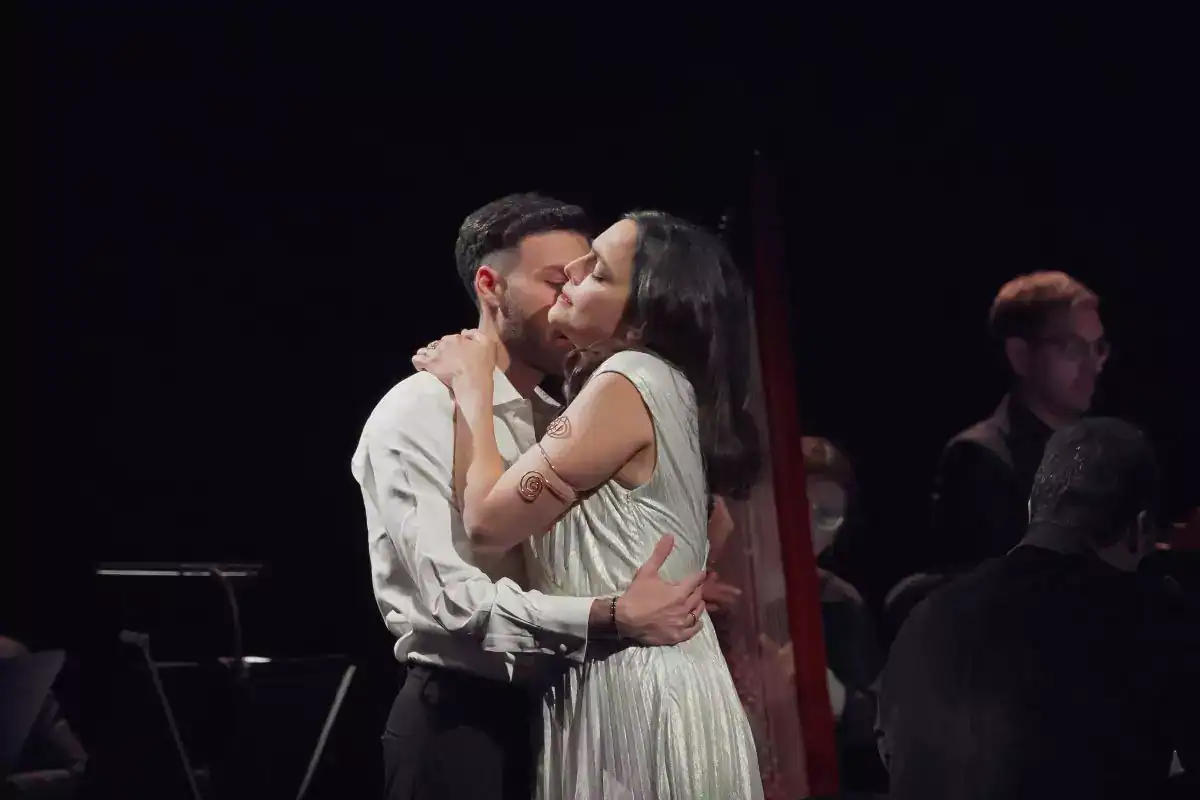
On 4 July 2025, the ensemble Cappella Mediterranea under the direction of Leonardo García-Alarcón gave a concert performance of L'incoronazione di Poppea at the Grand Manège in Namen. The evening developed into a masterful interpretation of Monteverdi's final opera, in which the music stood entirely at the centre and the dramatic power of the work could unfold unimpeded.
García-Alarcón, who may almost be regarded as a house conductor at the Grand Manège, led his musicians with his customary brio and a marked sense of tension and colour. His approach is always permeated with a deep understanding of dramatic structure and the rhetoric of Baroque music. Under his direction, the continuo sounded not like accompaniment, but as an organic beating heart, propelling the entire drama forward rhythmically and harmonically. Cappella Mediterranea proved once again to belong to the world's top tier of historically informed performance practice. The richness of sound, the refinement in phrasing, and the infectious pleasure in playing ensured a spirited and at the same time perfectly controlled performance.
The soloists interpreted their roles with an intensity that more than compensated for the concert format. French-Belgian soprano Sophie Junker shaped Poppea with a voice that sounded both seductive and unerring. Her interpretation blended sensuality with ambition, without descending into caricature. Nicolò Balducci as Nerone produced a voice that expressed both youthful impetuousness and inner anguish. The confrontations between him and Poppea excelled in building tension and dramatic force. Mariana Flores, frequently heard in the past in García-Alarcón productions, gave the deposed empress Ottavia a blend of dignity, bitterness, and emotional vulnerability. Her voice coloured her emotions subtly, without any striving for effect. Christopher Lowrey convinced as Ottone with a sensitive, almost fragile reading of his part, in which he made the inner conflict of his character clearly felt.
The Grand Manège, with its warm and transparent acoustics, provided an ideal acoustic space for this production. Without scenography or visual effects, attention was drawn entirely to the words and music, which only heightened the dramatic intensity. This was evident from the audience, who allowed themselves to be carried silently into the play of intrigues, desires, and power that Monteverdi and his librettist Busenello outlined with such psychological insight. The minutes-long, thunderous applause, with many "bravos" ringing out, testified to an enthusiastic and convinced but also grateful audience.
This performance is part of a broader tour. The production was previously performed in, among other places, Versailles, Aix-en-Provence, Toulon, and Cologne. Further performances are to follow in Canada, including in Toronto and Montreal, as well as in New York. Everywhere this approach garnered praise. In Gramophone, it was praised how the action never slackens and attention never falters, while French critics commended the interplay between conductor and director Ted Huffman as an example of restrained yet suggestive musical theatre.
That this Poppea also stands on its own without scenic framing is a testament to the musicality of the performers and to the timeless power of the score itself.
The performance in Namen confirmed why this production is so highly valued internationally. It brought Monteverdi's opera back to its essence: a musical drama that takes place not on stage, but in the mind and soul of the listener. It was an evening that lingered on, and in which past and present, sound and emotion, merged perfectly.