
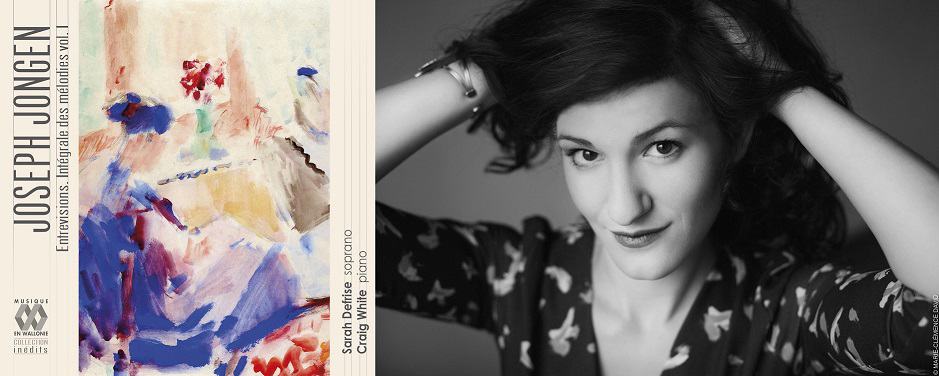
*** Musique en Wallonie is such a treasure trove for Belgian composers and performers as Phaedra is in Flanders. Their three recent recordings present works by Eugène Samuel-Holeman (1863-1942), César Franck (1822-1890) and Joseph Jongen (1873-1953). Of the three, only César Franck is well known in the world of classical music. It is therefore certainly commendable that Musique en Wallonie pays attention to the two contemporaries Samuel-Holeman and Jongen, two representatives of the fin-de-siècle in Belgium. The cd with Mélodies by Joseph Jongen is announced as the first volume of an Intégrale des mélodies. That promises and it indeed whets the appetite for more.
The cd was given the somewhat mysterious title Entrevisions. This designation, "catching a glimpse", is derived from the song to a text by Charles Van Lerberghe. The poetry on which the songs are based indeed does not always offer a univocal meaning and leans towards the dreaminess and fragility of symbolism. Jongen is better known for instrumental music (quartet, symphony). Yet between 1890 and 1948 he composes some 55 songs for voice and piano. After that his musical production stalls due to a serious existential crisis. Sarah Defrise distinguishes three periods in this song oeuvre: French romanticism (1890-1900), the post-Wagnerian style and the influence of Debussy (1902-1914) and Jongen's own synthetism.
Sensuality and subtlety
That Jongen is above all a composer of the intimate and hushed is proved by the recording in its entirety. Defrise's vocal style matches this perfectly. She sings with great sensitivity and it is a pity that her voice sometimes has somewhat shrill high soprano tones, which is all the more noticeable in the rather recitative character of the opening song Les Chrysanthèmes. In some songs the uniformly shrill tone is disturbing as monotonous, for example in Pourquoi?. But the sensuality and subtlety of the interpretation makes up for much. Her middle register is softer, as in the opening of Après un rêve, a song that drips with deliciously performed melancholy. In Ferveur printanière passion sounds, but so genuine that pathos is far away. The poetry of the performance is moreover excellently supported by the very refined piano accompaniment of Craig White.
The texts of the songs are mostly taken from symbolist authors, including the Belgian poets Franz Hellens and the aforementioned Charles Van Lerberghe. Besides, this cd also includes a series of songs to texts by Armand Silvestre, whom we know as poet of, among others, Gabriel Fauré. These songs are – apart from some others on the cd – a world premiere. This certainly adds to the importance of this recording. Moreover, Sarah Defrise is not only the singer, but also the author of the text in the booklet - which has also been translated into Dutch. In it she writes about her research work, which makes the recording extra interesting to become acquainted with the oeuvre of Joseph Jongen. Actually an achievement in itself and certainly a factor to look forward to the continuation of the Intégrale des mélodies of Joseph Jongen.
- WHAT: Entrevisions. Intégrale des mélodies, vol. I, with music by Joseph Jongen (1873-1953)
- WHO: Sarah Defrise (soprano) and Craig White (piano)
- RELEASE: Musique en Wallonie (MEW 1993) – website (click here)
- PHOTO: © sarah-defrise.com