
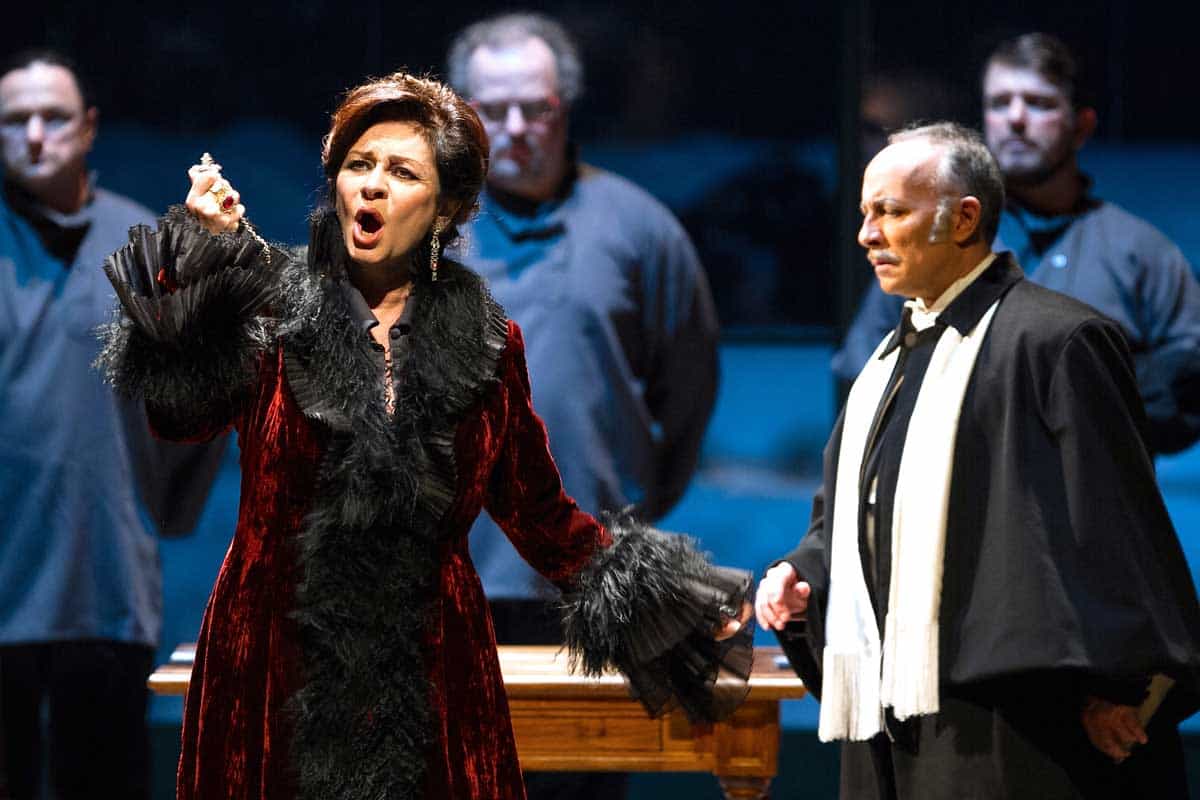
** This recording of Fedora by Umberto Giordano is primarily an incentive for opera lovers who want to seize the opportunity to see this lesser-known opera. It is above all a showcase piece for the soprano and although Daniela Dessì does not do it at all badly, she is nevertheless unable to control the overall performance enough to make it a complete success.
After seeing Sardou's play in Naples in 1885 as an 18-year-old student with none other than Sarah Bernhardt, Giordano conceived the idea for an opera based on this story. He composed it after the success of Andrea Chénier. The premiere took place in November 1898 at the Teatro Lirico in Milan with the composer as conductor. That Gemma Bellincioni sang Fedora may not mean much to us now, but that Enrico Caruso sang the male leading role of Loris certainly appeals to the imagination.
The story tells of the difficult and tragic love story between Fedora and Loris Ipanov, the man who is initially suspected of having shot her fiancé, Count Vladimir Andreyevich. Fedora is a Russian aristocrat with a passionate temperament, a character type typical of verismo, and she swears to find the guilty party. That would be Loris, but a romance has developed between Fedora and Loris, which Fedora initially resists. In the opera's best-known aria, Amor ti vieta, Loris admits that he has succumbed to her charms and that he realizes the attraction is mutual. During a party that Fedora has organized (with a musician who claims to be as good as Chopin), news arrives that the Nihilists have attempted to assassinate the Tsar. Loris manages to convince Fedora that he has nothing to do with the assassination, and moreover, he can reveal to her the contents of a letter from the Count that he has intercepted, which explains why he shot the Count. The letter is addressed to a poor girl with whom the Count had a relationship and in which he claims that—despite his marriage to Fedora—he would not end their affair. Fedora is shocked by the Count's betrayal, who would marry her only for her wealth. She spends some time happily with Loris in her villa in Switzerland. But their relationship comes to an abrupt end when Fedora reveals the complicity of Loris's brother in the murder of the Tsar. This news causes the death of the mother of the two brothers. Fedora hopes for mercy and forgiveness from Loris, but he curses her. She commits suicide with poison (which she always carries in a Byzantine cross) and dies in the arms of Loris, who finally forgives the dying woman.
Accurate atmosphere, muted involvement
Director Rosetta Cucchi (who also directed La Favorite at the Opéra Royal de Wallonie in November 2017) divides the stage into two parts. In the foreground we see—usually in a sober but effective rendering—the event being discussed at that moment (the Count's palace, the party in Paris), and behind a translucent curtain reference is made to the context in which that scene takes place (the snowstorm, the terror in Russia, the assassination). The atmosphere is accurate, but the emotional investment of the characters is often muted and fails to engage the audience. That is actually true for everyone except the two female characters, Fedora herself and Olga, her cousin, whom we meet at the party in the second act. Vocally, they are also the best-cast roles. Daniela Dessì gets off to a somewhat slow start, but in the scene where she makes the decision and admits her love for Loris (second act), she sings convincingly with a strong, clear soprano. She is certainly worth watching the performance for. Olga is a lively character and Daria Kovalenko sings her with great panache and lyrical playfulness. The role of Loris is split on stage, with an old Loris who silently and mysteriously "observes" everything from a corner in the foreground throughout the opera. A bizarre directorial intervention. The "real" Loris is performed by a very disappointing Fabio Armiliato, who can please neither through his acting nor his performance. The chorus and orchestra of the Teatro Carlo Felice also play without much commitment under the direction of a rather unenthusiastic conductor, Valerio Galli.
A recording that primarily has its value as an introduction to the certainly compelling and versatile opera by Umberto Giordano, from which certainly more could be extracted.
- WHAT: Umberto Giordano (1867-1948) | Fedora
- DIRECTION: Rosetta Cucchi
- VOICES: Daniela Dessì, Fabio Armiliato, Daria Kovalenko, Alfonso Antoniozzi, Margherita Rotondi and others
- ORCHESTRA: Chorus and orchestra of Teatro Carlo Felice, Genova conducted by Valerio Galli
- RELEASE: Dynamic 57772 (recording March 2015)
- PHOTO CREDIT: © Marcello Orselli