
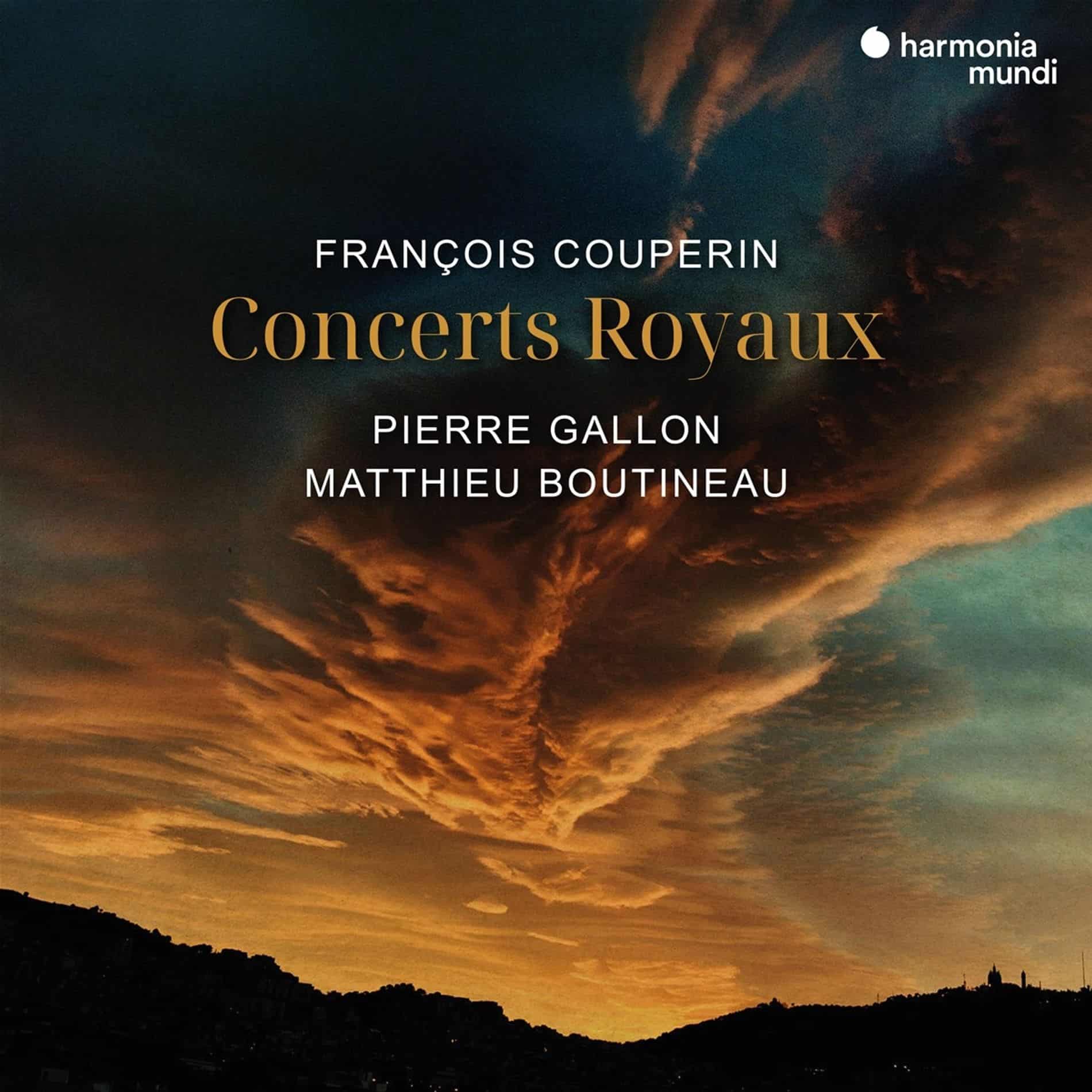
François Couperin - Concerts Royaux
Pierre Gallon & Matthieu Boutineau (harpsichord), Thibaut Roussel (theorbo & baroque guitar)
Harmonia Mundi HMM 902725 • 62' •
Recording: July 2023, Église Saint-Martin de La Croupte, Livarot-Pays-d'Auge (F)
Concerts Royaux, version à deux clavecins, suggests at first glance (or at least leads one to suspect) that this is a version by the composer himself, but this is only partly the case. Whoever consults the manuscript does indeed encounter an added second right-hand part, but one introduced by the composer only occasionally: the majority is written out for only one harpsichordist. Why François Couperin left it at that remains, unfortunately, unknown. It may have been an experiment. It certainly was not a 'sweet inspiration', for the extra part, wherever it has been added, is indeed carefully notated. Which only makes it all the more remarkable.
Since the manuscript has been preserved in its entirety, one can logically rule out the possibility of a 'lost' part for a second harpsichordist. Not that this necessarily settles the matter conclusively, since theoretically a second, fully written-out part could have existed and subsequently disappeared for inscrutable reasons; whether or not due to the composer's actions. In short, we are left with a puzzle. Or perhaps Couperin did not see fit to write out more (completely), for whatever reason.
What is fortunately no puzzle: the playing of these two harpsichordists, who have laid out a veritable tapestry of sound and provided sparkling dialogues (which also says much about the way they themselves have filled in the missing parts). These largely courtly dances in their original form must certainly have pleased the artistically very demanding Sun King. What also works in this case is the role of the continuo (here alternating theorbo and baroque guitar - though not in all pieces: see the table of contents) that beautifully supports the colorful character of these fascinating instrumental pieces.
These Concerts Royaux, and royal they are, date from around 1710, forming part of the Troisième Livre de Pièces de Clavecin published in Paris in 1722. On this basis, one could be satisfied with just one harpsichord. This is generally how we know these pieces. This does not mean, however, that there is anything objectionable about this version for two harpsichords and continuo. For we know that in those times it was the most common thing in the world to spontaneously create arrangements. Moreover: the playing of this duo is beyond all criticism: thoroughly musicianly, imaginative, tasteful, technically perfect, and with ornamentations that are delightfully executed. The echo effects, the characteristic 'give-and-take', the juggling of melody and harmony: it all comes off magnificently.