
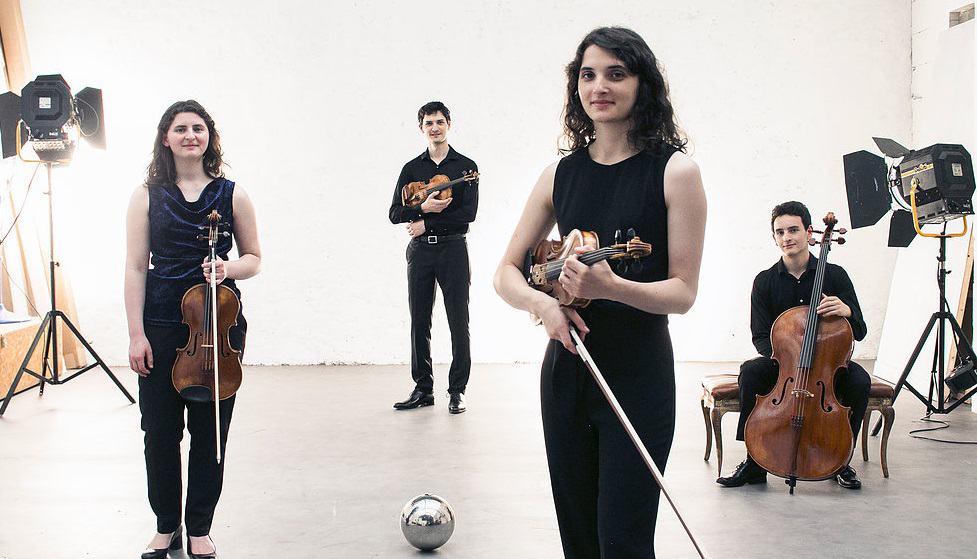
The final day of Midis-Minimes' string quartet week was one to cherish. How could it be otherwise with one of Beethoven's last magna opera on the programme? But there was more. So the generous Quatuor Tchalik threw in the moving Quartettsatz at the end. Schubert, whom we indeed had not heard during this five-day festival …
Yet the week ended as it had begun: in a family setting. The siblings Tchalik, between 19 (!) and 29 years old, belong in the ranks of Europe's most promising quartets. Since 2016, the French-Russian ensemble has studied under Günter Pichler – former first violin and founder of the renowned Alban Berg Quartett – at the Madrid Escuela Superior de Música Reina Sofía. At the end of last year, the quartet took up a residency at ProQuartet, a promotion and training institute for chamber music in Paris that also houses other emerging talent such as Quatuor Van Kuijk and Quatuor Arod. But the first real highlight in their still young career took place half a year ago, when Quatuor Tchalik captured both the first prize and the jury prize at the thirteenth edition of the Mozart Wettbewerb in Salzburg. In doing so, it convinced a jury chaired by the leader of the Hagen Quartet, and which also included Jonathan Brown (Cuarteto Casals) and Mark Steinberg (Brentano Quartet), among others. A group to keep an eye on, and certainly an ear on as well.
Fitting apotheosis
With its choice of the first of Beethoven's late string quartets, Quatuor Tchalik provided a fitting apotheosis to conclude a week like this. For this is the pinnacle of the genre. Nothing more challenging than this exists, neither for the listeners, and certainly not for the musicians. Completed in early 1825, the brilliant opus 127 aroused mixed feelings in the first years after its creation. In a review published in the very first volume (1827/1828) of the Allgemeine Musikzeitung, it is made clear that not everyone warmed to this music of the future: "Die Urtheile über die letzten Werke dieses Meisters sind überhaupt sehr verschieden, ja nicht selden sich selbst wiedersprechend. Die Einen sage, man könne nichts Schöneres un Herrlicheres finden, als namentlich dieses hier genannte Quartett […]; die Anderen hingegen sagen: Nein, es ist hier Alles undeutlich, Alles Wirrwarr; […] So Etwas darf man den Unkundigen nicht vorlegen, sie wissen ja nicht, was sie daraus machen sollen." Fortunately, Quatuor Tchalik clearly knew which way the wind was blowing. Throughout the first movement (Maestoso – Allegro), the ensemble made an urgent statement three times with some forceful sforzandos. In between, the young musicians delighted the audience with beautifully articulated lyricism and abundant festivity. In the subsequent variation sequence that followed, according to composer Vincent d'Indy "une des pages les plus représentatives de la grande variation beethovénienne", the quartet demonstrated its keen eye for dynamics and a subtly balanced tonal quality. The result was an Adagio ma non troppo e molto cantabile that navigated between tension and relaxation. Particularly noteworthy was the third variation, executed with supreme control: one of many signs of hope in this outright brilliant movement. Here four like-minded souls were at work. In the Scherzando vivace, a single rhythmic cell moved briskly from instrument to instrument, followed by incisive attacas that drove the question-and-answer play even further (Allegro). Delightful. The short trio, in turn, possessed a superb drive that gave the music a great deal of mobility. For the life-affirming finale – curiously without a tempo marking – the quartet held back somewhat on the gas. But it did not rest on its laurels. A lovingly crafted first theme gave way to a lively accented second idea and clear development. The coda, brilliantly colored, crowned the work. Bravo!
After this solid Beethoven, Quatuor Tchalik showed itself in a generous mood. It added the moving Quartettsatz by Schubert (1820), "a joy and tenderness that refuses to be captured by the grief and apprehension that enclose it", according to British philosopher Roger Scruton. A week of the string quartet without a single line of Schubert: a music lover may indeed not think of it …
- WHAT: Ludwig Van Beethoven (1770-1827), String Quartet no. 12 in E-flat (opus 127)
- WHO: Quatuor Tchalik [Gabriel & Louise Tchalik (violin), Sarah Tchalik (viola), Marc Tchalik (cello)]
- WHERE: Koninklijk Conservatorium, Brussels (as part of the Midis-Minimes festival)
- WHEN: Friday 3 August 2018
- PHOTO: © Julien Daniel