
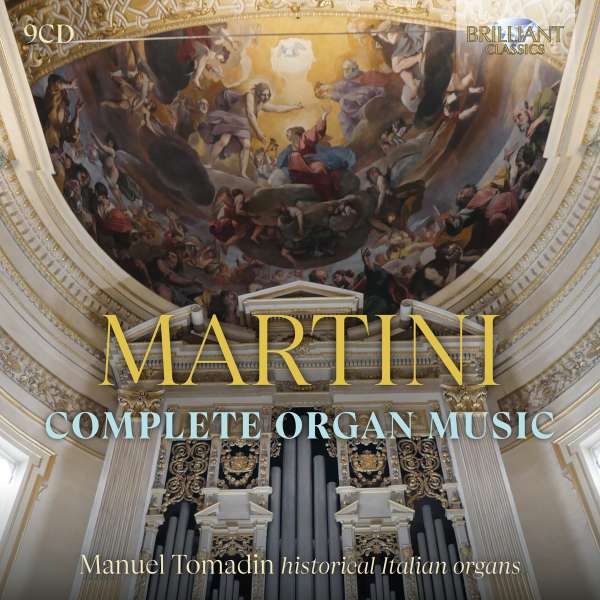
"After such a brief acquaintance, I have never loved a man more", wrote the English traveller Charles Burney, "and I felt after a conversation of a few hours just as little restraint towards him as towards an old friend or beloved brother". The young Mozart also had the privilege of enjoying his friendship: "I never cease to be sad that I am far removed from that one person in the world whom I love, adore and esteem most."
One writes about (and to) Giovanni Battista Martini (1706-1784), who at his death was called "Dio della musica de' nostri tempi" - the god of the music of our time. Born and raised in Bologna, he entered the Order at a young age and rarely left his native city, apparently due to his poor health.
His own music testifies to a lively spirit that mastered the conventions of the 18th century, but also displayed considerable stylistic variety, undoubtedly inspired by his erudition. His organ works are dominated by a series of 12 sonatas op. 2, some composed as French dance suites, others as Italian trio sonatas, which can easily be transposed between harpsichord and organ.
In addition, there are many individual shorter pieces for liturgical use, such as for the elevation of the host, the final blessing and the end of the mass, which Martini undoubtedly first performed himself in the church in Bologna, where he was uninterruptedly music director for almost 60 years. Around the specifically liturgical pieces, Manuel Tomadin arranges toccatas, allegros and "Pieni per organo" into nine concertos that span the entire stylistic spectrum of Martini's production and can be enjoyed independently of the others.
*If you make a purchase via the above link, we receive a small commission. This allows us to continue providing you with reviews and articles. By purchasing something via our link, you support us in writing new articles. Products will never be more expensive for you if you use our links.