
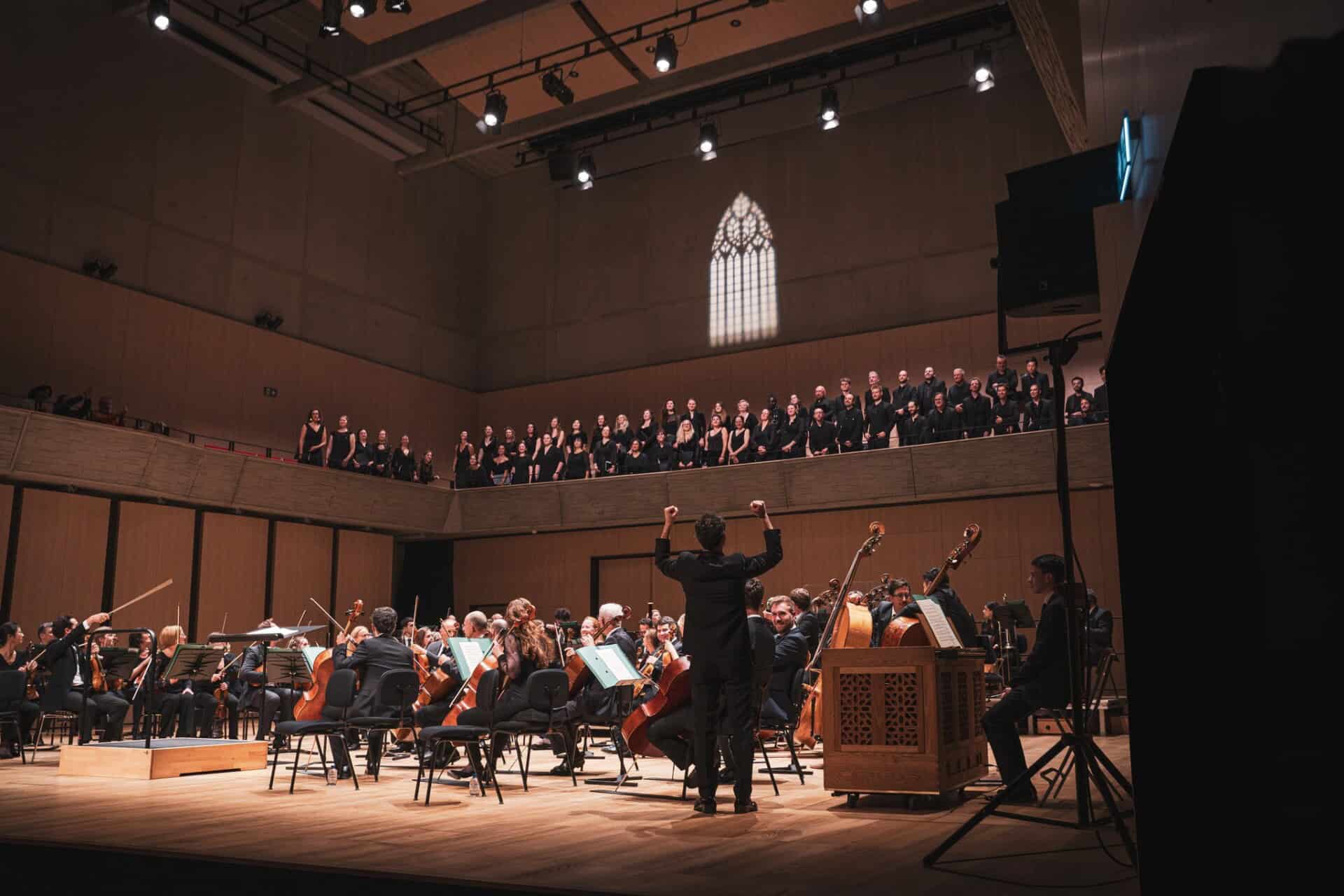
The Grand Manège in Namur is a very spacious and pleasant concert hall with a particularly rich and varied programme that appeals to enthusiasts of Renaissance and Baroque to contemporary classical music. The programme includes a mix of instrumental and vocal performances, making each event a unique experience. As the home of the prestigious Festival Musical de Namur, the hall also welcomes international top artists annually, further strengthening the cultural offering and attracting music lovers from all over Belgium and beyond. The Choeur de Chambre de Namur, the Capella Mediterranea, and the Argentine top conductor and 'ambassador' of Namur Leonardo García Alarcón are welcome guests here who can always count on a full house.
Although the car park next to the building is heavily used and often full, there are several public car parks within walking distance in the centre of Namur. On the very accessible Grand Manège website, visitors will find not only a very wide musical offering, but also plenty of information about parking spaces and accessibility.
The reception always runs smoothly and professionally, even with a large influx of visitors. Helpful stewards are on hand to show visitors to their seats or provide assistance to those who are less mobile. The comfortable seating with generous legroom also ensures a relaxed concert experience.
The concerts in this hall alone make a trip to the beautiful city of Namur well worth the effort.
One of the many concerts not to be missed at the Grand Manège is the performance of Acis et Galatée (Acis and Galatea, HWV 49) by Georg Friedrich Händel on Thursday 20 March 2025. This masterpiece by Händel, originally composed in 1718, is a pastoral opera that tells the tragic, mythological love story between the shepherd Acis and the nymph Galatea. Händel composed this version of Acis and Galatea during his stay at the estate of Cannons, on the outskirts of London, where he worked at the commission of James Brydges, the later Duke of Chandos.
After the original version of Acis and Galatea from 1718, Händel later created two new versions of this work: a second in 1732 and a third in 1739. It is interesting to note that Mozart also made an arrangement of the piece in 1788!
During the concert at the Grand Manège, the first, original version will be performed, in which Händel brings his pastoral inspiration to full expression. The piece opens joyfully with an overture and the cheerful Oh, The Pleasure Of The Plains, a hymn to the beauty and serenity of pastoral life. In this landscape we find the shepherd Acis, silently in love with the nymph Galatea, who is also in love with the shepherd. Halfway through the story they finally confess their love to each other, which they celebrate in the exuberant duet Happy We!
However, the mood shifts with the dramatic Wretched Lovers, in which the chorus warns them of the impending disaster, Polyphemus, a Cyclops who has set his sights on the beautiful Galatea. As Acis and Galatea sing their love in the beautiful duet The Flocks Shall Leave The Mountains, Polyphemus' jealousy grows into a terrible hatred. In a fit of rage and envy, he crushes Acis under a boulder, marking the tragic turning point of the story.
Deeply grieved and urged on by the chorus who remind her of her magical powers, Galatea decides to grant Acis eternal life by transforming him into a fountain. This brings him immortality, but the price is high: Galatea will never again be able to be close to her beloved. Despite the tragedy that marks the second part, the work ends with Galatea Dry Thy Tears, a comforting celebration of Acis' eternal life, an ode to immortal love.
The work, written in a charming, playful style, is considered one of Händel's most beloved English compositions and reflects the elegance and refinement of English Baroque.
In the intimate and perfectly balanced acoustics of the Grand Manège, this performance promises to be a highlight for lovers of Händel and Baroque music in general.