
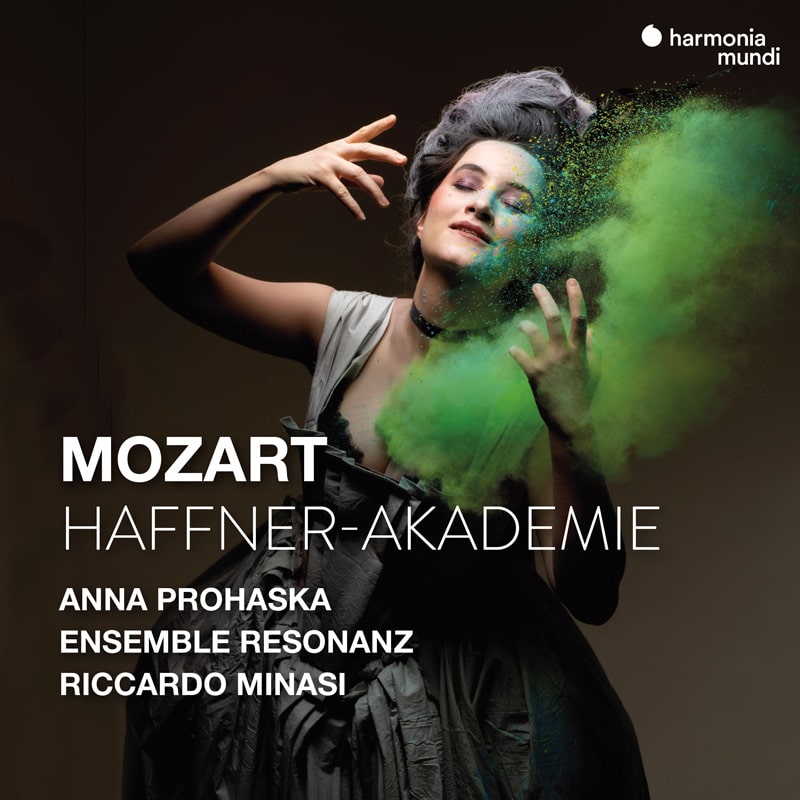
The new recording Haffner-Akademie, released by Anna Prohaska, Ensemble Resonanz and conductor Riccardo Minasi, aims to show more than the familiar image of Wolfgang Amadeus Mozart (1756–1791). Through thorough source research and a well-considered selection, this album offers a layered insight into the final ten years of Mozart's composing — a period in which he navigates between opera seria, Sturm und Drang and the early seeds of romantic opera.
From the first fragment, Giunse alfin il momento from Le nozze di Figaro (1786), Anna Prohaska lets her warm, brassy timbre be heard. Her light, buoyant singing suits the lyrical character of this recitative-aria well, yet her interpretation lacks something of the emphatic drama this passage demands. She also seems to hurry at times: words slip as it were from her hands. Yet the aria that follows convinces — performed at a quicker tempo than, for example, Cecilia Bartoli with Barenboim and the Berliner Philharmoniker — through a subtle swing, beautiful woodwinds and the elegant phrasing in which Mozart's musical language fully comes into its own.
In Così fan tutte (1790) Prohaska shows a more powerful side. Her interpretation of Come scoglio (track 4) calls for a certain dramatic presence and although her phrasing could be sharper at moments, she impresses with her vocal suppleness. Her voice sounds like a bell, even in the virtuosic runs, and her eye for detail — the colour shadings, articulation and text interpretation — testifies to great musicality and deep textual insight.
As Elettra in Idomeneo (1781) Prohaska has ample room to express the frustration, anger and despair of the character explosively. Her singing approaches the panic at moments, without losing its control. Ensemble Resonanz, under Minasi, accompanies here with a powerful, almost symphonic sound, making the ensemble sound larger than it actually is.
Besides the opera fragments, the album also contains an instrumental work: the Haffner Symphony (KV 385), composed in 1782. This piece presents a totally different face of the ensemble. In the opening movement, Allegro con spirito (track 9), the musicians play with an energy that sometimes crosses the border of the expressive and produces a somewhat sharp tone. But their enthusiasm is unmistakable.
Earlier, reviewer Jonah Pearl noted in the recording of Mozart's Symphonies 39 to 41 that Ensemble Resonanz works with historical wind and percussion instruments, but modern strings. In this recording too, that unique sound palette stands out. The slow second movement, Andante (track 10), forms a nice contrast with the fiery opening and shows how the musicians also approach a historical playing style with the strings. The final movement, Presto (track 11), is undoubtedly the highlight of the symphony: spicy, complex, but coordinated to perfection. The precision and the pleasure of ensemble playing between Minasi and the ensemble are audible in every measure.
The cd comes with accompanying texts by Gabriele Riccebono, which are clear and substantively strong. Unfortunately, the small font size and compact layout make reading less comfortable. Fortunately, neither the original texts nor their translations are missing.
Haffner-Akademie transcends the classic "best of" format. It is a carefully constructed programme in which Anna Prohaska demonstrates her versatility and Ensemble Resonanz, under Minasi's driven leadership, re-draws Mozart in fresh, nuanced colours. For every Mozart lover, this recording is a valuable addition to the collection.