
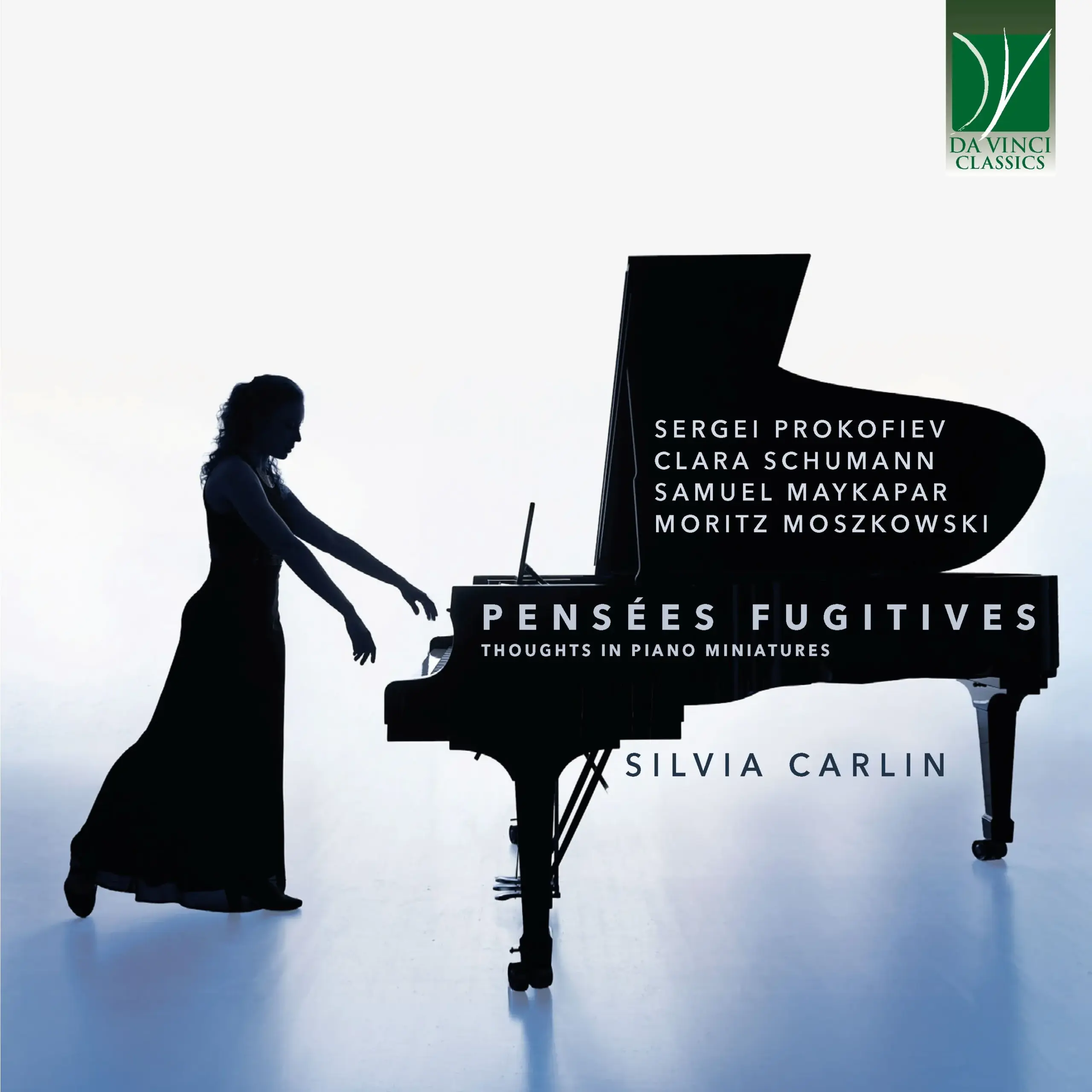
There are programmes that lend themselves to a simple enumeration of works, and there are programmes that start from an idea. This is one of those. Silvia Carlin has not simply brought together four composers who "did something with miniatures", but has sought the common denominator of the word fugitif itself: fleeting, transient, temporary. That could easily have remained merely a programmatic concept. However, anyone who listens to the cd will notice that the idea does indeed take root musically. This is not just a collection of short pieces, but a considered reflection on what a miniature actually is, and why composers in the nineteenth and early twentieth centuries so often resorted to it: not as a small genre, but as a concentrated form in which every note takes on meaning.
The focal point
The Visions fugitives op. 22 form the heart of this cd not by chance. Twenty little pieces, written between 1915 and 1917, at the turning point between the early, angular modernism of Sergei Prokofiev (1891-1953) and his later, more restrained, introspective style. The title refers to verses by the symbolist poet Konstantin Balmont, in which the idea is central that no truth is absolute and man must content himself with fleeting impressions. Prokofiev never presented the twenty miniatures explicitly as an inseparable cycle – during recitals he usually played only a selection. The order in which they were published nonetheless reveals a carefully constructed dramaturgy.
What makes Carlin's performance remarkable is that she takes that dramaturgy seriously. The first ten numbers still allow room for levity. No. V (Molto giocoso), in which something of playing children resonates, or no. X (Ridicolosamente), a real joke in notes, sound in her interpretation precisely as witty as the marking promises, without becoming caricatural. From the second half of the cycle onwards, however, the musical landscape changes, and you hear that immediately. No. XII (Assai moderato) is essentially a waltz, but a waltz that seems to have completely lost its danceability – it is more reminiscent of the endless, monotonous tread of the hurdy-gurdy player from Schubert's Winterreise than of a salon. Carlin plays this piece with a noticeable restraint in tempo and dynamics, as if she is deliberately letting the waltz grind to a halt.
The last three miniatures form the emotional focal point of the cycle, and Carlin treats them accordingly. In no. XVIII (Con una dolce lentezza) something resonates that is reminiscent of a danse macabre: elegant, but at the same time sinister. No. XIX (Presto agitatissimo e molto accentuato) takes on an almost physical urgency in her hands. Some have later wanted to hear in this music an echo of the revolutionary unrest that would soon overwhelm Russia; whether Prokofiev intended it that way himself, of course remains the question. Carlin lets that tension emerge mainly from the music itself, without her approach ever becoming hard or uncontrolled. Then comes no. XX (Lento): a hushed, almost empty landscape after the storm, smoke and rubble where something once stood. Carlin lets this piece fade away rather than close it off, and that is precisely the right choice.
Intimacy with a surprise
The four Pièces fugitives op. 15 by Clara Schumann (1819-1896), written in 1840, shortly after her marriage to Robert, form a very different kind of miniature: not diary fragments, but salon pieces that deliberately elude a predictable form. The order alone surprises: an intimate Larghetto, followed by an agitated Un poco agitato, then an Andante espressivo that hovers between nocturne and chorale, finally ending with a Scherzo – a form you would more likely expect in the middle of a sonata than as the conclusion of a cycle.
Carlin emphasizes that element of surprise not through grand effects, but through her natural phrasing. She plays the Andante espressivo with a warm, almost vocal line that gives it something aria-like about it, after which the concluding Scherzo appears as an unexpected flash of light. At the same time, she shows that Clara Schumann was much more than the gifted wife of Robert: behind the familiar romantic language lies a composer with a remarkably distinctive sense of lyricism, timing and formal design. Moreover, they are pieces that are musically intriguing miniatures that deserve much more recognition. Carlin brings them with an effortless elegance and shows how fresh, original and surprisingly contemporary this music still sounds.
Two approaches to the same genre
What is also interesting about this programme is how it shows the term Pensées fugitives itself as a nineteenth-century genre concept, whereby two composers deal with it in totally different ways. The nowadays scarcely played Samuil Maykapar (1867-1938) wrote two series, op. 11 (of which unfortunately not everything was preserved) and op. 23, and thinks decidedly cyclically: the first piece functions as a prologue, the last as an epilogue in which previously heard material returns and the entire series takes on a closed form. This creates the feeling that loose thoughts come together again at the end. They are, each and every one, little pearls that in themselves already make this cd worthwhile and that raise the question of why Maykapar's piano music appears on music stands so rarely. Carlin brings that internal coherence nicely to the fore, so that the miniatures do not present themselves as loose ideas, but as parts of a carefully constructed cycle. More than that: she audibly believes in this music. Without making them larger than they are, she gives each miniature its own lustre, so that one jewel after another unfolds. For many listeners, these miniatures will undoubtedly be an equally surprising discovery.
Moritz Moszkowski (1854-1925) then chooses a very different approach. He too has somewhat faded into the background today, although around the turn of the century he was one of the most popular piano composers in Europe. His three Pensées fugitives op. 66 do not form a cohesive cycle, but three independent character pieces: the first hunted and virtuosic, the second airy and playful, the third – especially in the middle section – decidedly lyrical. While Maykapar invites the listener to discover a larger whole, Moszkowski shows how rich and versatile the miniature can be as an independent genre. Carlin makes that difference convincingly audible. She gives each piece a pronounced character of its own, without losing sight of the stylistic unity of the programme. It is precisely in this that one of the great qualities of this recording resides: four composers each speak their own musical language, but Carlin knows how to make one convincing story out of it.
The art of the small
What ultimately makes this cd so intriguing is not only the intelligence of the programme – and it is there, unmistakably – but above all the quality of the piano playing. Carlin, trained by Filippo Gamba in Basel and Alexandar Madžar in Hamburg, among others, has a transparent touch without ever sounding dry, and a fine sense of timing. It is precisely in such concentrated miniatures that a pianist shows how much character, tension and poetry can be contained in a few minutes of music. Miniatures do not tolerate an excess of gesture; they live or die by the right balance between sound and silence. Carlin forces nothing, pushes nothing through, and yet there is no flatness at any moment. On the contrary: it is precisely in the smallest dynamic nuances that the character of her playing reveals itself.
This is not a cd you let play thoughtlessly in the background. It demands attention to detail and rewards that attention. Those who already know Prokofiev's Visions fugitives in larger, more extroverted interpretations will discover here a more introspective, almost literary reading. Those who have little or no acquaintance with Clara Schumann, Maykapar and Moszkowski will at the same time gain an excellent and carefully constructed introduction to repertoire that deserves to be heard much more often.
Like the miniatures themselves, this recording too reveals its true meaning only gradually. The more fleeting this music presents itself on first hearing, the longer it lingers on.