
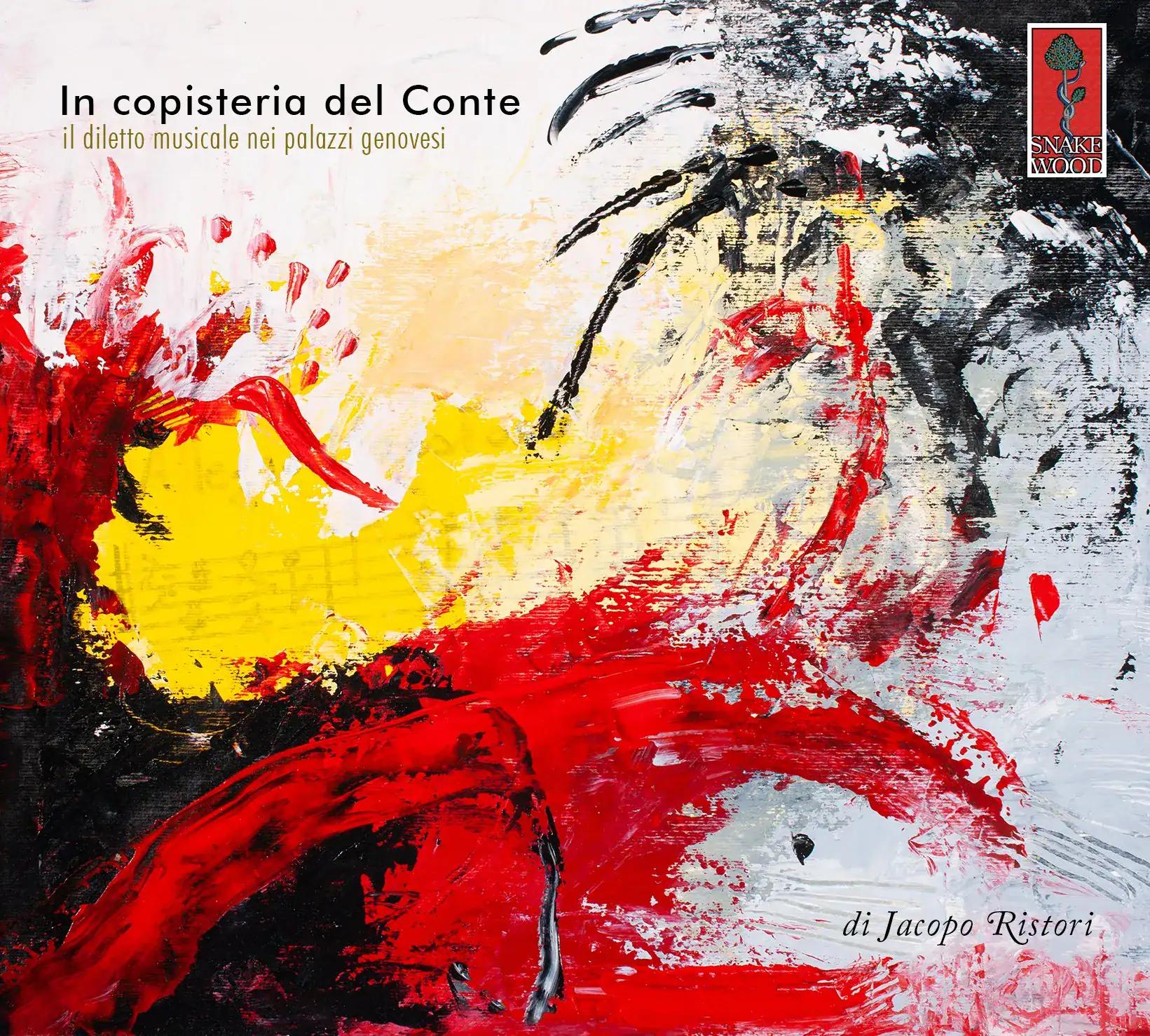
In copisteria del Conte – Il diletto musicale nei palazzi genovesi (Snakewood Editions, SCD202401) forms a fascinating musical journey of discovery along lesser-traveled paths of eighteenth-century Italian musical practice. The project, devised and led by cellist Jacopo Ristori, is dedicated to the repertoire choices from the music collection of Count Federico Taccoli (ca. 1727–1809), who fulfilled a unique role in Genoa as a copyist in the cultural life of the city. Rather than limiting himself to Genoese composers or local styles, Ristori opted for a broader, documentary-inspired approach: reconstructing musical practice as it unfolded in Genoese salons, with Taccoli as a central figure.
The copyist as curator
In the eighteenth century, Genoa was not a center of music printing like Amsterdam, Paris, or London. For the elite who wished to play music, the copying practice of figures such as Taccoli offered an alternative: manuscripts of foreign editions or unique collections circulated through his workshop. Taccoli, who was himself a nobleman and, according to Genoese musicologist Davide Mingozzi, an eccentric and rather unsympathetic character, supplied music to the music lovers of his time. His carefully copied scores — nowadays preserved in the library of the Conservatorio Paganini — form the starting point for this double cd, which contains exclusively works that have not appeared on cd before, with one exception.
A kaleidoscope of styles
Although the repertoire is geographically widely dispersed — from Naples to Parma and Paris — the underlying logic remains strong: all works come from Taccoli's practice. The result is a rich and varied program in which the sound palette of the second half of the eighteenth century resonates with surprising vibrancy.
One of the most striking choices is the recording of two sonatas by the virtually unknown Gasparo Arnaldi, composed for an unusual combination of psaltery, violin, and cello. The psaltery, a trapezoid-shaped stringed instrument related to the hackbrett, played an important role in Italy at that time, but is rarely heard today. Anna Pontz brings the instrument to life here with subtlety and clear timbre. Arnaldi's sonatas are intimate and playful, a sonorous curiosity that tickles the ear and conquers the heart.
Cello works form the core of this edition, which is hardly surprising given Ristori's specialization. Luigi Boccherini (1743–1805), the best-known name on the program, is represented with a Sonata in F (G 579) and a Sonata for two cellos in D (G 571). Particularly striking in the first sonata is the choice of double bass as basso continuo: a nod to Boccherini's father, a double bassist with whom he performed together in Genoa.
Two more cello duets — titled Gara — are by Carlo Ferrari (1714–1790), a poorly documented but evidently gifted composer. The title Gara, which means 'competition' or 'duel', suggests virtuosic interplay between the two voices, although technical acrobatics are carefully avoided. This music is written for experienced amateurs: elegant, lively, and perfectly balanced.
The Neapolitan Michele Gallucci, likewise a name absent from the major music encyclopedias, opens the album with a refined Sonata in D for cello and basso continuo. The structure with rondo as the closing section and a singing central movement is representative of the galant idiom of the period.
Not only the cello receives a prominent place: the violin also comes into view with two duets by Emanuele Barbella (1718–1777). This Neapolitan violinist and composer, student of Leonardo Leo among others, was active at the Teatro San Carlo and wrote countless pieces for unaccompanied violin. The two sonatas recorded here — in F and G — are graceful, melodic, and well-constructed, giving violinists Antoinette Lohmann and Sara de Vries ample opportunity to display their collaboration.
The Hoffmeister-Nardini puzzle
Particularly fascinating is the presence of two string quartets that were initially attributed to Pietro Nardini, but are nowadays assumed to be by Franz Anton Hoffmeister (1754–1812). The confusion may be due to Taccoli himself, who for commercial reasons may have used Nardini's name — a well-known figure in Italy and student of Tartini — to make his copies more attractive. Apart from the authorship question, these quartets are lively, classical in structure, and performed with particular elegance by the Gut String Quartet.
Ensemble and performance
The ensemble consists of both established names and young, promising musicians. Antoinette Lohmann, Sara de Vries, Viola de Hoog, Jesse Solway, and theorbo player Earl Christy form, together with Ristori, a homogeneous whole. The performances testify to both historical knowledge and artistic flair. The articulation is nuanced, the phrasing sparkling, and the recording quality is clear and spacious. Also noteworthy is that each work is approached with care, however obscure the composer may be.
This project transcends the merely musical: it is a small piece of cultural archaeology that provides insight into musical practices in eighteenth-century Italy — a period often overshadowed by the great figures of the baroque and romanticism. At the same time, it is an ode to the non-professional music lovers of that time, who with dedication and passion played music in salons and private circles.
With In copisteria del Conte Ristori proves that musical archaeology need not be dusty. On the contrary: it is vibrant, surprising and above all enriching. This is an album that sparks curiosity, delights the ear and invites repeated listening. A real recommendation for lovers of the galant period, cello music and musical discoveries.