
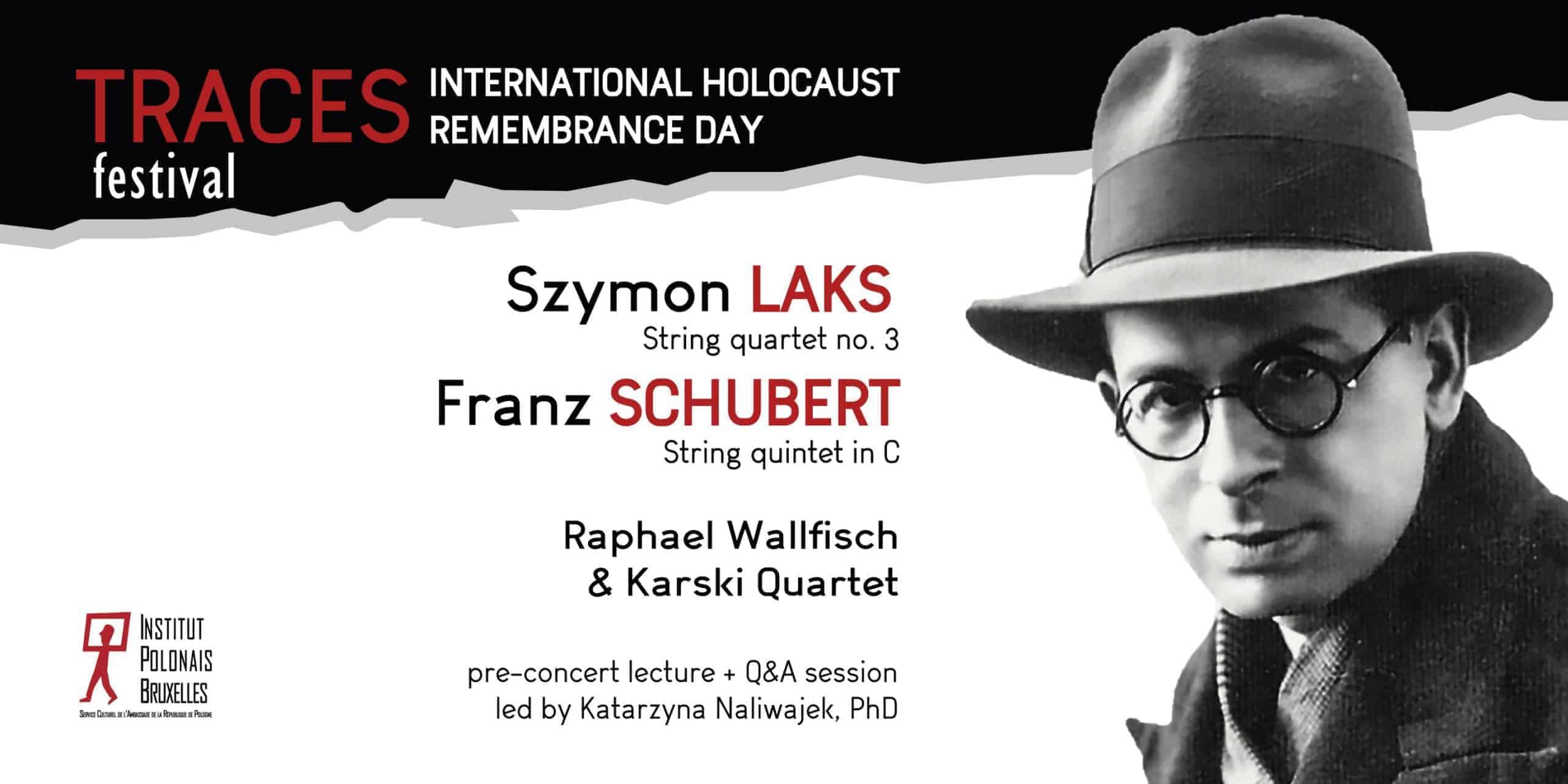
27 January 1945: when the concentration and extermination camps of Auschwitz are liberated by Soviet-Russian troops, a former 'kapelmeister' of this dehumanizing place is waiting many hundreds of kilometres away for his own V-day. 29 April finally came. American army divisions put an end to the horrors in Dachau and surroundings in the following hours and days. From the camp in Landsberg, Szymon Laks could return to France, his adoptive country à venir. Art had not saved the world, and this Polish composer and violinist therefore not from deportation either – wars are after all decided by courage and repugnant weapons. But how many human lives do we ultimately owe to music?
It is a question that today, on this annual International Holocaust Remembrance Day, not only seems highly relevant, but also sounded particularly impressive. The United Nations had much to do with it, and so did Traces. The Brussels festival, founded in 2019 by violinist and musical detective Philippe Graffin, wants to breathe new life into chamber music repertoire that has been unjustly neglected. And between those folds of music history, many a victim of both the chilling Nazi terror and other equally abhorrent totalitarian regimes drowned. Some of these drowning victims barely survived their sad fate. Their memoirs were translated to the silver screen, think of Władysław Szpilman (1911-2000), the pianist from Roman Polanski's eponymous successful film (2002). Or their music is already making a noteworthy comeback, as in the case of Mieczysław Weinberg (1919-1996). For unlike his family, who were completely murdered in a gruesome way, this Russian composer of Polish-Jewish birth was spared from the hands of the advancing Third Reich. Only to be confronted with antisemitism in Soviet land. The death of Stalin on 5 March 1953 ultimately proved his unexpected salvation from the captivity he had been in since January of that year. Other 'degenerate' composers and musicians were unfortunately less fortunate. For many, the Second World War proved fatal. Some continue to resound in the name and repertoire of an ensemble: Pavel Haas, for example (1899-1944), an extraordinarily talented student of Janáček, who was rescued from oblivion by a highly acclaimed Czech string quartet. Or Gideon Klein (1919-1945), who like Haas was deported from the Theresienstadt ghetto to Auschwitz in October 1944, and who in recent years has found a London string trio of three young champions.
Folklore against forgetting
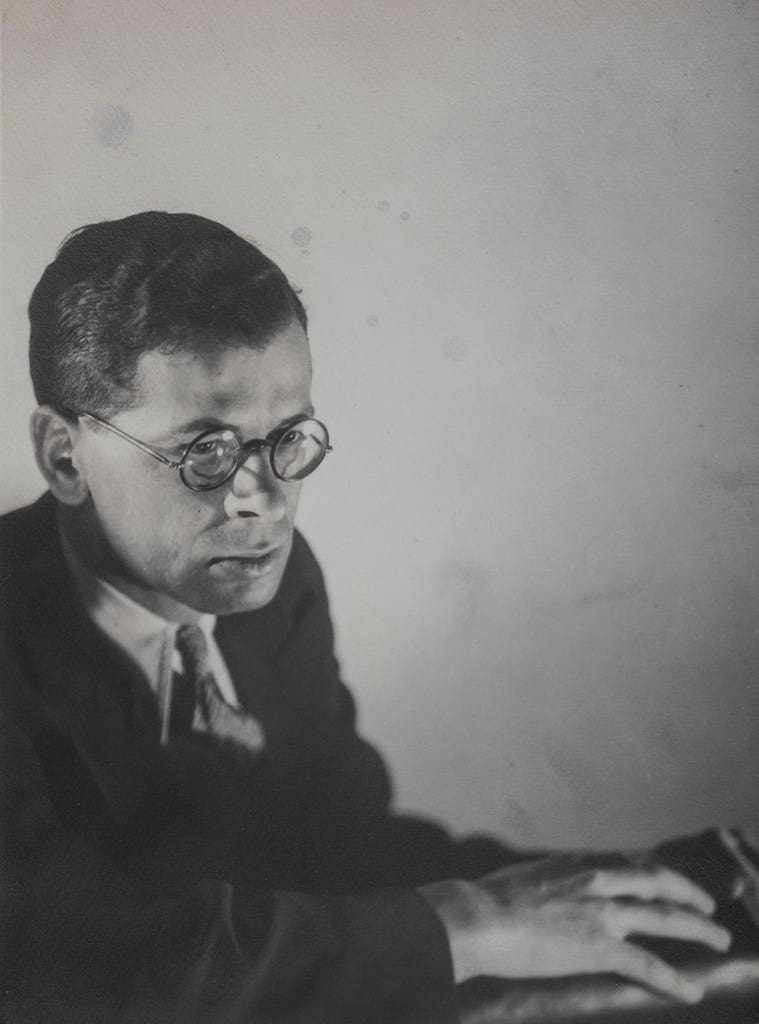
Someone for whom remembrance and actual revival could certainly use a bit more momentum is Szymon Laks. His third string quartet was on tonight's programme. But first the audience in the Royal Chapel – the former Court Chapel in the Palace of Charles of Lorraine, which was granted to Protestant worship by Napoleon in 1804 – received an introductory lecture by Dr. Katarzyna Naliwajek. The Polish musicologist outlined the remarkable journey her compatriot would undertake in the 20th century. Laks, born in Warsaw and from a family of assimilated Jews (1901), was initially trained as a mathematician, then threw himself into composing, before seeking his artistic fortune in Paris in 1926. He perfected his studies there at the conservatory, also worked as a conductor and was instrumental in founding the thriving Association des jeunes musiciens polonais. Jusqu'ici tout va bien so far… But the tide would turn in France, as we read in a first programme note: "There his musical creativity was violently halted on 14 May 1941, when he was arrested, detained in a transit camp in Pithiviers and on 19 July 1942 transported to Auschwitz II Birkenau, where he received number 49543", writes Naliwajek. An unreal number, that 49543, but fortunately behind it was a gifted violinist, arranger and orchestrator, who as 'Kapelmeister of Auschwitz' and with the help of some friends managed to save his neck. "There were four prisoner orchestras in the Auschwitz complex, whose primary task was to play lively marching melodies to facilitate the prisoners' departure for work and their return to the camp. Their duties also included giving concerts for SS men, usually on Sunday afternoons, and, with permission from the camp administration, for fellow prisoners", explains historian Jacek Lachendro in a second programme note about the orchestra in Birkenau (1942-1944). And the researcher, affiliated with the Auschwitz-Birkenau State Museum, adds among other things that this male ensemble was formed in August 1942, that the number of Jews gradually became predominant and by the summer of 1944 consisted of more than thirty musicians.
Szymon Laks was an all-rounder in music. Thanks to his "breathtaking" craftsmanship, he escaped a certain death, argues musicologist Frank Harders-Wuthenow in this interview. After his return to Paris on 18 May 1945, Laks, in a meticulous and principled manner, began to set down his experiences in the camps. To manuscript paper he entrusted a new string quartet, and also his first post-war creation – the first two copies were destroyed, along with the rest of his work at that time. In this third string quartet 'sur des motifs populaires polonais' the composer resolutely strikes an exuberant tone. It is contagious folklore against oblivion. The native folk music, forbidden by the Nazi rulers, makes a very striking, symbolic comeback here. The manner in which the Karski Quartet interpreted the four movements was equally remarkable. From the very beginning it seemed as if the Polish-Belgian ensemble had had this piece on their stands for years. Quod non, according to all involved. These Polish tunes are simply in our blood, joked the eldest of the twin sisters Kotarba afterwards.
And so the Allegro quasi presto sounded inspired, but always in consultation, without becoming impetuous. There was great unity of thought and action, and both the balance and the dynamics benefited from this. Following a series of powerful organ points came the subdued Poco lento, the longest movement and at the same time also the only true moment of stillness. Intense ensemble playing, without much embellishment – read: vibrato, alternated with a poignant theme on the viola and the fragile sound of both violinists: a steady but especially exhausting march that ended with an ironic sigh. The revival came quickly enough, in the form of a delightfully plucked and clearly accented scherzo (Vivace non troppo). It proved to be music with the rhythmic allures of a Debussy and Ravel, who had employed a comparable idiom in their string quartets. Short, lyrical trios were then played with visible pleasure, while the bass continued to resonate nicely before diving into the finale. The hymnic Allegro moderato was the only movement that, once the quartet got up to speed, at times held together less well. The boundary between gripping and being gripped, and between stamping or rather lumbering, became thinner as it progressed, but that did not detract one bit from the energy with which Laks was defended with fire and bow.
This third quartet formed the basis for a piano quintet in 1967. A suggestion for the next edition of the Traces Festival?
[caption id="attachment_27915" align="aligncenter" width="1024"]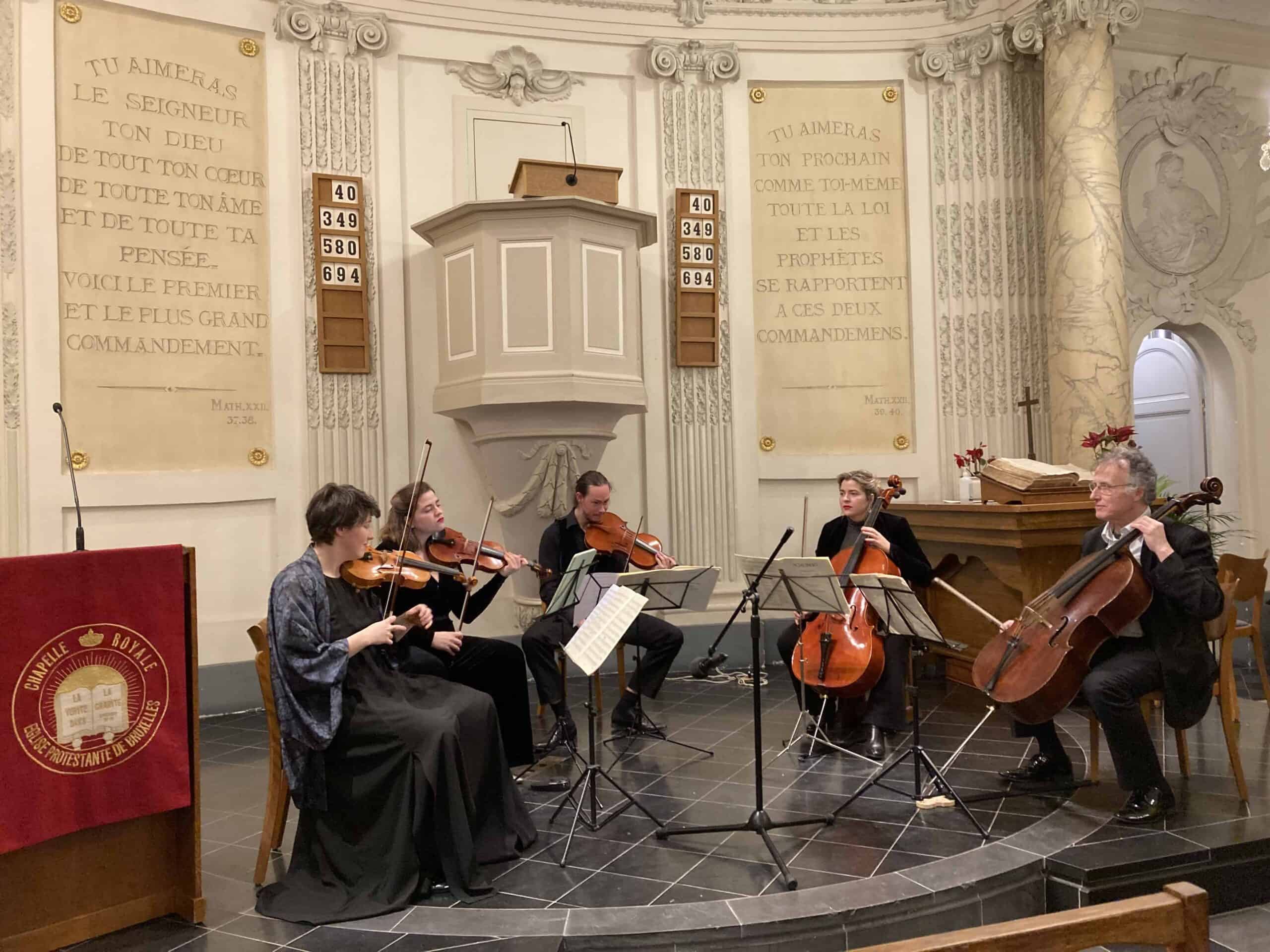 © Klassiek Centraal[/caption]
Fugue of Death
After the interval, the Karski Quartet received reinforcement from Raphael Wallfisch. Together with the renowned British cellist, whose mother survived the Shoah as a member of the Birkenau women's orchestra, the musicians ventured into Schubert's imposing string quintet (1828): one of the most grandiose chamber music works ever written, and belonging to the 'Musiques d'un autre monde' – to quote the original title of Laks's memoirs. With its heavenly length, and the equally moving and compelling Adagio, this quintet fitted perfectly with a commemorative day such as this one. After the ultimate climax of the rousing finale (Più allegro) had been brought to a close by way of a successful contrast with a prolonged morendo, a small addition imposed itself on the commandment displayed on the wall behind the ensemble. 'Tu aimeras ton prochain comme toi-même…', we read in the Gospel of Matthew. 'Et la musique de Schubert encore plus!', the church and concert goers affirmed in chorus with a standing ovation.
On this 27th January 2022, we were fortunately not only reflecting on the persecution of the Jews. We also celebrated happier events. Such as Mozart's birthday, of course, and this year also the start of Poetry Week in the Netherlands and Flanders. Poetry Day, music and memories of the Holocaust come together nowhere as powerfully as in Todesfuge by poet Paul Celan (1920-1970). A few verses from Fugue of Death, translated by Ton Naaijkens, thus form, together with a beautiful Allegro con spirito by the timeless Amadé, an appropriate farewell:
Er ruft spielt süßer den Tod der Tod ist ein Meister aus Deutschland
er ruft streicht dunkler die Geigen dann steigt ihr als Rauch in die Luft
dann habt ihr ein Grab in den Wolken da liegt man nicht eng
He calls play sweeter death death is a master from Germany
he calls draw darker the strings then you rise as smoke into the air
then you have a grave in the clouds there you do not lie tight
WHO: Karski Quartet [Kaja Nowak (violin), Natalia Kotarba (violin), Diede Verpoest (viola), Julia Kotarba (cello)] – Raphael Wallfisch (cello)
WHAT: Szymon Laks (1901-1983) – String Quartet No. 3 'sur des motifs populaires polonais' || Franz Schubert (1797-1828) – String Quintet in C (D 956)
WHERE: Koninklijke (Hof)kapel – Protestantse Kerk van Brussel
WHEN: Thursday 27 January 2022
PHOTOS: © Traces Festival, Archiv André Laks, Klassiek Centraal
ORGANISATION: Traces, Chamber Music Festival in Brussels in collaboration with the Polish Institute Brussels