
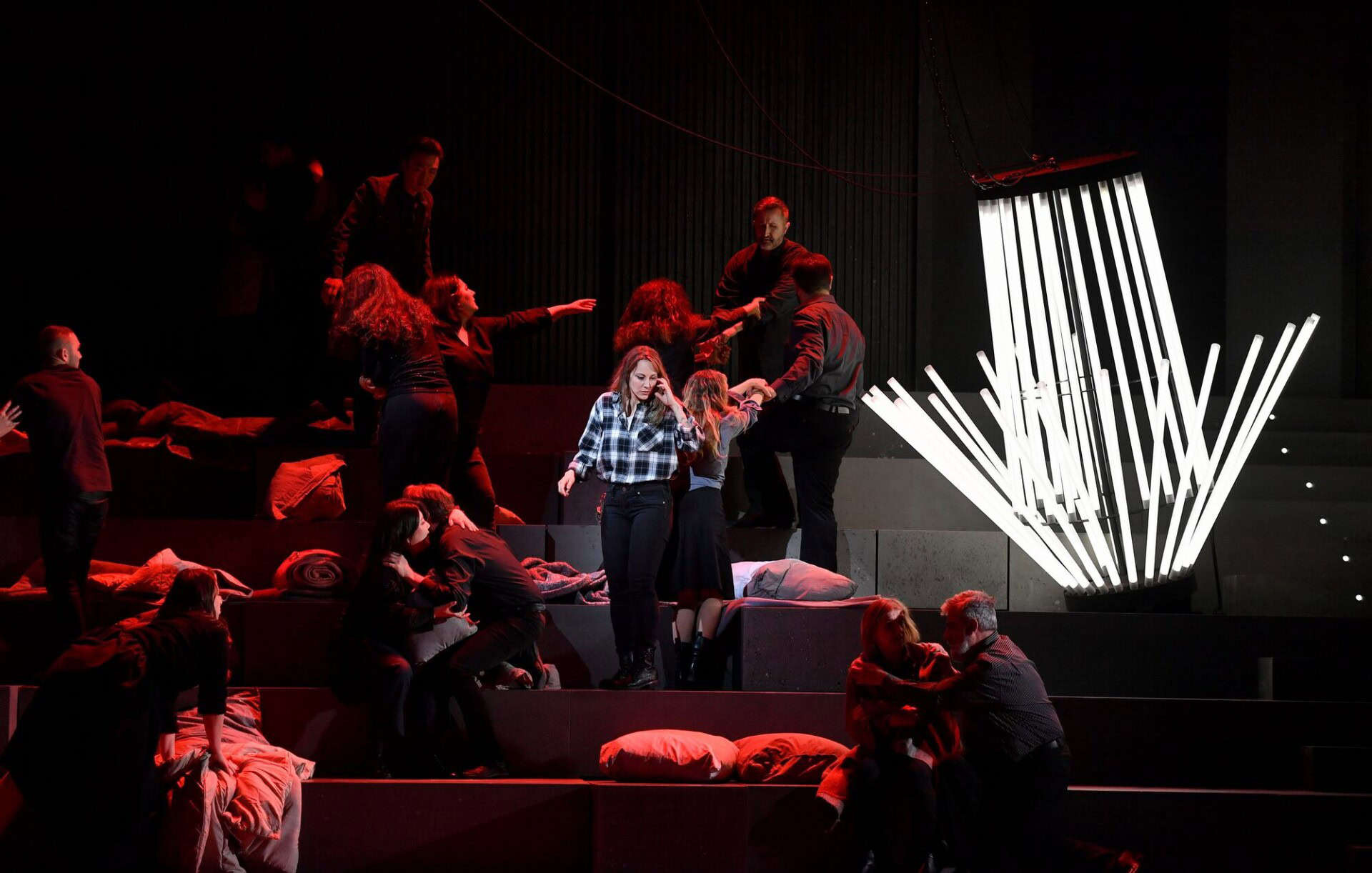
Belgian premiere of a timeless masterpiece inspired by contemporary tragedies.
The timeless opera Iphigénie en Tauride by Christoph Willibald Gluck experiences its Belgian premiere on 25 October at Opera Antwerpen. Under the musical direction of maestro Benjamin Bayl and directed by young Spanish director Rafael R. Villalobos, this revolutionary work is being brought to the Belgian stage for the first time. An opera that not only illuminates the mythological themes of Greek tragedy, but also receives a contemporary interpretation through Villalobos' reference to the current war in Ukraine.
A tragic myth in a war zone
Director Rafael R. Villalobos drew inspiration from a contemporary tragedy for this production. The bombing of the Drama Theatre in Mariupol, Ukraine in 2022 was an event that deeply moved Villalobos. He found a direct link between ancient Tauris, mentioned in the title of Gluck's opera, and the current region of Crimea, where war still rages. Villalobos' vision places the myth of Iphigenia in a modern context: a theatre that serves as a refuge for the inhabitants of Tauris, threatened by war outside its walls. This creates a striking parallel with the dramatic events in Mariupol, where 1,300 people sheltered from Russian bombardment in the Donetsk Drama Theatre. When this building was destroyed, an estimated 600 civilians lost their lives.
The story of Iphigénie en Tauride
In Iphigénie en Tauride we follow the Greek priestess Iphigenia, who was saved from sacrificial death by the goddess Diana and now serves as a priestess in the remote Tauris. There, King Thoas commands that all strangers must be sacrificed to Diana. When Iphigenia discovers that the next strangers are her brother Orestes and his friend Pylades – though she does not recognize them immediately – a tragic dilemma ensues. Orestes is pursued by guilt and the vengeful Furies after he murdered his mother Clytemnestra. Although he longs to die to escape his inner torments, Iphigenia feels a special kinship and wishes to send him to Greece to inform her sister Electra of her existence. Ultimately, the goddess Diana offers redemption: Orestes is forgiven and brother and sister are freed from the curse that has plagued their family, so that they can finally return to Mycenae.
Villalobos' direction: Theatre within a theatre
Young director Rafael R. Villalobos makes his debut with Opera Ballet Vlaanderen with this production and approaches the opera as a "theatre within a theatre". The play takes place within the safe walls of a theatre where the inhabitants of Tauris seek shelter from the cruelties outside. This directorial choice gives the story an extra layer of meaning and relevance, referring to the disruption of the arts in times of war. Villalobos saw the bombing in Mariupol not only as an assault on humanity, but also as an attack on art itself.
Gluck's revolutionary music
Iphigénie en Tauride will be a discovery for many, even for seasoned opera lovers. The opera is rarely seen in a complete staged performance, but has been gaining attention in recent years. Gluck, who was known for his striving for innovation within the opera genre, breaks with the conventions of opera seria in this score. He aimed for a continuous dramatic line, in which recitatives, arias and choral parts flow seamlessly into one another. No excessive musical ornamentation, but intense dramatic scenes that give voice to the inner emotional world of the characters. This innovative approach paved the way for classical music and makes Iphigénie en Tauride a work of lasting value.
The musical direction lies in the hands of Benjamin Bayl, who has previously conducted Idomeneo with great success and specializes in the work of Gluck. He will guide the Symphonic Orchestra and Choir of Opera Ballet Vlaanderen through this complex score.
An outstanding cast
The cast of this production is impressive. Michèle Losier, the French-Canadian soprano, makes her house debut as Iphigenia. Kartal Karagedik, previously seen as Almaviva in Le nozze di Figaro, brings the tormented Orestes to life. Belgian tenor Reinoud van Mechelen needs little introduction and performs the role of Pylades. Wolfgang Stefan Schwaiger, known as Dr. Falke in Die Fledermaus, takes on the role of the tyrannical Thoas. Lucy Gibbs, the young British mezzo-soprano, embodies the goddess Diana. Additionally, Vincent van der Valk and Pleun van Engelen perform some fragments from the Oresteia in Dutch, in the added spoken roles of Agamemnon and Clytemnestra.
Please note: this rare and special title can only be seen at Opera Antwerpen and is a unique opportunity to experience Gluck's revolutionary opera in a modern, deeply felt interpretation. A must for every opera lover!