
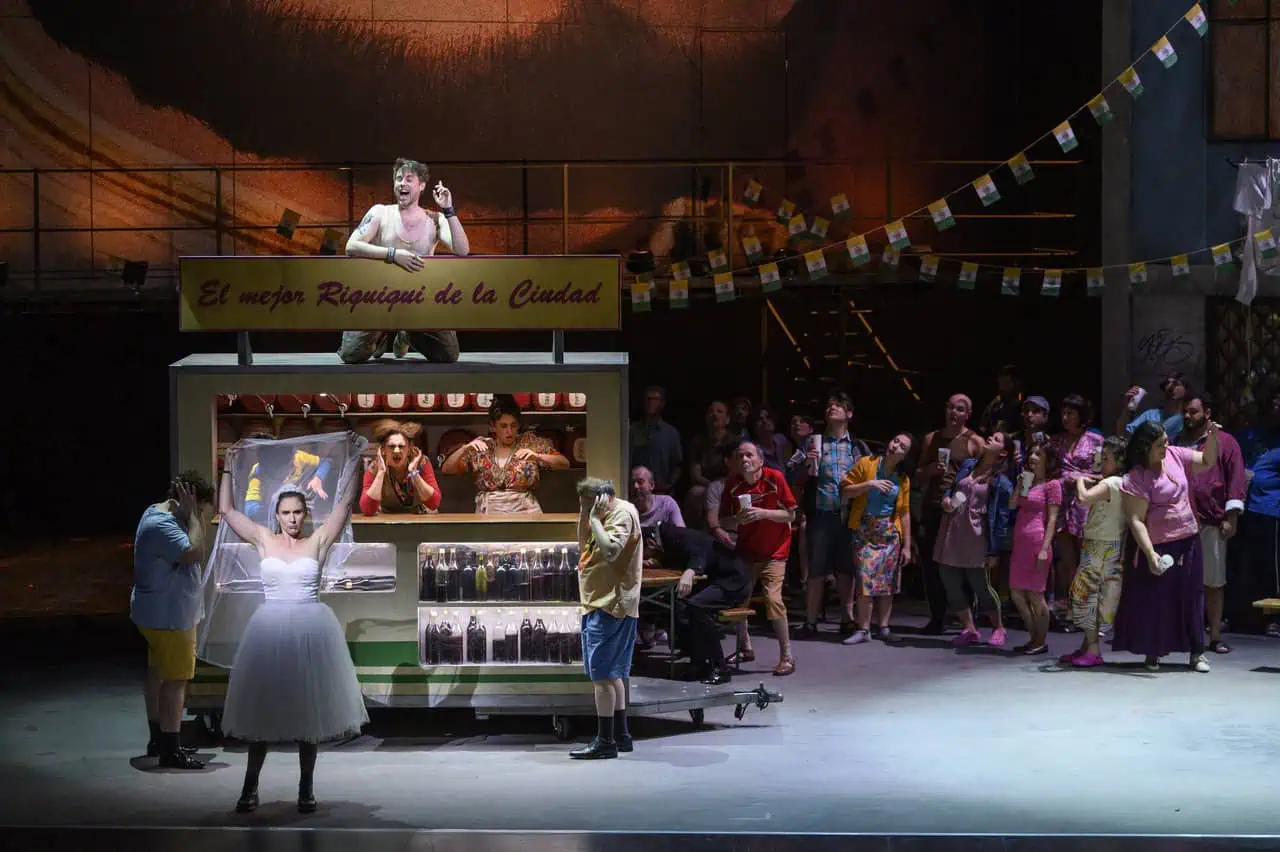
As a year-end production, La Périchole, an Opéra Bouffe by Jacques Offenbach, promises plenty of cheerfulness. We get it in abundance at the Opéra Royal de Wallonie, especially with Laurent Pelly directing. At the same time, he does not lose sight of the finesse of Offenbach's satire!
The operetta La Périchole is set in Lima in Peru. On the square, the celebration of Viceroy Don Andres de Ribeira is being celebrated. The "Trois cousines" are present with their stall with all sorts of – mostly strong – drinks. The king and some of his confidants have mingled incognito among the people. Two street singers arrive, La Périchole and her beloved Piquillo. They don't earn much, and exhausted, Périchole falls asleep, while Piquillo goes out to find food. The viceroy discovers the sleeping Périchole and falls head over heels in love with her. She becomes his mistress but this is the beginning of a series of confusions and masquerades. Piquillo even ends up in prison when he resists the viceroy. But ultimately the story ends with a happy ending. The viceroy is gently put in his place (even briefly in prison) and Piquillo and Périchole are cheered as bride and bridegroom by villagers and courtiers.
We get the typical Offenbach characteristics with the social stratification, the "ordinary" people, the outsiders and the upper class. The decadent aristocracy is gently but clearly mocked. Offenbach's sharp observation pervades his theatre here, as always.
Laurent Pelly is the perfect director to stage this kind of comic work with an undercurrent of irony. Completely in the spirit of the Second Empire in which Jacques Offenbach situated his "Opérette à la française", there is merry laughter, but at the same time the excesses and decadence of the bourgeoisie are put on display. But La Périchole also has its sentimental content, because when the enamoured couple find each other again after all the foolish complications, the finale bubbles over with happiness.
On the stage of the ORW, the villagers are a colourful bunch of jolly party-goers, the status of viceroy is ridiculed from the outset by his silly outfit with wig and his pompous appearance. Lionel Lhote feels completely at home! Each character receives a typical caricatural portrayal that fits the story. Thus La Périchole transforms from the initially impoverished but self-assured street singer into a chic, elegant lady as mistress of the viceroy. Strengthened by clever experiences, she returns to her original status.
The performers fully engage with the wild story. They act and sing with commitment. Antoinette Dennefeld moves as Périchole, charms as a lady and varies her sensual style depending on the situation in which she appears. She sings with a clear sparkling soprano that also expresses the finesse of the irony. Pierre Derhet's soft tenor does not prevent him from coming across convincingly and fighting for his Périchole. His tenderness is touching. Lionel Lhote proves that a comic role like this blasé viceroy suits him too. He clearly enjoys the various aspects of his part and his baritone sounds perfect as always. The smaller parts and certainly the chorus are completely immersed in their performance.
Clelia Cafiero makes her debut with the Orchestre Opéra Royal de Wallonie. The young conductor makes a good impression with her lively and precise conducting style, guiding her musicians through the light yet refined score.
The performance ended with a few extras presented as year-end wishes, playing into the exuberant mood of the satisfied audience.