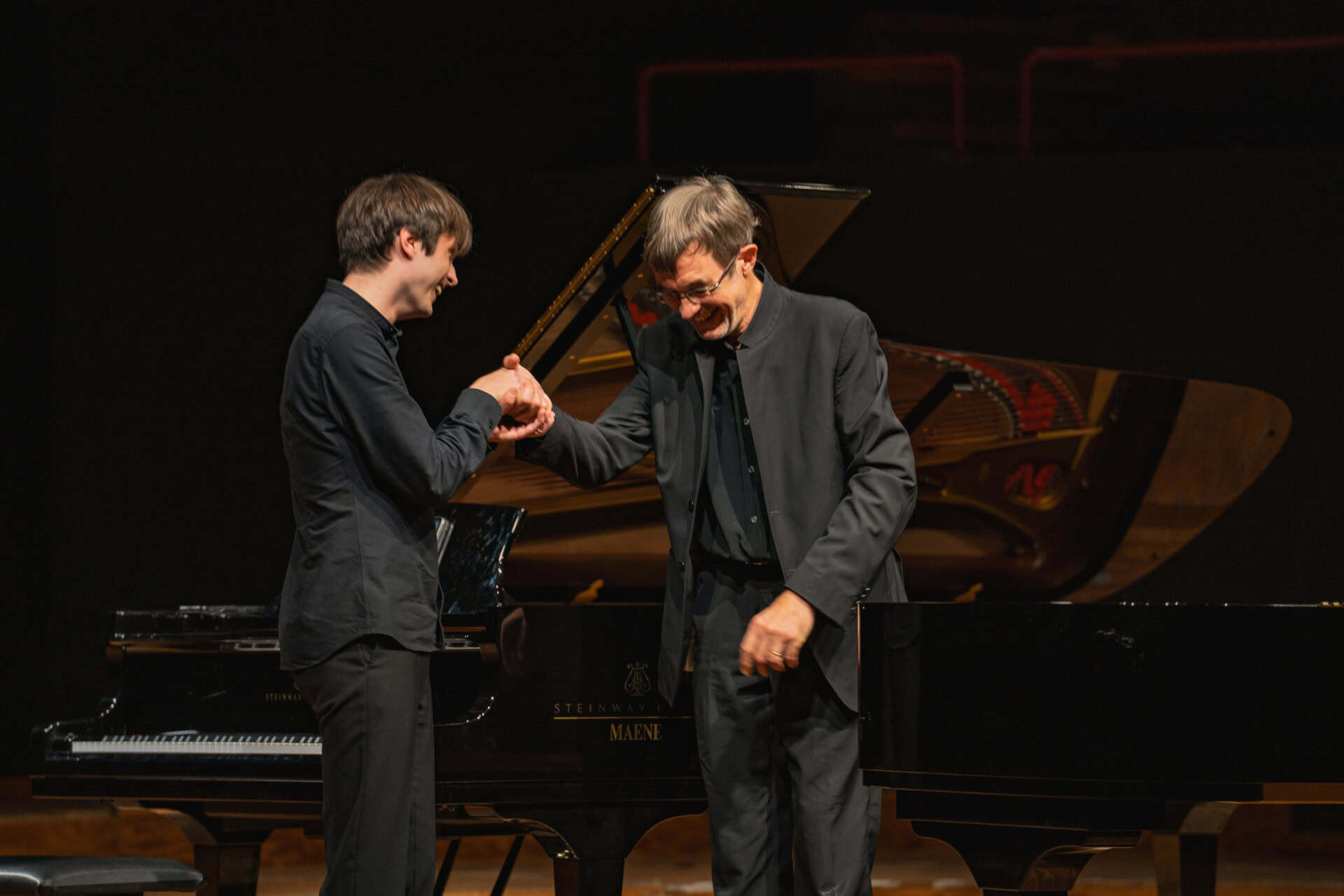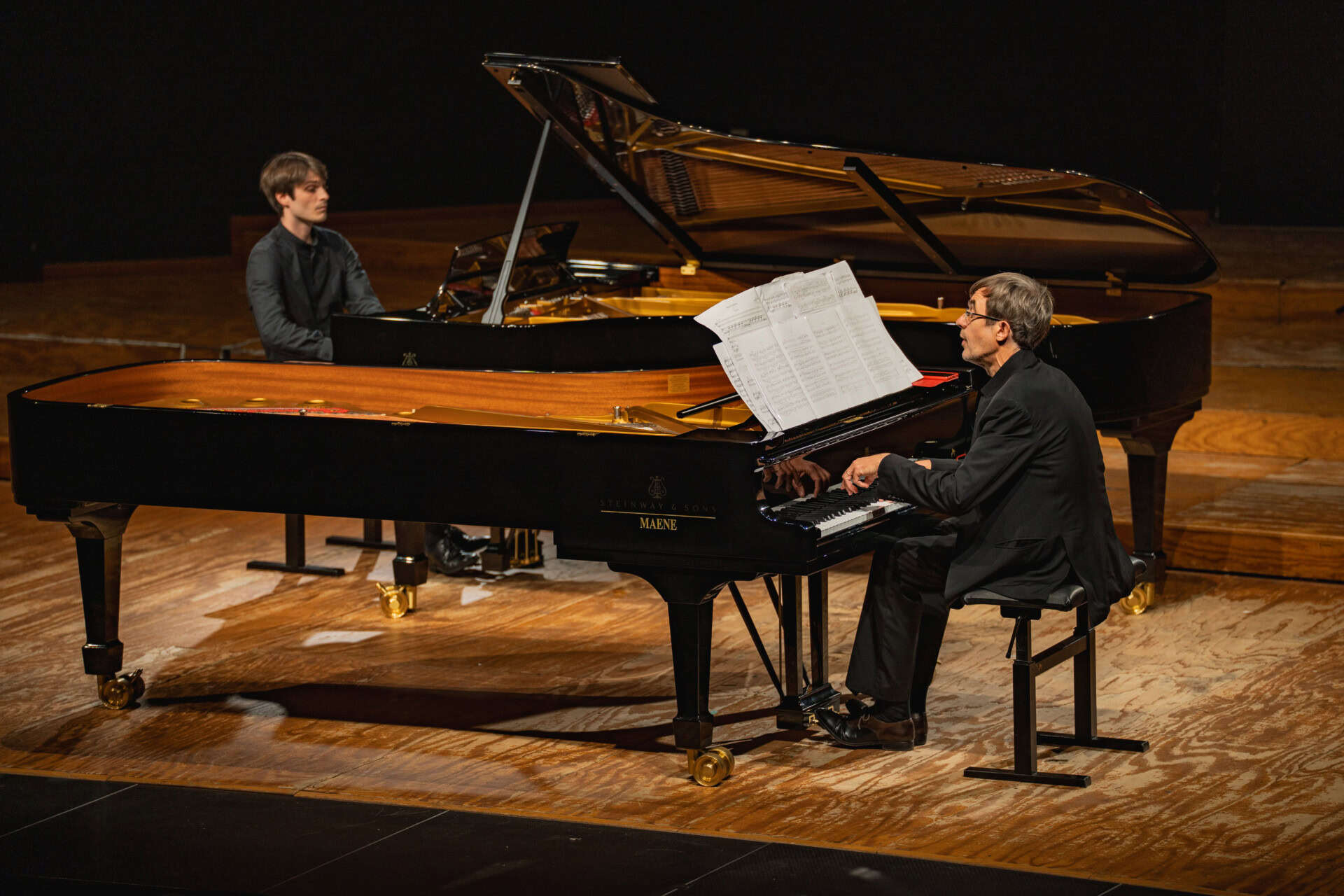
Festival 20·21 is in its final week, and it was kicked off with an impressive duo recital centered on rhythmic exploration featuring artist in residence Brecht Valckenaers and renowned pianist Jan Michiels. Valckenaers is serving as artist in residence for the second consecutive year, and he will continue in this role for the next two years as well. During this four-year trajectory, he is focusing on the piano repertoire of Ligeti. Last year, the starting point was Ex Nihilo, composing from nothing, with Ligeti's Musica Ricercata as the central work. This year, Valckenaers and Michiels are engaging with works for two pianos, anchored by the Drei Stücke für zwei Klaviere (1976).
The duo presented a five-part collection of works in which the rhythmic perception of the listener — and especially of the pianists — is put to the test. Fortunately, prior to the recital, artistic director Pieter Bergé provided a very interesting and illuminating introduction.
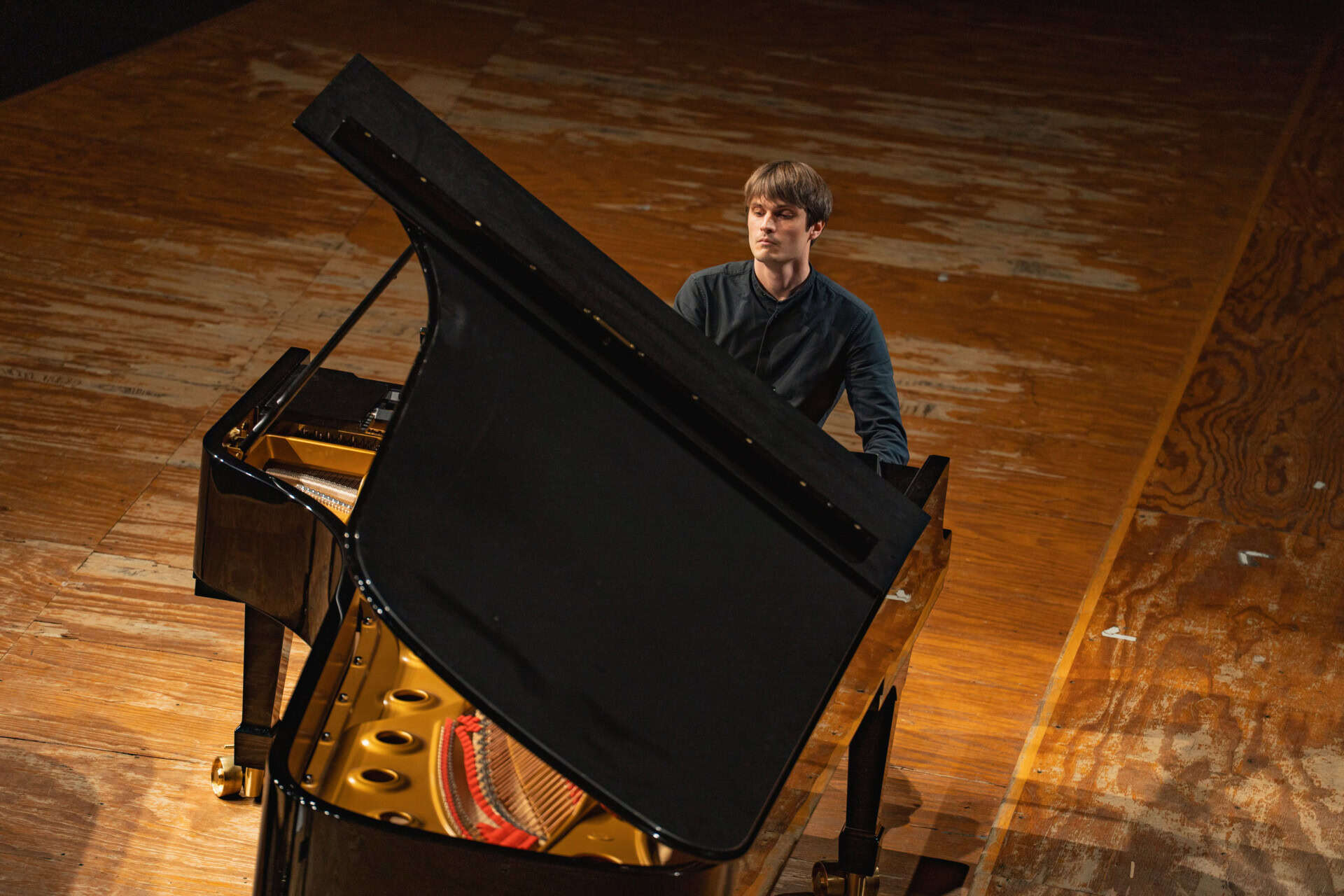
The program did not consist solely of works by Ligeti. Conlon Nancarrow (1912–1997), an American-Mexican composer, experimented — like Ligeti, but entirely independently — with rhythm and did not shy away from pushing boundaries. Some of his piano studies are even no longer playable by a single individual. To give musical form to his rhythmic ideas, he switched to an original notation system that could be realized through player pianos. Later, Ligeti met Nancarrow, and their mutual admiration was great. Nancarrow even wrote a piece as thanks for Ligeti's 65th birthday: For Ligeti (1988). In addition to Nancarrow and Ligeti, Valckenaers' own work was also on the program. Just as last year, he wove this intelligently into the established pieces.
The recital opened with lighter rhythmic work by Ligeti: the sonatina from Fünf Stücke für Klavier zu vier Händen (1950). This witty piece was followed by two studies for player piano by Nancarrow: Study 20, arranged for piano duo by Helena Bugallo, and Study 6, arranged by rhythmic wizard and pianist Thomas Adès. In Study 6, Valckenaers played a continuously transforming boogie-woogie bass figure, while Michiels took the upper voice — a charming little gem.
Especially for this recital, Valckenaers prepared an extremely difficult transcription of For Ligeti, a work that had never before been performed by two "real" pianists. A true rarity, and certainly a unique work. It is difficult to get a grasp on, but as Bergé aptly put it in his introduction: sometimes it is better to zoom out on the music and experience it rather than analyze it — a true open mind and open ears mentality.
States of Matter (Valckenaers, 2025) formed the third section of the evening. Just as he intelligently wove his five rhythmic studies into the program of Ex Nihilo last year, he continues with that momentum here with three pieces for two pianos. Valckenaers succeeds in building a bridge between rhythmic experiment and accessibility. Following in the footsteps of Nancarrow and Ligeti, he starts with a rhythmically highly qualitative core idea and builds it up steadily. His approach is apparently less radical, less "scientific" than that of Ligeti, for example, which gives the whole a more human touch. Furthermore, he employs his own harmonic language. States of Matter consists of three parts: the sensitive Liquid, the playful Gas, and the imposing Solid. Especially Solid resonates long after, with the almost ritualistic, resonant overtones in the coda.
The penultimate section of the evening reintroduced us to Nancarrow's work: a fresh, youthful, and melodically tinged piece that remains comprehensible and playful — the sonatina from 1941, in an arrangement for two pianos by Yvar Mikhashoff.
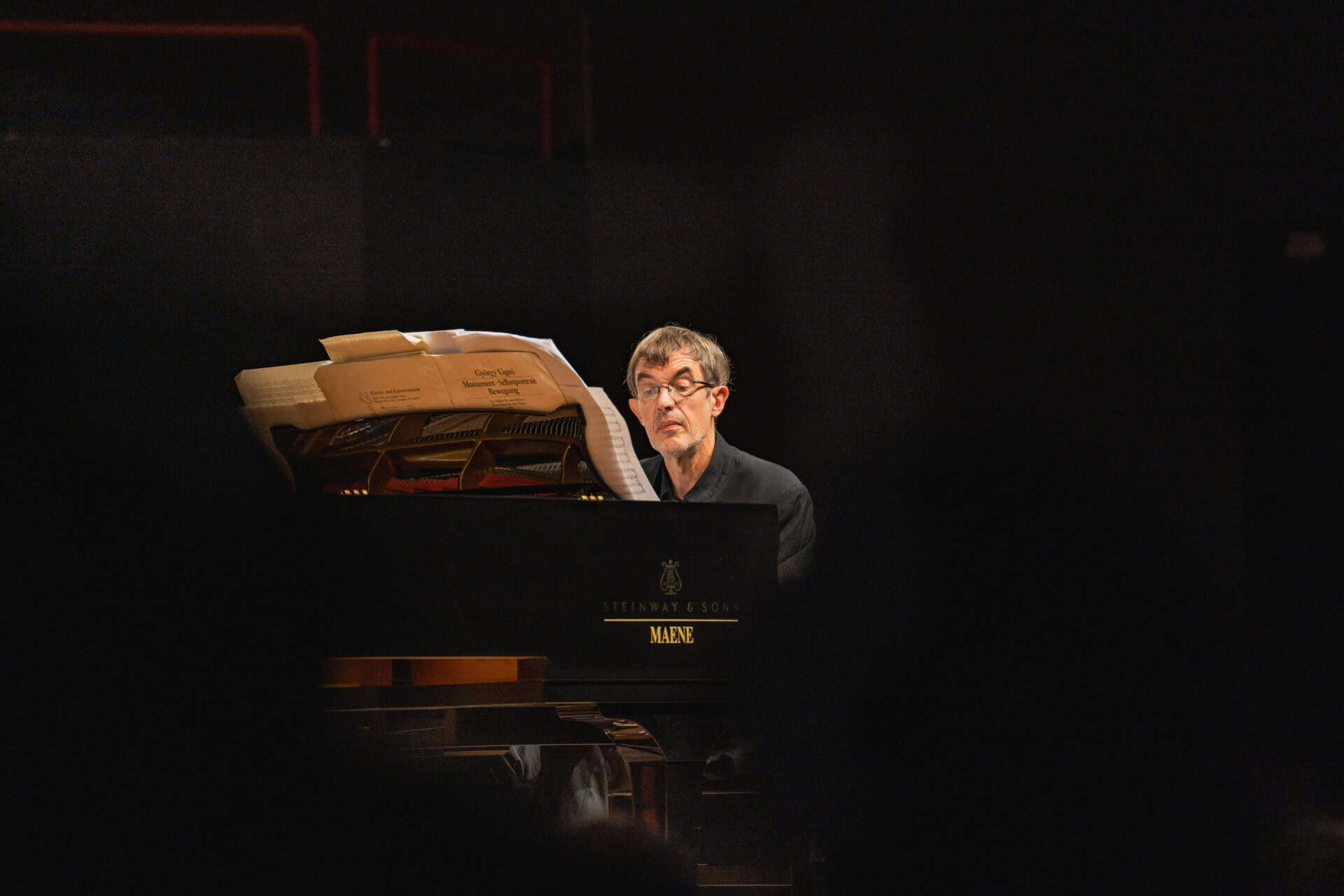
A monument to end with? Absolutely. Michiels and Valckenaers performed Ligeti's Drei Stücke für zwei Klaviere in the fifth and final section of the evening. In this imposing work we find three fantastic pieces, based on rhythmic ideas of Ligeti himself, but also on those of the minimalists Reich and Riley, whom he so admired. Even Chopin makes a brief appearance. Michiels and Valckenaers master this work and make it entirely their own — a true tour de force of hyperfocus. This triptych formed a fantastic conclusion to the evening, delivered by two rhythmic masters, but above all two top musicians.
Later this year, an episode will be released in the podcast series RECITATIVO dedicated to Brecht Valckenaers and his music. He will go into his compositional methods in greater detail and discuss two of his own works in detail.