
Click here for the table of contents
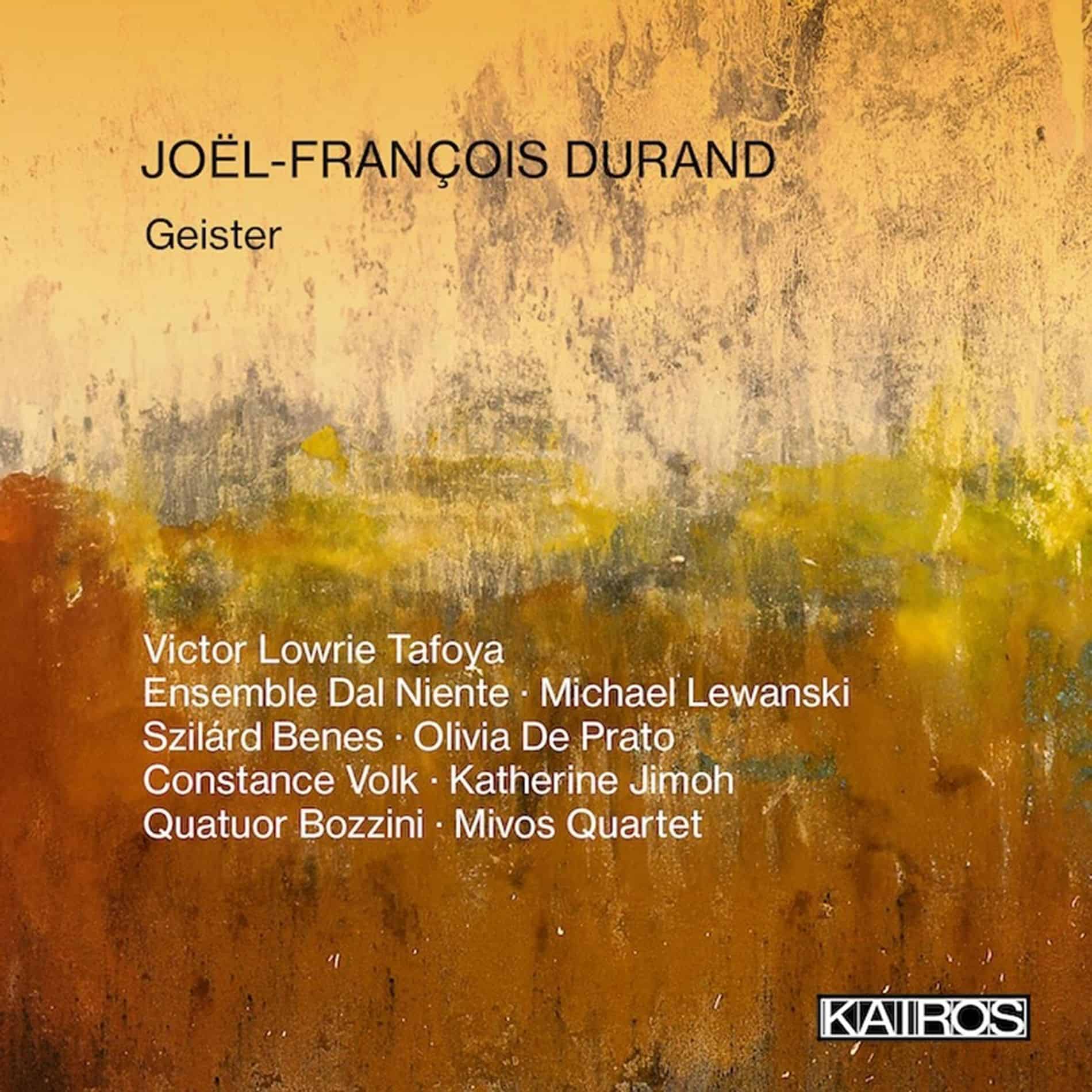
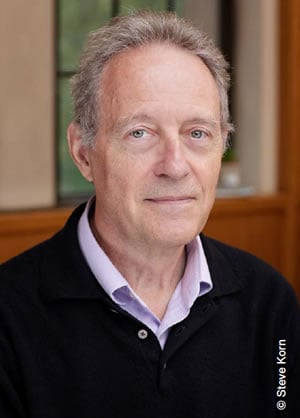
The compositions on this double album span a period of two decades and can certainly be considered representative of the variety in the oeuvre of French composer Joël-François Durand (*1954), with microtonal ity and quarter tones as important characteristics (here explained perfectly) and quarter tones. Both can already be found in his String Trio from 1981, which is documented as his 'official' opus 1. Later in time, the importance of microtones in his work increased considerably, in melodic and harmonic terms, but also in texture.
However, about five years ago, an important turning point occurred when Durand combined the compositional 'functionality' of microtonality with what he referred to as 'beating': the pulsation between two pitches whose frequencies lie very close together but are not identical to each other. He explained it himself:
"Under ordinary circumstances, we cannot directly perceive the mathematical ratio between the frequencies of two notes played simultaneously; it remains a matter of abstraction. However, when the pitches are very close, the phenomenon of 'first-order beat' becomes an actual experience. If, for example, the frequencies are 3 Hz apart – say, 443 Hz and 440 Hz – we hear two things: first, the two original frequencies become one single tone (mathematically, it's the median value of the two); additionally, we hear a pulsation of three beats animating this single tone. The 'median value' in this case is 441.5 Hz, and the pulsation that accompanies it – the difference between the two original frequencies – is three beats per second, which, when we hear them, is the audible manifestation of an arithmetic equation, in this case, the subtraction 443-440 = 3! This newfound technique thus allows, among other things, for relationships to be established between motivic elements played the "regular" way (for instance, as components of melodic lines) and rhythmic patterns echoing or foretelling these motivic elements generated by first-order beats."
However, that was not yet the case in 2005, when Mirror Land was created, the earliest work on this release, composed for flute and oboe, but also readily playable in other combinations (flute and clarinet, oboe and clarinet, etc.) On this album you hear the combination flute and clarinet.
In that same year the First String Quartet was created, a commissioned work for BeethovenFest 2005, as a contemporary 'echo' of Beethoven's late string quartets, with Beethoven's last string quartet, in F, op. 135 as a point of reference. Not a pastiche, but an imaginary scenario in which Beethoven is hard at work, testing the ideas that arise in his mind and changing them as the creative process progresses. According to Durand, this yields 'alternative trajectories, distant images and dramatic chronologies'. Not in Beethoven's musical language, but in Durand's: the relationship with Beethoven takes place entirely on an abstract level. 'Conceptual impetus rather than direct allusion'. A good example of this is the second movement from op. 135, which Durand completely dismantles, then reconfigures and replaces in stages, with each of the four voices first presented separately and then by the entire ensemble. In keeping with historical tradition, Durand has cast the structure of his string quartet in classical sonata form.
Ten years later, Mundus Imaginalis (2015) was created, its title derived not from an imaginary, but from an 'imaginal' world, a term coined by French philosopher Henri Corbin and which refers to ancient Persian mysticism. The 'imaginal' that moves between rational perception and intellectual intuition. From Durand's musical perspective, the listener is invited to 'travel' between sonic perception and intellectual intuition.
Ten years later, Mundus Imaginalis (2015) was created, its title derived not from an imaginary, but from an 'imaginal' world, a term coined by French philosopher Henri Corbin and which refers to ancient Persian mysticism. The 'imaginal' that moves between rational perception and intellectual intuition. From Durand's musical perspective, the listener is invited to 'travel' between sonic perception and intellectual intuition.
Geister, schwebende Geister (2020) is the first work in which Durand makes use of the '(first-order) beats' principle. The 'schwebende' or floating character of the piece is determined by the precisely calibrated ensemble of integrally structured semitones and quarter tones. What is particularly special about this is that the rhythmic patterns seem to emerge from nowhere, while clearly perceptible but not produced by the performer(s). Ghosts, floating ghosts, here represented as a composition for solo viola and chamber orchestra.
Two more works from that same year are: In a weightless quiet and the Second String Quartet, Cantar de Amigo.
In a weightless quiet for solo violin, owes its name to a poem by Ted Hughes, The Hawk in the Rain, containing the following key passage for this work: 'Effortlessly at height hangs his still eye. / His wings hold all creation in a weightless quiet, / Steady as a hallucination in the streaming air.' But contrary to what the evocative title suggests, the tenor is one of continuous unrest, even with a threatening undertone, the imagination further driven by the flapping wings of a hawk in full flight. Yet this is not program music. In this work too, the 'first-order beats' are unmistakable.
The Second string quartet likewise has a poem as its source of inspiration, D. Diniz by Portuguese lyricist Fernando Pessoa, dedicated to Portuguese king Dinis I, nicknamed the Farmer and also the Poet (1279-1325). The poem is included in Pessoa's book Mensagem (1934). Four of the total five movements contain a quotation from this poem. The final movement recalls the Heiliger Dankgesang eines Genesenen an der Gottheit, in der Lydischen Tonart, known from Beethoven's String Quartet in a, op. 132. In Durand's string quartet it is called Chorale - in ancient style. It is indeed designed in the style of the chorale, the movement that is note against note, but unlike Beethoven's, there are uncomfortable gaps in the texture, as if chunks have been omitted.
Finally, on this album the most recent work by Durand: La descente de l'ange (2022) for violin and clarinet. The title suggests an angelic atmosphere, but that is not the case. According to the score, the angel 'lands' 'playful and a bit clumsy' after first descending in a glide with increasing speed towards the earth. At the end of the piece, the angel seems to rise again, but is this to be called program music? According to the composer it may seem so, but that was not what he had in mind.
This work too has its roots in the 'beat', both between the two instruments and the strings of the violin, with D as the focal point, around which space has been created for microtonality.
I can be brief about the performances: they are solidly executed, with knowledge, experience, technique and commitment as the main pillars of support.