

Eight classical gems among the festival hubbub
From July 18 to 27, the Ghent Festivities took place again. One of the largest folk festivals, the largest multi-day cultural festival in all of Europe. Ten days of culture in the city, with both paid and plenty of free performances. Well-known names in cultural venues and on the squares, alongside street musicians who often surprise passersby. Among hundreds of events there is quite a lot of classical music. In eight days I attended eight performances. Concerts in the Miryzaal, the Sint-Jacobskerk, the Sint-Michielskerk, a house concert, a concert in a piano shop.
Mysterious musical surprises
I listened to some classics, also discovered some special composers and ended up at a festival of minimal music. They are gems by soloists and some chamber music ensembles. Both in the Sint-Jacobskerk, the Sint-Michielskerk and in the Miryzaal there is a classical concert every day during the Ghent Festivities. They attract large audiences. In the Sint-Michielskerk this series is called "musical reprieves". Misleading, because the word reprieve understates the richness and surprising programming. Better would be to call it musical surprises.
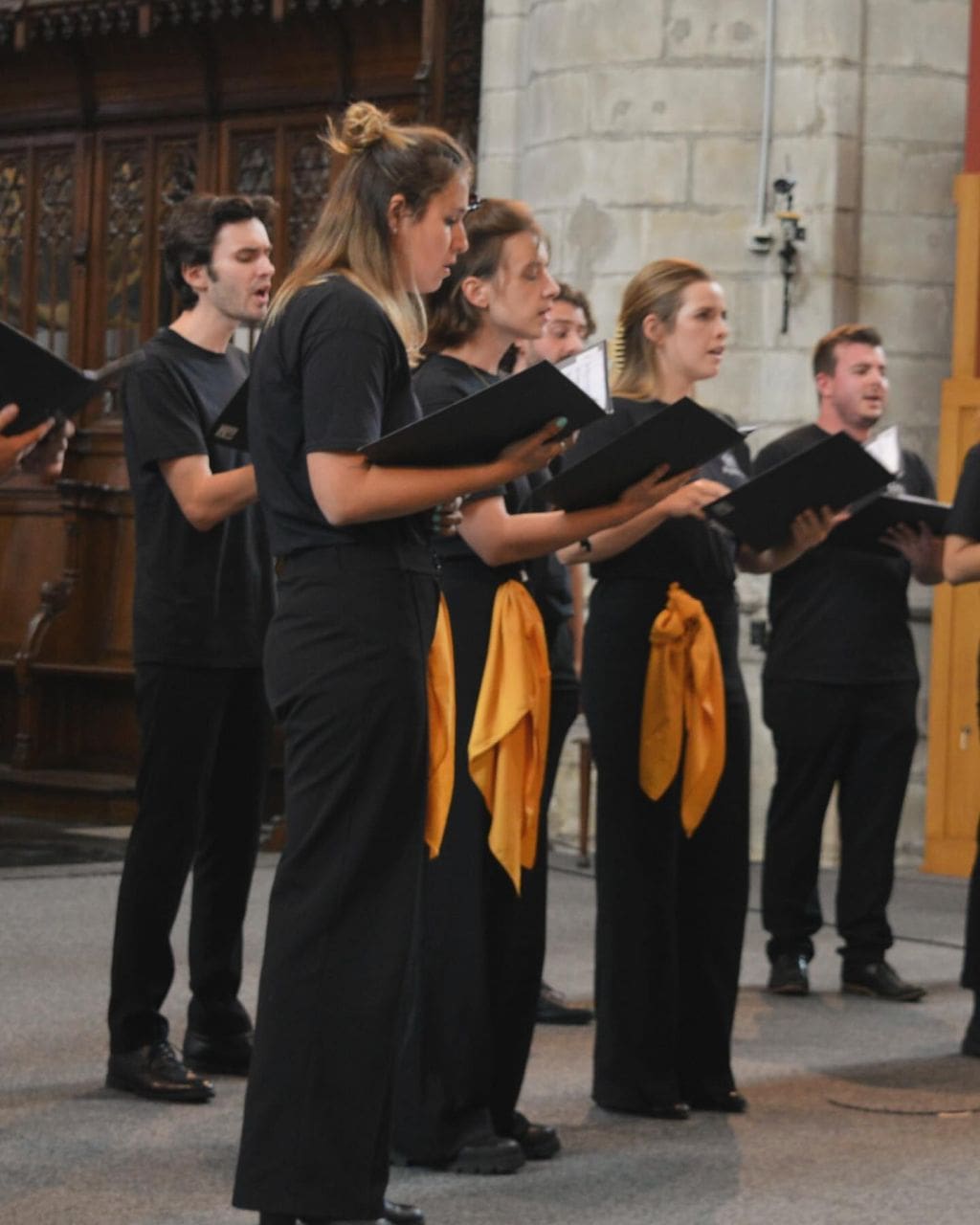 On July 21, the mixed choir Mysterioso sang in the Sint-Michielskerk. Originally the alumni choir of Artevelde University of Applied Sciences, they took their name from the café where they rehearse. The title of this concert is also mysterious: "I Grille e le Voci", the crickets and the voices. Only eight singers stand on the podium out of the twelve listed in the brochure. Two conductors alternate. It sounds different from a large choir, where every voice is absorbed in the greater whole. In this vocal octet you hear every individual voice.
A large choir is like a large cruise ship where you barely feel the waves. A chamber choir, on the other hand, is like a small boat at sea. Sometimes they have to row against the waves, the contrasts forte and piano could be clearer. But nevertheless it is a gem of a concert. This is first and foremost due to the multilingualism! Besides English and French there are songs in Norwegian, Farsi and even in the language of the Incas, Quechua. During the intermission, Iranian Ehsan Yadollahi plays an intermezzo on his Tar, which further underscores the multicultural character of the choir.
Elbow work
Renaat de Keyser is the first of the two pianists I hear at the Ghent Festivities. He is 24 years old, graduated from the Ghent conservatory with Daan Vandewalle. Besides the Tombeau de Couperin by Maurice Ravel, he also plays works by the lesser-known composers George Antheil and Frederic Rzewski. With the latter, his teacher worked closely together.
American George Antheil is rarely performed. An enfant terrible, Renaat tells us at the beginning that after a few bars it will be clear why this work is called "sonate sauvage". It sometimes sounds monstrous. Stravinsky squared. Antheil was also influenced by the futurism of after World War I, with the piano as a percussion instrument to mimic machines. Strange to think this music is a hundred years old. It differs by only a few years from Ravel's Tombeau, which contrasts with Antheil's violence through subtle harmonies. In the Tombeau, Renaat takes small liberties with the tempo. Slightly too lively for this dead music.
Jazz sounds are a thread running through the recital. So too with Rzewski, also an American composer with Polish roots like Antheil. The Winsboro Cotton Mill Blues sounds like a real Blues. In the fast sections, it's not just the hands, but sometimes he also presses his elbows on the keys. Renaat De Keyser is a promising pianist, co-founder of Shapovalov, a group of young musicians who organize classical concerts in Ghent.
Rocking, swinging and hammering
Pianist Thomas Eeckhout I have heard during previous editions of the Ghent Festivities. Under the name "het klinkende dok" the Eeckhout family organizes a series of concerts in their large living room in a new apartment in the docks, with room for about forty listeners. After his studies with Levente Kende in Antwerp, Thomas went on to perfect his craft in London, where he specialized in art song accompaniment. The adagio by Mozart, with which he opens, sounds extremely controlled and refined. Technically not difficult, but as always with Mozart, the pianist cannot hide behind virtuosity and bravura.
After Mozart, Thomas stands up and gives an explanation of the rest of his recital. With sweeping arm movements he explains the Barcarolle by Chopin. You can see that he often works with singers, because he cannot help but sing the rocking motion of the gondola, on which the piece is based. In Chopin he unfolds his romantic soul. Last year he already played all of Chopin's preludes during het klinkende dok.
After Mozart and Chopin it goes to the Balkans. First with a rhapsody by Liszt, in which he shows how nimble-fingered and virtuosic he is.
It is a very brave choice to then end with Szabadban by Béla Bartók. Here too he explains the piece in a singing manner beforehand. Bartók does not write as virtuosically and pianistically as Liszt. As a Bartók fan I naturally prefer nothing more, but Bartók is of course a different listening experience than the romantic Chopin or Liszt. "I prefer to hear the melodies of Chopin to the hammering in Bartók," I heard a woman admit at the drink on the terrace afterward, with the old harbor cranes in the background, which as iron giraffes stately and gracefully embody the rich past of the Ghent harbor.
Bach, Ysaÿe and Deep Listening
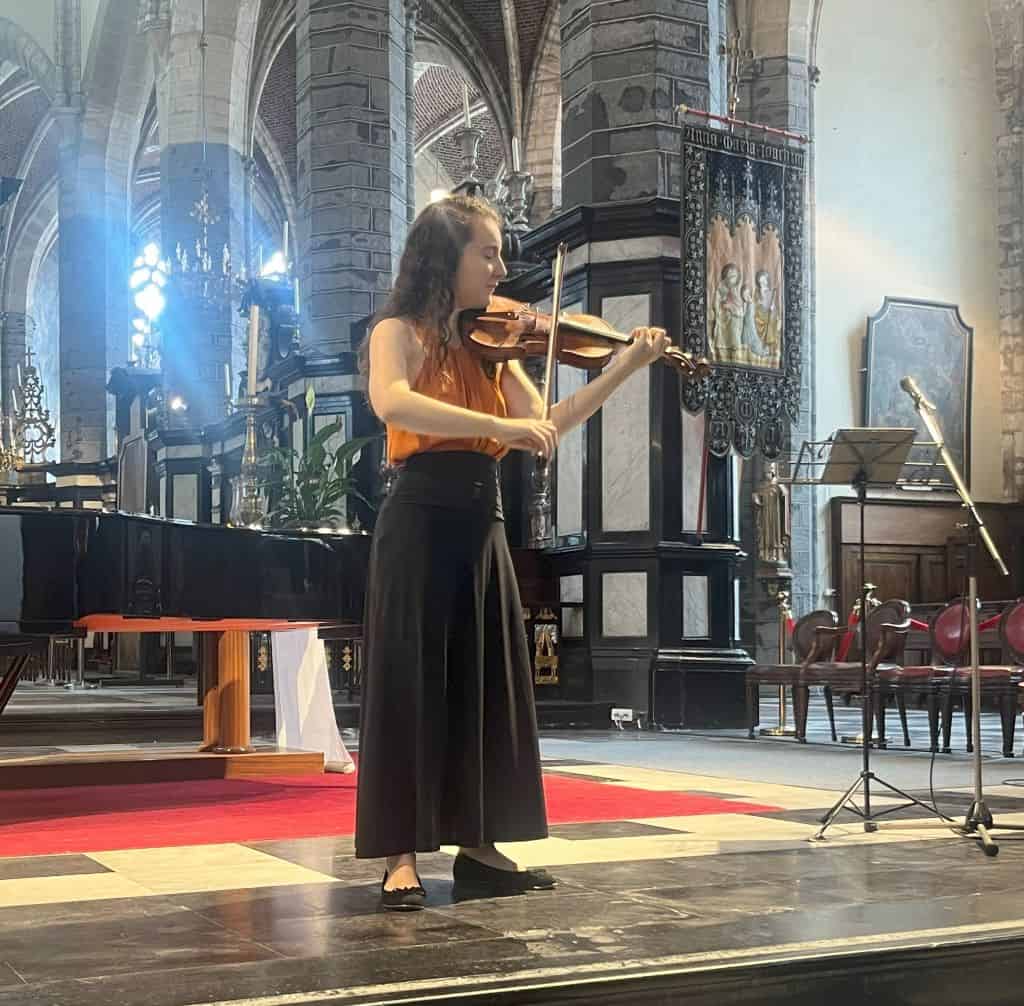 Ruth Mareen gave a special solo recital on 24 July at 11 a.m. in the Sint-Jacobskerk. Special is no exaggeration here. She not only performs some notoriously difficult works for solo violin, but also introduces the audience to what Deep Listening is. She teaches us to listen in a different, more intense way. The audience is also involved. At one point we are invited to hum or sing along, or to listen to our own breathing with our hands over our ears.
She begins with some works by Pauline Oliveros. They are improvisations. There is a sort of score, but it does not consist of musical notes, but of a few sentences that you must realize on the violin. From the very first notes we hear the crystal-clear tone of her violin, a Jacquot from 1876.
Then comes the main course, two solo sonatas from the two bibles of the solo violin repertoire, the solo sonatas of Bach and Ysaÿe. She performs the fourth sonata by Eugène Ysaÿe, dedicated to Fritz Kreisler. Perhaps the most difficult, because least spectacular of the six. Notoriously difficult, but Ruth pulls it off without a hitch. Then the first solo sonata of Bach. These are nowadays often played on Baroque violin or in a Baroque manner. Ruth applies that in a certain sense, as she performs the sonata consistently without vibrato. She fills the church with the polyphonic texture. Especially in the second part, the fugue, that is impressive.
St. James Day
The next event is not a concert, but a Catholic mass in the Sint-Jacobskerk. Like all St. James churches, this church is the departure point for pilgrims to Santiago de Compostela in northwestern Spain. 25 July is the feast day of Saint James. Occasion for the annual pilgrims' mass, which almost every year falls during the Ghent Festivities. At this time, future pilgrims and their attributes are also blessed. With their shoes, backpack, walking stick they come forward to be blessed by the priest.
The mass is enlivened by a real pilgrims' choir. In the pilgrims' choir "Adalard van Aubrac" under the direction of Johan De Ridder, only pilgrims sing! They sing religious songs, including the well-known Donna Nobis Pacem by Mozart. At the end of the mass, a peace song sounds, accompanied by organist Natalia Tchebotareva. I hear the melody of Sibelius' Finlandia in it. The finale is the Ultreia by Jean-Claude Bénazet, the most famous song of the camino.
In the church sits an older audience. Many of them completed part or all of the pilgrimage during the last decades. Only one of them made the journey, the camino, 40 years ago. That pilgrim is myself. I departed in 1985 from the portal of this church, after we received our first stamp in the rectory. I was nineteen, the beginning of an unforgettable adventure in a time without a mobile phone, without a bank card and with a simple bicycle with ten gears.
Last Rays of Sunlight
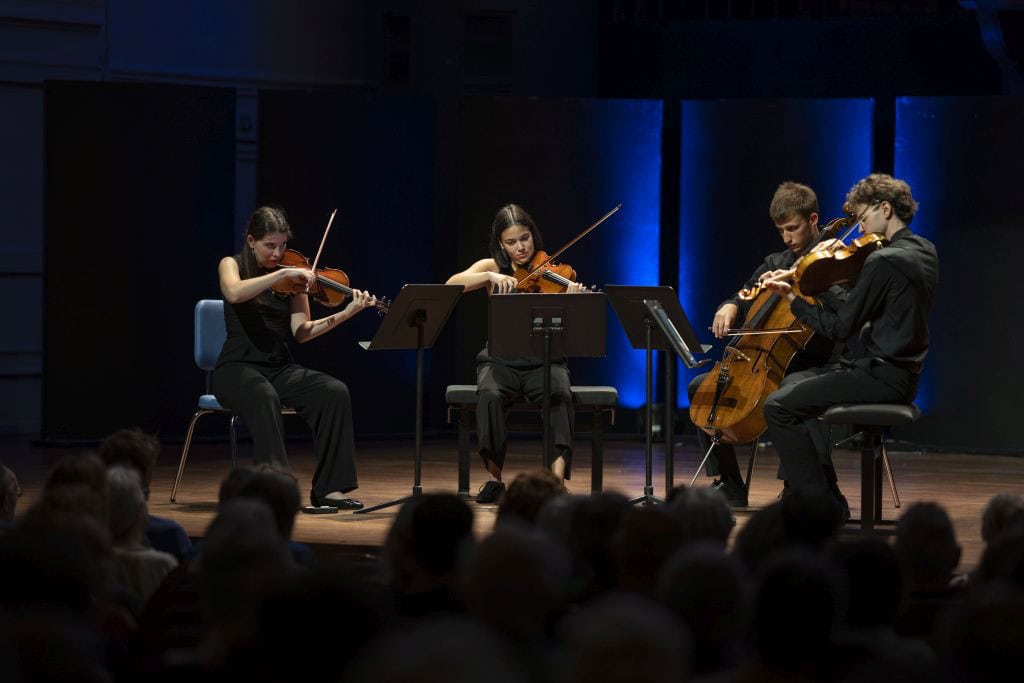 Back in the Miryzaal, for the young string quartet Lusco Fusco. This jolly name is Galician for the last rays of sunlight of the day. Apart from the Flemish Rune, first violin, the other members of the quartet are from Galicia, northern Spain, where Santiago de Compostela is also located. Cristina plays second violin, Jorge viola and Ignacio cello.
They study chamber music at the Ghent conservatory, they have barely been playing together as a string quartet for a year, the most difficult form of ensemble playing for string players.
You have to give them credit, because there were quite a few intonation impurities. The second violin sounds too much in the background, while it often also has an expressive melody. But after the first movement of Beethoven op. 18 no. 4 they land on their feet and it sometimes sounds wonderfully beautiful. String quartet is harder than string trio. Those are three, a quartet must form a unity, must transcend the four individual string players. That is always dancing on a tightrope without a safety net. After Beethoven they play Mendelssohn's masterful second quartet op. 13, which he wrote at eighteen. What a genius, this Mozart of the nineteenth century!
Wonderboys
On Saturday 26 July I walk again to the Sint-Jacobskerk. Via the Vlasmarkt it's wading through scattered rubbish, left behind by the party-goers of the night before. A single drunk is half lying on a bench, stupefied by beer and the techno beats of the previous night… Ghent Festivities, that is high and low culture.
On the programme were cellist Jacob Van Durme with pianist Taha Posman, with the cello sonata of Rachmaninov and Pohádka by Janáček. But Taha's brother, clarinetist Yassine comes forward with an announcement. No Rachmaninov, but instead they play Brahms' clarinet trio. Thus we hear the acclaimed Malatya trio, clarinet, cello and piano. The Posman brothers begin with Robert Schumann's Phantasiestücke. Yassine plays delightfully slowly and lyrically, with perfectly spun out musical phrases. At one point a chair shifts, its legs form a tritone with the clarinet. Schumann has gone mad.
With Brahms it is always autumn, I once read. Also in this mature clarinet trio. In the slow section the clarinet alternates between the clarion and the chalumeau register. Yassine can work magic with his clarinet. As at a concert in early May, the brothers Posman also show here again that they are the wonder boys of the Ghent classical music scene. No blood flows through their veins but musical notes. Besides being a musician and conductor, they have also started their concert organization, the Shapovalov concerts.
Ottomani
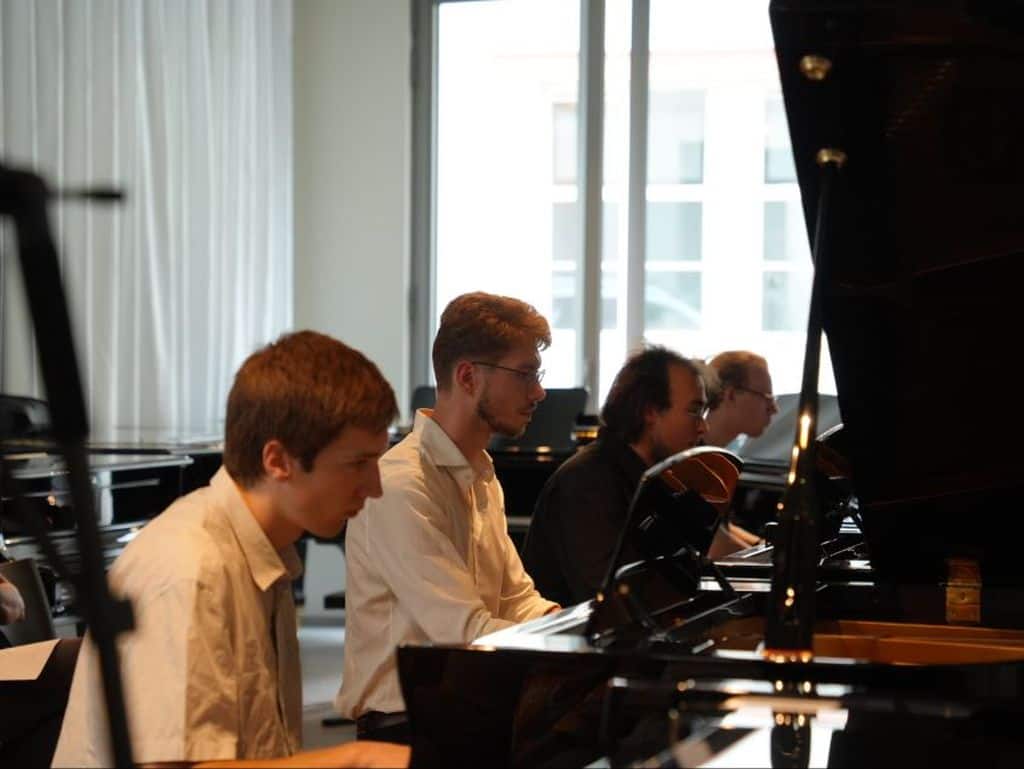
In the afternoon I go to the Shapovalov festival in the rooms of piano house Quatre Mains. The festival is devoted to minimal music. Throughout the afternoon there are nine performances in the rooms and in the courtyard. First I listen to the best-known work by Simeon ten Holt, Canto Ostinato. The work is free to interpret in different arrangements. Here, in the showroom of the piano shop, four pianists play it on four grand pianos. Eight hands, huit-mains, ottomani.
Minimal music is above all captivating, meditative, sometimes impressive, sometimes confusing, sometimes sleep-inducing. The same motifs are repeated for minutes on end, until there is a small change, when it continues for minutes on end again. It is a completely different listening experience than "regular" classical music. As if your brains are put on hold for forty minutes during this performance by Ten Holt. As captivating music it sounds here and there even oriental, ottomani, Ottoman…
Buddhist monastery
I must recover from it somewhat and go to the courtyard for a beer. I cannot escape it, because two accordionists are preparing themselves in the courtyard for "Accordeon Phase" by Steve Reich, the best-known composer of minimal music. Insofar as you can speak of a composer here, because usually not much is written down. The score is more of a machine manual. It often sounds like a machine too, a humming loom that endlessly reproduces musical notes. The two accordionists Thijs Amez and Jeroen Werbrouck sit a few meters opposite each other, staring at each other as if they are ready for a duel.
In any case, it is music that gives food for thought. Empty music, almost without meaning. Perhaps the meaning is that it hardly has meaning. What is music, what is musical content? Interesting questions, just as postmodernism as a historian has made me waver and has made me think about history in a completely different way. That captivating, meditative quality evokes yet another association. It is as if we are sitting here in a Buddhist monastery, among meditating and reciting monks. Minimal music was a nice excursion between the other concerts at the Ghent Festivals. After three hours of Reich, Arvo Pärt and Simeon ten Holt it is enough and I go home, back to Mozart, Beethoven and Bartók!