
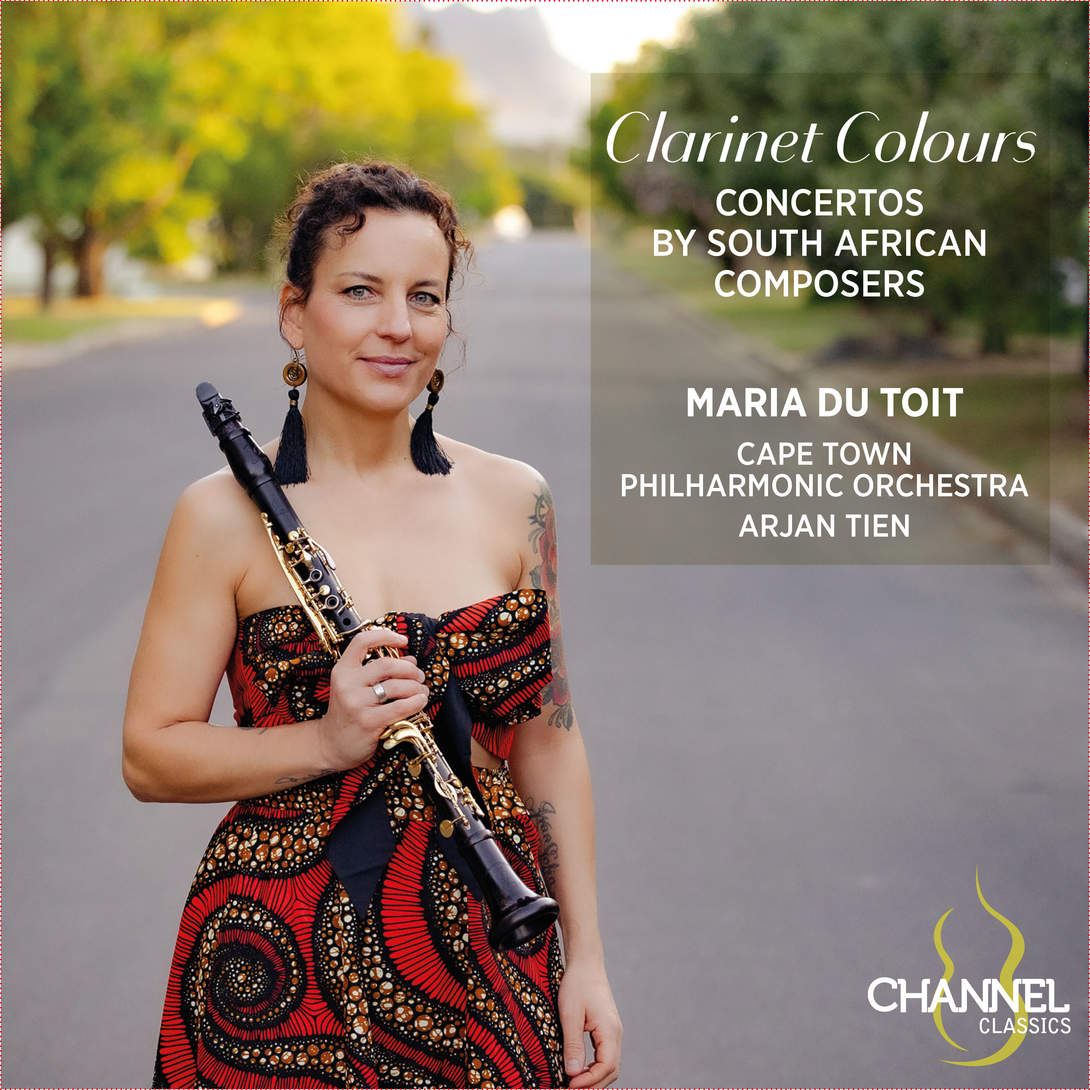
A repertoire rarely develops on its own; it takes shape because someone actively fills in the gaps. The South African clarinet repertoire is such a field: not absent, but fragmented and without an obvious tradition. With Clarinet Colours, Maria du Toit makes a substantial contribution to that development. The three concertos on this cd were written for her or dedicated to her, premiered by her, and are recorded here for the first time. Thus this release documents not only new music, but also the emergence of a repertoire.
The cd booklet places the three works under the familiar image of South Africa as a 'rainbow nation'. As historical background, that metaphor is useful; as an interpretive framework, less so. It suggests a harmonious diversity, whereas what Conrad Asman (°1996), Roelof Temmingh (1946–2012) and David Earl (°1951) primarily share is their mutual incomparability. The persuasive power of this release thus lies not in a shared color palette, but in the self-evidence with which three radically different musical voices can exist side by side.
Color as construction
Conrad Asman's Colour Concerto (2017–2018, revised in 2024) is the most conceptual of the three works. The composer departs from mechanomorphism and the color theories of Newton and Goethe, but as soon as the music begins, those ideas fade almost immediately into the background. What remains is a concerto that constantly changes shape. One musical idea forms the starting point, but never returns literally; it is continuously re-illuminated, distorted and further developed, so that the form does not unfold linearly, but seems to rewrite itself as we listen.
This also changes the relationship between soloist and orchestra. The clarinet does not stand opposed to the ensemble, but moves continuously through it, takes on colors, withdraws and steps forward again. Maria du Toit plays this continuous shift with great suppleness: her tone changes character without the musical line ever being interrupted, while the orchestra captures each transformation with remarkable sensitivity and integrates it into a clear whole. Asman's orchestration is notably inventive in this regard. The music switches effortlessly between energy and stillness, between sharp contours and almost dreamlike sound fields, without any one atmosphere becoming definitive. Color here is not an ornament, but a compositional principle that keeps the form in constant motion.
The contrast between Newton's systematicity and Goethe's intuitive color perception thus remains not confined to the explanation in the cd booklet, but acquires an audible musical meaning. Asman writes a concerto in which color, form and movement are inextricably connected. It is precisely this combination of compositional inventiveness and direct significance that makes this the most intriguing contribution on the album, a work that seems to reinvent itself with each listening and would undoubtedly gain in intensity when heard live as well.
Between seriousness and irony
With Roelof Temmingh, the perspective shifts to a composer who thinks less theoretically and more rhetorically. His Klarinetconcerto (2009–2011) is a work of late maturity in which discipline and expression come together in a rare balance.
The opening section, Lamentoso, unfolds from an almost restrained gesture. The clarinet enters hesitantly with short motifs that search their way tentatively. The orchestra takes up those thoughts, responds, supplements or holds back just again, creating a refined dialogue in which neither takes the upper hand. Now and then a orchestral eruption – with prominent timpani – breaks the hushed atmosphere open, after which the clarinet takes the word again. Soloist and orchestra continue to sound each other out carefully without ever overwhelming one another. Maria du Toit masters this tension exemplarily, while Arjan Tien and the Cape Town Philharmonic Orchestra make the layered structure of the score clearly audible. The section thus acquires something of a musical retrospection, as if Temmingh with quiet determination draws up the balance of a lifetime.
Against this stands a brief Scherzando that opens the work to playfulness and irony. The clarinet seems here to subtly wink at Shostakovich now and then, without Temmingh losing his own voice. Du Toit switches effortlessly from introspection to lightness, while Tien and the orchestra follow her with equal precision. The contrast between both parts is sharp, but never schematic. Temmingh develops his material with clear architectonic logic and achieves remarkable emotional intensity by relatively simple means. This is undoubtedly the most rounded concerto on the cd and perhaps also the work that resonates longest. Yet Asman's concerto remains the most adventurous: where Temmingh convinces through mastery, Asman convinces through risk.
Lyricism as memory
David Earl's Klarinetconcerto (2012) closes the cd with a quite different tone. Where Asman continuously explores new sound worlds and Temmingh reduces expression to its essence, Earl opts for a more lyrical and continuous musical thought. Melody and recognizability function here not as nostalgic reminiscence, but as carriers of musical memory that unfolds gradually. With its more extended orchestral complement, including harp and celesta, Earl creates a warm, transparent sound world in which the first section develops in broad breathing arcs without losing the tension curve. Du Toit treats this lyricism not merely as cantabile, but gives it direction and breath, while the orchestra carries her with perfect naturalness without placing itself in the foreground.
The middle section, a hushed Nocturne, forms the emotional focal point of the concerto. The clarinet seems here not to sing above the orchestra, but to dissolve into it, as it were, so that the restraint of the music actually gains in intensity. In the final section, the medieval melody L'homme armé appears not as a historical quotation, but as musical memory that continuously assumes new forms in a series of vivid variations. Thus the concerto does not end with a emphatic closing gesture, but with a sense of continuity, as if the music continues to carry its own past even after the final measure. Of the three works, this is perhaps the most accessible. Less experimental than Asman and less tense than Temmingh, but precisely for that reason convincing in its warm lyricism and its self-evident melodic significance.
Repertoire in the making
Maria du Toit possesses a homogeneous tone palette: warm, flexible and entirely at the service of expression. Even more important is her stylistic intuition. In Asman she becomes a color dramaturg, in Temmingh an introspective narrator, in Earl a lyrical singer. Precisely for this reason, she makes it audible that these three concertos, however different, do not stand side by side by chance, but are connected to one another by her artistic vision. The collaboration with Arjan Tien and the Cape Town Philharmonic Orchestra is essential in this regard. Their shared sense of timing, breath and balance keeps even Asman's complex orchestration transparent, while the Channel Classics recording with its open, natural sound image optimally supports that refinement.
Clarinet Colours is therefore more than a collection of new works. The three concertos differ fundamentally in style and aesthetics, but together form a convincing showcase for a South African clarinet repertoire that can measure itself without reservation against contemporary international concert repertoire. Asman opens new perspectives, Temmingh gives the project its emotional focal point and Earl provides a lyrical conclusion. Between them, Maria du Toit moves as initiator, performer and ultimately also as co-shaper of a still young tradition. What this recording documents, then, is not only the first recording of three concertos, but the emergence of a repertoire. It shows that repertoire is not only transmitted, but also emerges because musicians actively shape it.