
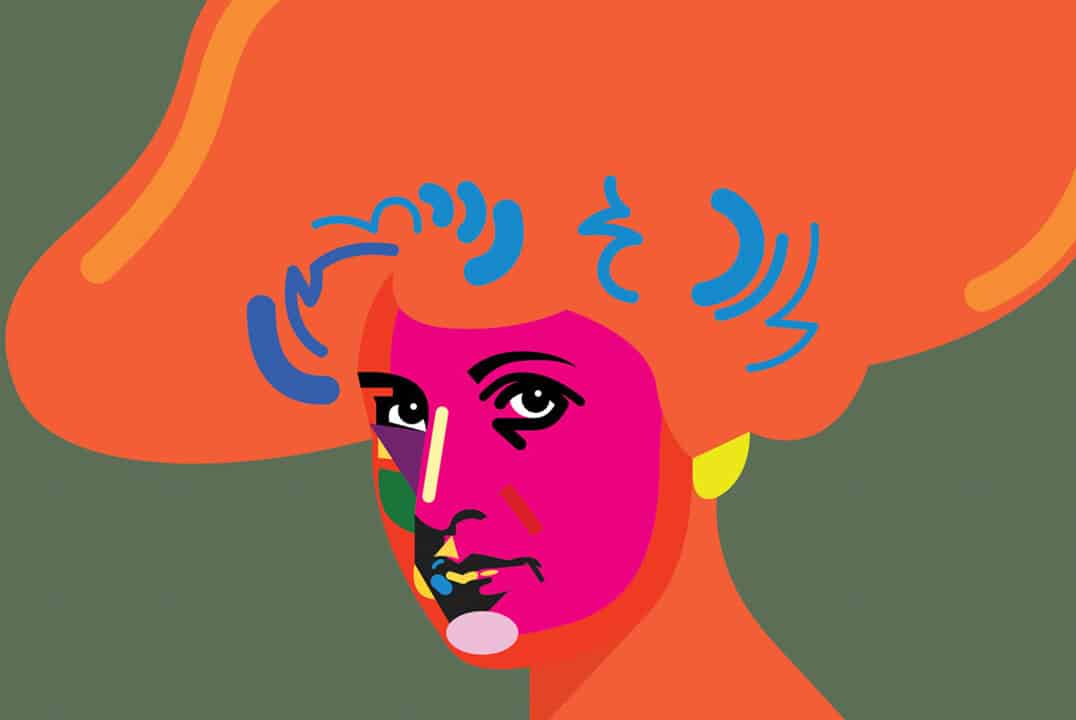
The second edition of the Komponistinnenfestival her:voice takes place in the German city of Essen from March 20. Once again, (orchestral) works by completely forgotten female composers are on the program, such as Charlotte Sohy. In a good mix, contemporary works are also presented, this time by Missy Mazzoli and Kaija Saariaho. Much attention is also given to Alma Mahler-Werfel. At the Folkwang Museum, an exhibition is running featuring work by Oskar Kokoschka from the time when he was extremely captivated by the widow of Gustav Mahler.
Female composers are receiving increasing attention. Their work is – finally and fortunately – being rediscovered and published and performed again or for the first time. Often these are songs, works for solo piano and for small ensembles. Female composers rarely appear on orchestral programs, as research by the English organization Donne convincingly demonstrated.
It is all too easy to assume that women did not compose symphonies, concertos or operas in the past. This was thought to be due, among other things, to their more limited education and a lack of resources and network to bring compositions for larger ensembles to the public. Yet it is increasingly proving to be a misconception that women did not write great work. If one is open to it, and if necessary actively looks for it, there turn out to be many masterpieces still to discover.
The festival her:voice at the Aalto-Theater in Essen has therefore set itself the task of presenting four major, until now (almost) unknown orchestral works by female composers over four years. Last year these were the opera Fausto by French composer Louise Bertin (1805-1877) and the third symphony by Florence Price (1887-1953). We received contemporary orchestral work from New York-based Missy Mazzoli (1980), who was inspired by Detroit's industry for River Rouge Transfiguration. It was a magnificent program, as we ourselves could establish, and it called for more.
La grande guerre
The celebrated Fausto by Louise Bertin, until recently virtually unknown to almost everyone, was at least repeated this season and is also the finale of the second edition of the Komponistinnenfestival, from March 20 to 23. The new name on the her:voice program this time is Charlotte Sohy (1887-1955), a woman with a large family of seven children who, like Clara Schumann with her eight children, nevertheless managed to have artistic adventures. Despite her extensive education – including study with Vincent d'Indy at the Schola Cantorum in Paris – and the support of her husband, she had to publish her works under the male name Charles.
During a 'conversation concert' pianist Juriko Akimoto illustrates the life and work of Charlotte Sohy with compositions for chamber music on the grand piano. During another concert at the Philharmoniker we can get acquainted with Sohy's late-romantic symphony La grande guerre, an orchestral work forgotten until 2014 that was never performed during her lifetime. She began this symphony during the First World War and expressed her longing for peace and brotherhood in it. Could it be more timely?
Two contemporary pieces complete the program of that concert: Color Field by English composer Anna Clyne (1980), inspired by a painting by Mark Rothko, and Winterhimmel by the multi-award-winning Finnish composer Kaija Saariaho (1952-2023).
For another work by Saariaho, we venture to Gelsenkirchen, 30 km away. The opera Innocence is on the program at the Musiktheater there. 'A topical yet timeless subject, gripping and excitingly packaged in a fast mix of contemporary music theater, theater and ancient tragedy', it says. This 'celebrated opera-thriller' deals with 'trauma, grief, anger and helplessness of people'.
Gekmakend gebrom
Even more suspense is promised by the invited American Missy Mazzoli at the Aalto-Theater in Essen with The Listeners, an opera in two parts. Claire suffers from sleepless nights due to a deep, permanent hum that drives her mad. With her student Kyle, who also perceives that low-frequency tone, she visits the house of Howard Bard, a charismatic philosopher who has allegedly helped other people troubled by it. She is warmly welcomed by Howard and the group of 'Listeners'. And Claire learns to accept the unexplainable hum and its ever-growing powers. But once the listeners' meetings take on cult status, the situation spirals out of control.
Missy Mazzoli is one of the most famous and sought-after artists of her generation. The opera caused quite a stir at its premiere in Norway in 2022 and is now experiencing its German premiere. The composer herself, who will speak with the audience during the festival, describes The Listeners as an opera about 'our desperate desire for connection, our search for community and meaning, and the power of charismatic leaders who abuse that desire'. Other compositions by the American, such as a string quartet and an aria from her first opera Breaking the Waves, will also be heard.
Belgian touch
The German festival also has a somewhat Belgian flavor with a concert by B'Rock Orchestra and the Vocal Consort conducted by Andreas Küppers. Under the title Seraphim, they bring with mezzo-soprano Lucile Richardot 'heavenly' music by, among others, Francesca Caccini, Hildegard von Bingen, Isabella Leonarda and a whole series of even lesser-known female composers.
Kokoschka and Alma Mahler
In the somewhat more distant Folkwang Museum, the exhibition Frau im Blau opens together with the festival, featuring works by Oskar Kokoschka. The young painter became completely captivated by Alma Mahler-Schindler in the early 20th century. The obsessive love he developed in a short time for Gustav Mahler's widow is expressed in paintings, drawings, fans, and a mural. He reached the peak of that creative obsession when he had puppet maker Hermine Moos create a life-size doll modeled after his unreachable love, who had since married Walter Gropius. Woman in Blue (1919) was the first painting with that doll as its subject. It marked a turning point in his painting style. The exhibition in the otherwise worthwhile Folkwang museum is the first in 30 years to bring together all of Kokoschka's works inspired by Alma Mahler. It runs until June 22.
The songs of Alma Mahler – no other compositions of hers have been preserved – are heard in a 'Viennese salon' during the festival, together with songs and chamber music by her contemporaries and acquaintances Berta Zuckerkandl, Evelyn Faltis and Kralik von Meyrswalden (a fellow student of Gustav Mahler). Additionally, in a symphony concert, five songs by Alma Mahler in an orchestral version by Jorma Panula will be heard.
With the interdisciplinary project Doppelbindnisse, to which, besides the Aalto-Musiktheater, the Essener Philharmoniker and Folkwang, the Alte Synagoge also contributes, among others, one wants to shed new light on both the biography of Alma Mahler and her work, which remained in the shadow of her famous husbands.
The Komponistinnenfestival is thus again framed with promising lectures. Those from last year have meanwhile been compiled in this publication.
This article previously also appeared on the blog notities.vrouwaandepiano.be.