
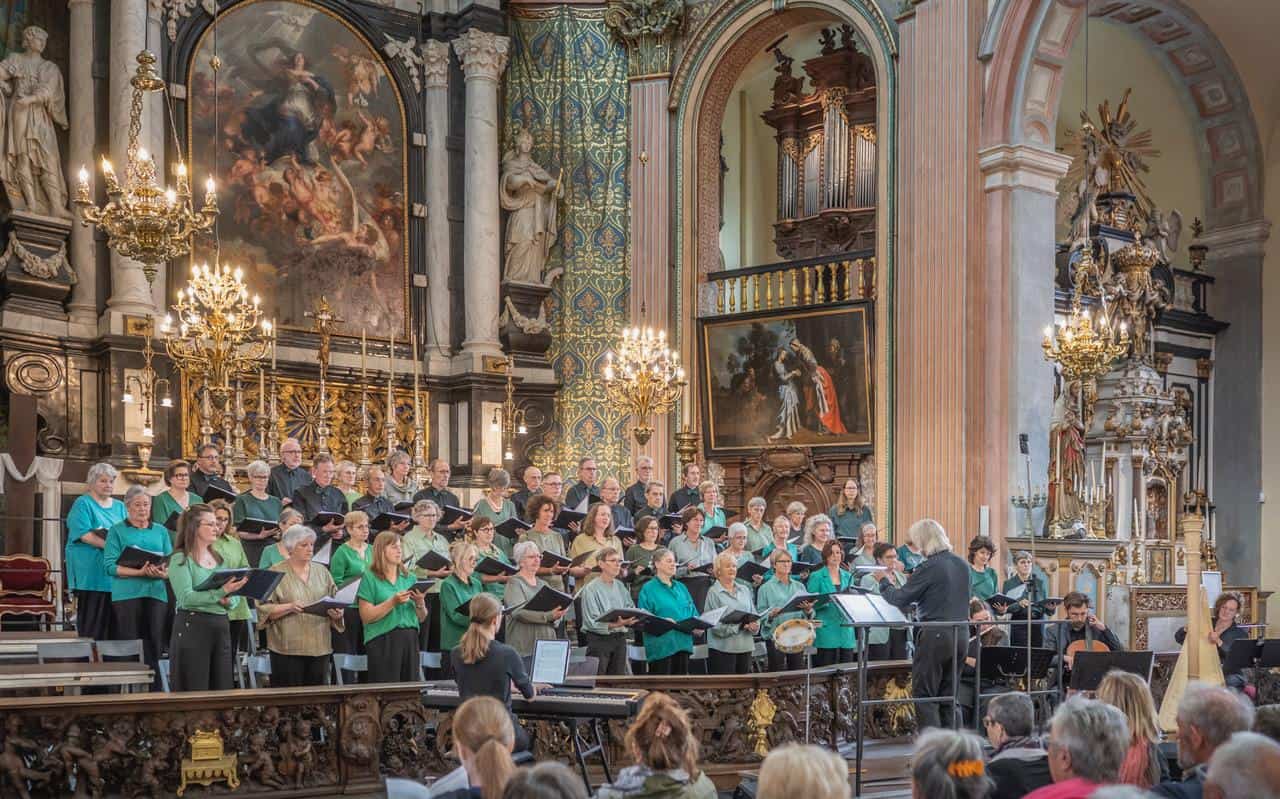
The choir Scala Vocale enjoys a solid reputation and works tirelessly under the inspiring leadership of musical polymath and conductor Lode Tooten. This weekend they presented two well-attended concerts in the beautifully restored Begijnhofkerk, a jewel in Mechelen's crown. Heritage that is cherished. A space with wonderful acoustics. To be able to perform there is a privilege.
The 52-member choir filled the space with impressive choral parts. With an eye for detail, the ladies appeared in green blouses in two shades: a bright green and a pastel shade, which refers to green Ireland. The polyphonic choir allows time to slow down in an era of instant consumption with their rich musical nuance. Love for music keeps the choir members young and fresh. The bar was set very high once again. Delivering such a repertoire flawlessly is a challenge even for professionals. Here and there there was a minor slip, but the whole was extremely enjoyable and commanded admiration. The commitment and dedication of choir and conductor were particularly appreciated and welcomed by the audience.
The choice of works is beautifully described in the programme booklet. The folk music of the British Isles – with its roots in England, Scotland and Ireland – is a treasure trove of stories, emotions and cultural heritage. Through the centuries, these songs have brought people together, preserved memories and offered comfort in times of joy and sorrow. Singing together is still deeply ingrained. Scala Vocale continues this tradition.
The first part opens with a traditional 'Greensleeves'. The harp, or clàirseach, the national symbol of Ireland, plays an important role in the accompaniment. Furthermore, it is very pure with the warm sound of a cello, piano and the tinkling sound of a flute. The first part is devoted almost entirely to the timeless music of Henry Purcell. His compositions combine the best of both traditional and more modern musical forms and structures and show an interesting fusion with French and Italian influences. He is a particularly brilliant and versatile composer and wrote church music, songs, instrumental fantasias, odes, music for plays and operas. What makes his music so special is the emotional directness, the lively rhythmics and his sharp sense of text. Moreover, he managed to bring together the language of the people, the theatre and worship into a unique musical idiom, deeply rooted in English culture.
Purcell was a popular composer of welcome songs for royal persons and hymns of praise. Lode Tooten made a fine selection from 'King Arthur'. This shows how 'King Arthur' is not only a political-historical work, but also a musical portrait of a people: lively, loving, warlike and connected to the earth. Thus he bridges the gap between court and village, between theatre and tradition, and between the grandeur of myths and the simplicity of the human heart. Furthermore 'Ode for Queen Mary's Birthday'. Excerpts from 'Dido and Aeneas' and 'The Fairy Queen'. Very beautiful is the song 'Hush no more' in which the conductor lets the silence between the words speak. In between a sonorous instrumental number so that the voices of the choir members can rest for a moment. A warm voice recites some English poetry in a nice alternation of music and language. As the closing piece of the first part, a work by the British contemporary composer John Rutter, who mainly writes compositions for choirs. The choice fell on the beautiful 'The Spring of Thyme'. The cycle is not only a tribute to British folk music, but also to the art of arranging. Scala Vocale, for its part, understands the art of filling in the offered oeuvre with aplomb. The songs string themselves together like beads in ever-changing arrays of sounds and forms. You listen to the whole with hushed delight. Conductor Lode Tooten proved that he masters the grammar of both composers. He sometimes takes control of the tempo and conveys it to his choir members: simple and complex, mysterious and transparent.
After the intermission, more popular English songs are performed with a series of folk songs stored in collective memory, including 'Old Irish Blessing', 'Cockles and Mussels' in a weaving of voices, 'Scarborough Fair' etc... As a finale, 'Your Hay It Is Mow'd' even received a humorous Mechelen translation created by the Institute of the Mechelen Dialect. This song refers to the Beggar's Opera. A beautiful and witty finale.
Choir and conductor, together with the instrumentalists, received enthusiastic and prolonged applause.