
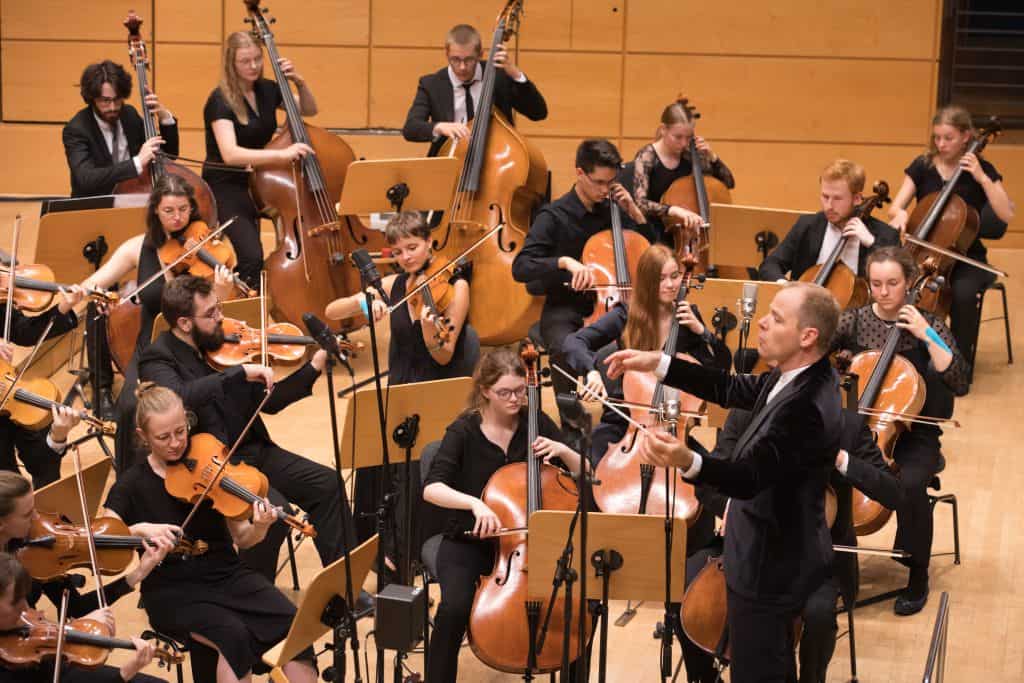
On Saturday, August 9, the Landesjugendorchester Sachsen-Anhalt (LJO) gave an impressive concert in Quedlinburg, a city in the German state of Saxony-Anhalt, known for its medieval charm and characteristic half-timbered houses. The city, which is on UNESCO's World Heritage List, hosts the "Quedlinburger Musiksommer" annually, this year for the 45th time.
The festival, organized by the Evangelische Kirchengemeinde Quedlinburg, offers listeners unique musical experiences at special locations, where both the eye and ear are stimulated.
Expectation and reality: historical charm versus modern venue
Yet that expectation was not fully met on this occasion. Despite the suggestive image in the festival brochure, the concert ultimately took place in the sleek, modern congress hall of the Palais Salfeldt. I was not the only one who had expected a different location: one of the speakers also referred in his remarks to a historical hall that appealed more to the imagination. The chosen space proved acoustically unsuitable for the late Romantic repertoire of the evening. Moreover, the heat and lack of ventilation made the circumstances particularly unpleasant. During the quietest passages, the sound of ventilation intruded audibly, which considerably disturbed the listening pleasure.
Some listeners left the hall early; others tried to cool themselves with a fan. The atmosphere hardly did justice to the promise of historical grandeur that the festival evoked. The lack of ambiance made it all the more painful that the music – though brilliantly performed – could not fully come into its own.
An orchestra that rises above the venue
For this very reason, the LJO deserves all the more praise for the way it managed to sustain itself under these conditions. The orchestra, consisting of approximately seventy young talents between thirteen and twenty-three years old from the state of Saxony-Anhalt, more than lived up to its reputation as a breeding ground for the next generation of classical musicians. The ten intensive rehearsal days under the direction of their experienced principal conductor Michael Wendeberg, assisted by musicians from the Staatskapelle Halle, clearly bore fruit. The ambitious program included works by Smetana and Bruckner, which require not only technical precision but also deep musical understanding.
Smetana's fresh opener
The evening opened with Smetana's Z českých luhů a hájů (From Bohemian Forests and Fields) from the cycle Má vlast (My Homeland), which the orchestra brought to life with liveliness and fiery energy. The freshness of the performance evoked images of the Czech landscape. The orchestra convincingly conveyed Bohemian lyricism and vivacity, and personally reminded me of the walk I had taken earlier that day on the Hexentanzplatz near Thale.
Bruckner's Fourth: layered grandeur
This was followed by Bruckner's Fourth Symphony, the "Romantic". Wendeberg chose the classical second version of 1878/80 and built his interpretation carefully and gradually. His approach – notably influenced by his teacher Toshiyuki Kamioka – united restraint with powerful eruptions, pushing the orchestra to its limits.
The first movement reminded me of a moment earlier that morning: from the bus I saw the Schlossberg slowly emerge in the distance with its castle and convent church. Similarly, this music unfolded – like a plant carefully opening, in a tension between control and intensity. In the Andante, the strings initially searched for balance, but gradually found their common voice. By the end, in the choral melody of the coda, a warm unity emerged in the ensemble. The chosen tempi allowed the music to breathe here.
The beloved Scherzo, with its playful hunting motifs, visibly brought life to the audience, despite the oppressive heat. But it was especially the finale that made a deep impression: Wendeberg built it with great control toward an imposing climax. Instead of rapid contrasts, he chose a long arc of tension. He gave the harmonies room to fully unfold, with a saturated, layered sound that organically grew toward a final chord that resonated long in the space. For a moment there was silence in the hall – the audience seemed to want to let the moment settle before applause burst out.
During this performance I had to think of the concept of "prism-ism" that I discovered earlier that day in the fascinating Lyonel Feininger Museum. Feininger built his paintings from transparent, interlocking planes of color – prisms of light, in which each part contributes to the whole. In a similar way, Wendeberg constructed his interpretation: not a sequence of isolated moments, but a layered build-up of sound blocks that illuminate and reinforce each other. Each musical 'prism' was individually lit and given its own color, but only in connection did the full image reveal itself – rich, multifaceted, overwhelming.
As an encore came Locus iste, sung by the orchestra. A welcome stillness after the symphonic sound spectacle. At the same time, this piece made painfully clear how beautifully this ensemble would have done justice to itself in a historic church with appropriate acoustics.
When youth opens up in sound
Yet the greatest applause rightfully and genuinely belongs to the young musicians, who exceeded themselves. Thanks to the expert direction of Wendeberg and the inspiring collaboration with their coaches from the Staatskapelle Halle, they gave nothing less than their very best. The emotion after the performance – visible in the exuberant reactions of the audience – was striking proof of this.
One musician in particular I want to mention: the solo horn player. I have attended concerts of top ensembles where the famous opening solo from Bruckner's Fourth Symphony ended in a fiasco. Here, however, the solo sounded unerring – full of control, tonal richness and emotion. A performance of considerable merit.
When music breaks free from the walls
What the concert in Quedlinburg above all demonstrated is how powerful music can be. The LJO proved that commitment, talent and close musical collaboration are capable of transcending the limitations of the environment. The young orchestra succeeded in bringing a programme of great artistic value to life, with moments of deep emotion and inspiration.
The performance was thus not only a promise for the future of these young musicians, but also a powerful plea for taking concert conditions seriously. When these two elements come together – talent and a worthy context – then music can show its full transformative power. And that is ultimately what festivals like the "Quedlinburger Musiksommer" are meant for. For art is not a luxury, but a necessity, as Feininger once aptly put it.