
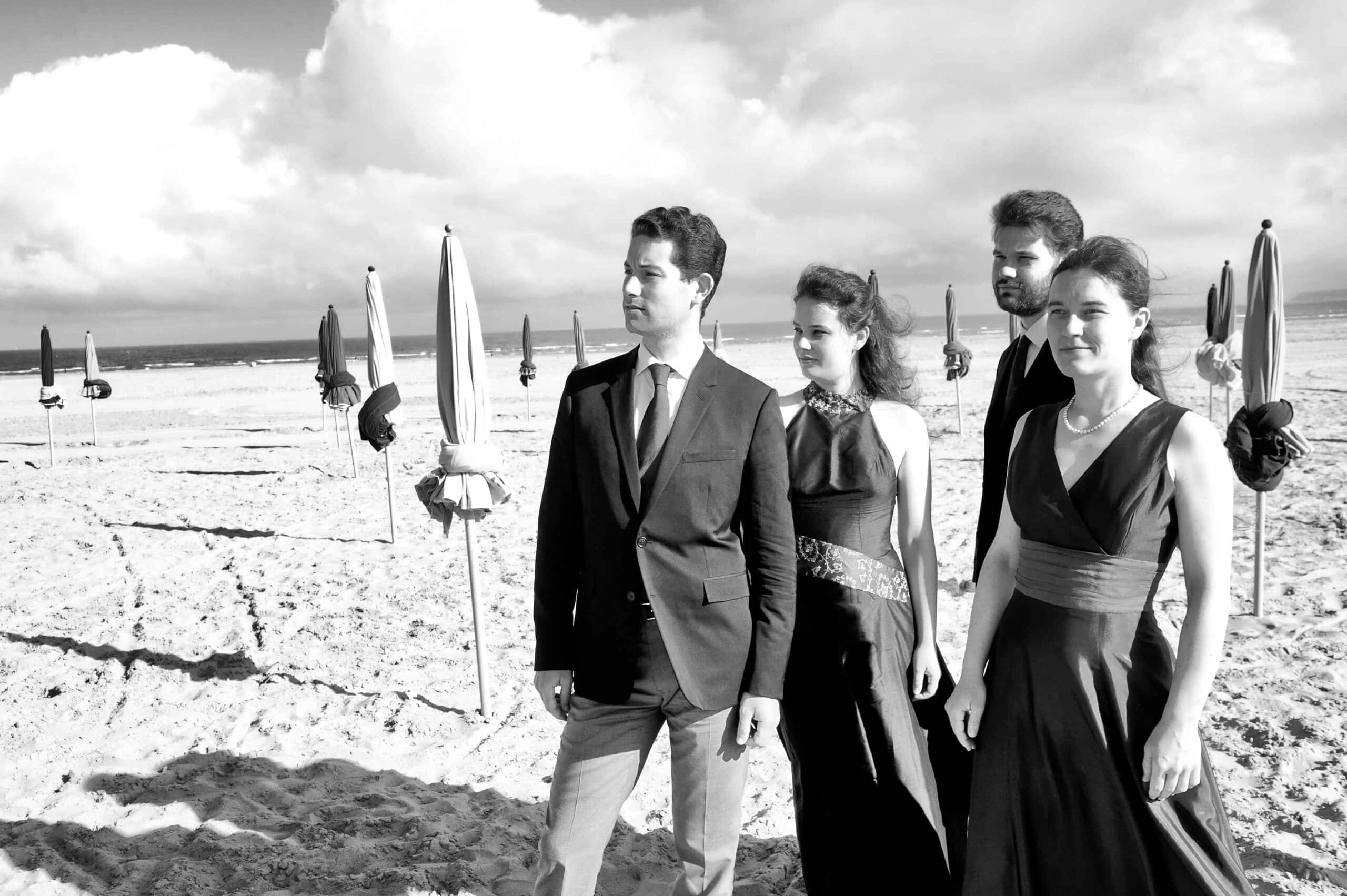
The summer festival Midis-Minimes is roughly halfway through, and for string quartet lovers, festive times are ahead. For a week you can enjoy the finest that the repertoire has to offer at the Brussels conservatory. Together with Guillaume Lekeu and Camille Saint-Saëns, the French Quatuor Girard opened the proceedings today.
For the young foursome, playing together is a family affair. Choosing a name for the ensemble was therefore quick for the two brothers and sisters. The quartet studied in Paris and Geneva and is also an alumnus of the European Chamber Music Academy. Since September 2016, Quatuor Girard has been based in Belgium. As artist in residence at the Muziekkapel Koningin Elisabeth, it perfects itself under the guidance of the Artemis Quartet. And that naturally opens doors. Over the past months, the ensemble was also heard at the Brussels Middagconcerten (21 March 2018) – when, notably, Saint-Saëns' first string quartet was also on the programme – and performed twice on stage during the second edition of the MuCH Waterloo Festival (6-10 June 2018).
But Quatuor Girard opened this afternoon with a remarkable Molto adagio by the short-lived Guillaume Lekeu. For this extended movement, written in October 1887 and a study for the six-part string quartet that he completed a few months later as an eighteen-year-old, the Belgian composer drew inspiration from a verse from the Gospel according to Matthew: "My soul is overwhelmed with sorrow to the point of death", Jesus spoke in the Garden of Olives shortly before He would be betrayed. Those who thought that this week of string quartet would start in a festive manner were therefore disappointed. Instead, the audience received a lamentation as gripping as it was sombre. Sempre cantate e doloroso Lekeu added to the title of his piece, and thereby nipped every glimmer of hope in the bud from the outset. Fortunately, the performance did make a positive impression. A well-balanced ensemble playing was presented: expressive, skilfully timed and with an intensity like ebb and flow. A feather in the cap also for the pure intonation, not least from the first violin, which made the music all the more compelling. This one-acter has a soul. Quatuor Girard laid it bare in a serene yet resolute manner.
Initial form
Despite his fairly extensive chamber music oeuvre, Camille Saint-Saëns only turned to the string quartet later in life. The man was already approaching retirement age when in 1899 his first work in the genre saw the light of day. But of course you are a tone poet for life. And a career without a single string quartet to your credit is unthinkable for any self-respecting composer. Le quatuor est "la forme la plus pure de la musique instrumentale, la forme initiale, la source d'Hippocrène", as Jean Bonnerot, secretary and biographer of Saint-Saëns, noted from his lips (C. Saint-Saëns (1835-1921): sa vie et son œuvre, p. 172). Ultimately, Saint-Saëns would also indulge at that fountain a second time, but he always coloured neatly within the lines of tradition. Could that be why both works have remained in the shadow of the new sound that Debussy and Ravel managed to produce with their quartets? Anyone who listens to the first movement (Allegro. Più allegro) and the subsequent scherzo (Molto allegro quasi presto) of Saint-Saëns' maiden work will indeed discern Mendelssohn's perfume. The Molto adagio, a haunting cry from the heart, in turn bears a strong resemblance to Beethoven. The finale (Allegro non troppo), on the other hand, makes a less memorable impression, and Quatuor Girard unfortunately showed itself unable to revise this judgment during this concert. But in what preceded it, the musical affinity certainly pulled its weight. From the outset, the empathy was clearly audible, as evidenced by the sharp contrast between the somewhat dreamy introduction and the at times particularly assertive bowing that followed. The attractive scherzo sounded neat, with a fugal middle section that excelled in transparency. And the slow movement was phrased with clear articulation and great feeling. Enough delights therefore to return home with a delighted feeling.
- WHAT: Guillaume Lekeu (1870-1894), Molto adagio sempre cantate e doloroso (V.52) || Camille Saint-Saëns (1835-1921), String Quartet No. 1 in E minor (opus 112)
- WHO: Quatuor Girard [Hugues & Agathe Girard (violin), Odon Girard (viola), Lucie Girard (cello)]
- WHERE: Koninklijk Conservatorium, Brussel (as part of the festival Midis-Minimes)
- WHEN: Monday 30 July 2018
- PHOTO: © Yannick Coupannec