
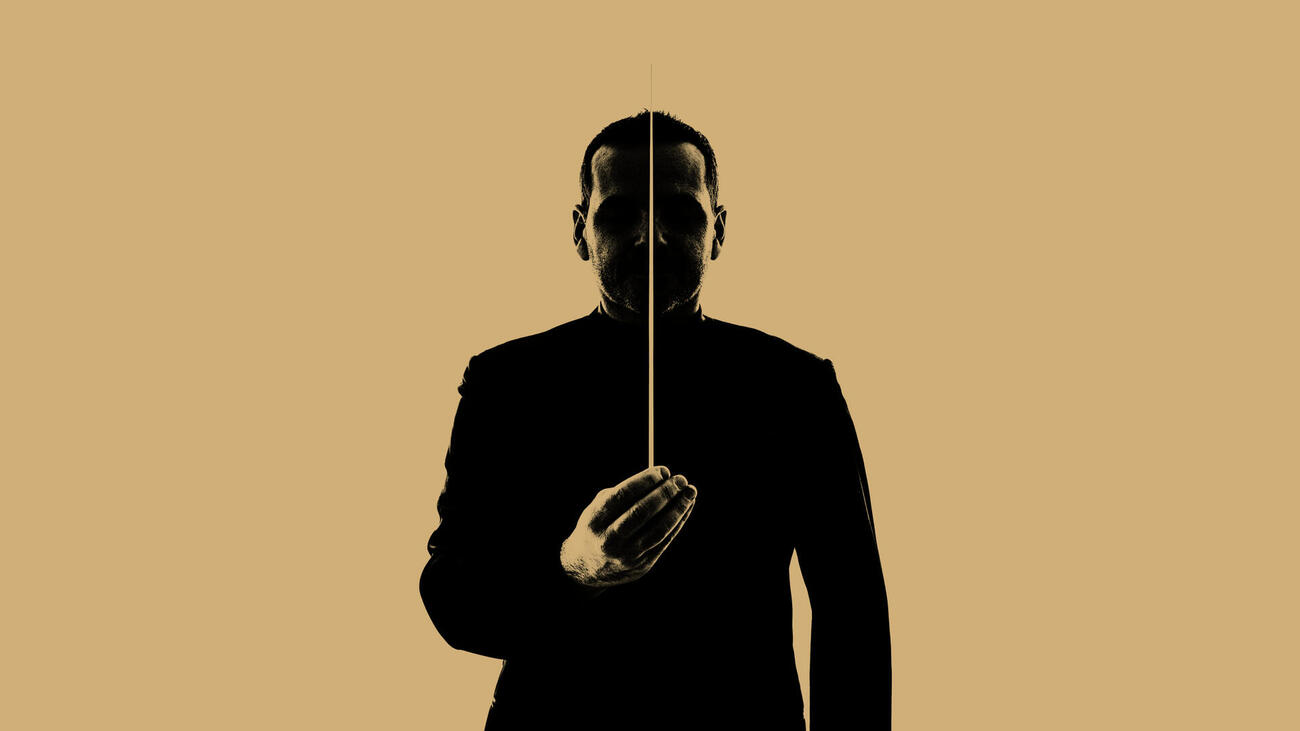
There are those season brochures you flip through and put away again. And then there are ones that immediately set you planning. The one from the Orchestre Philharmonique Royal de Liège – for many simply the OPRL – undoubtedly falls into the second category.
But don't be misled by the motto Un orchestre, mille couleurs. Those thousand colours are no marketing slogan. They describe a genuine artistic philosophy: tradition not as heritage carefully preserved under glass, but as material in motion. More than a hundred concerts, nineteen thematic journeys, and a dramaturgical coherence that holds it all together. That's no window dressing. That's a clear artistic vision.
Bringuier builds on
Music director Lionel Bringuier – the charismatic Frenchman who has visibly propelled the orchestra forward over the past season – begins his second season with a clear but not prescriptive direction. The great repertoire gets its full place: Rachmaninov, Brahms, Mahler, Tsjaikovski, Shostakovich, Saint-Saëns and Mozart shine on the programme. But Bringuier is too curious to stop there. Philip Glass, Danny Elfman, Jonny Greenwood, Steve Reich and John Adams – composers who push the boundaries of the classical – get at least as much stage time.
What stands out in the grand symphonic cycle is precisely this refusal to limit itself to one style. The OPRL presents itself as an open system in which French symphonic tradition, late-Romantic grand forms and American contemporary voices do not displace each other but modulate. Clearly structured, but open in aesthetics.
Carlos Simon as structural countervoice
The creative key to the season is Carlos Simon, an American composer who is working as compositeur en résidence. His music – rooted in Afro-American traditions, spirituals and jazz – functions not as an exotic addition or obligatory topicality slot, but as a full countervoice within the repertoire. Beethoven and Simon do not exist alongside each other on the programme: they are deliberately placed within the same field of tension.
His new creation will have its world premiere on 8 and 9 October, with none other than Hilary Hahn as soloist. If that isn't a statement.
A constellation of soloists
The list of soloists is impressive and diverse. Behzod Abduraimov opens the season on 17 September with Tsjaikovski's First Piano Concerto. Joe Lovano pays homage to John Coltrane on 25 September – a hundred years after his birth – in what promises to be an evening that attracts both jazz-loving classical fans and classical-loving jazz fans to the Salle Philharmonique. Ton Koopman conducts Mozart and Beethoven authentically on 3 October. Evelyn Glennie plays percussion in March in Jennifer Higdon's Concerto, in a programme centred on Steve Reich.
For piano recitals there are Benjamin Grosvenor (29 November), Anna Vinnitskaya (24 January) and Kirill Gerstein (4 April). But these recitals are more than an addendum to the great symphonic story. In the intimate context of a solo concert, the perspective shifts completely: the piano as a concentrated orchestra in miniature. And don't forget the organ recitals on the authentic Schyvenorgel, where the hall itself functions as a resonance space. A thousand colours, but in extreme concentration.
The public as co-programmer
This same philosophy of multiplicity is also reflected in public engagement. L'Heure Symphonique is being renewed: concerts at 7pm, kept compact at around sixty minutes. Not a simplification, but a redefinition of intensity. Music Factory approaches repertoire almost like a laboratory. OPRL+ seeks cross-pollination with other arts. Free concerts – Musique à midi on Tuesdays, the Hors-série events – ensure that the threshold to the Salle Philharmonique remains literally low.
And then there is the à-la-carte subscription, where the listener is no longer bound to a predetermined season package but creates their own journey. In doing so, the orchestra shifts from institutional programming to a model of shared curation. If that sounds theoretical: it simply means you choose what you want to hear, and the OPRL takes you seriously in that.
Why Liège is worth the trip
For classical music lovers in Belgium, the Salle Philharmonique is really a public secret. Liège is closer to most Flemings than they sometimes think, and the hall has something that is not taken for granted: an acoustics, an architecture, an atmosphere that truly brings a concert hall to life. And now also an orchestra that refuses to be a monument.
Under Bringuier, the OPRL has become less an endpoint than a flow of colours, tensions and reinterpretations – a workshop rather than a temple. If that ambition translates on stage into the same precision and curiosity as in the programming, then this will not be a season that is simply "presented". Then it is a season that unfolds – evening after evening, colour after colour.
Individual tickets go on sale from 8 June. Subscriptions are already available. If you already know that Hilary Hahn in October or Nelson Goerner in April must not be missed on your calendar, you'd better not wait.