
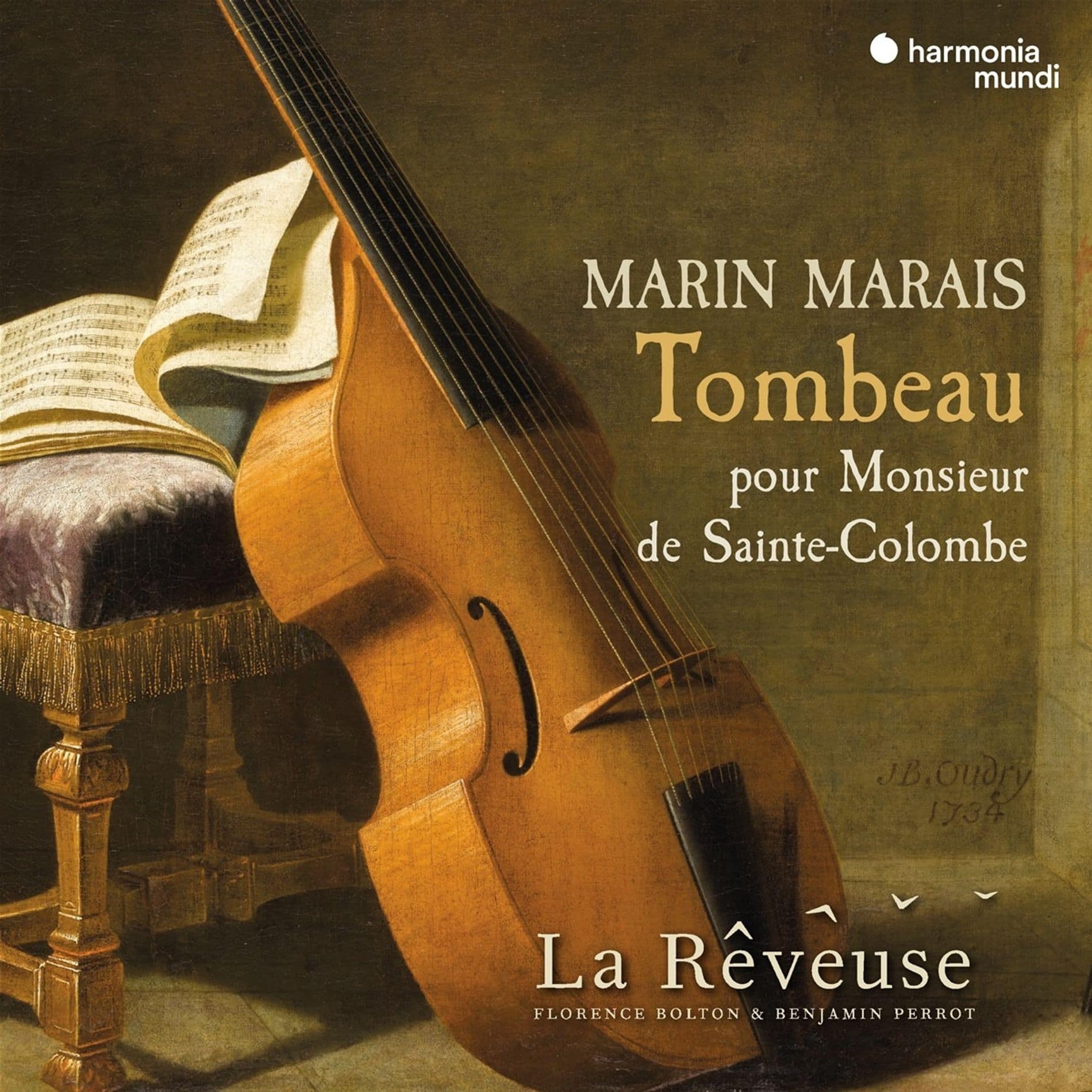
Marin Marais - Tombeau pour Monsieur de Sainte-Colombe - Pièces de viole du Deuxième livre (1701)
La Rêveuse: Florence Bolton and Emily Audouin (bass viol), Benjamin Perrot (theorbo & baroque guitar), Carsten Lohff (harpsichord)
Harmonia Mundi HMM 905356 • 66' •
Recording: Nov. 2022, Béguinage de St Trond
In August 2021 I discussed here the album La Rêveuse et autres Pièces de Viole released by Alpha with Sophie Watillon and Friederike Heumann on viol, Xavier Díaz-Latorre on theorbo and baroque guitar, Evangelina Mascardi on baroque guitar and Luca Guglielmi on harpsichord.
This time it is not Alpha, but Harmonia Mundi and with a different programme by…La Rêveuse with Florence Bolton and Emily Adoulin on viol, Benjamin Perrot on theorbo and baroque guitar and Carsten Lohff on harpsichord. The name of the ensemble is derived from the piece of the same name by Marin Marais for viol and theorbo from his Fifth Book. For the uninitiated, confusion regarding the naming is possible, but the distinction seems clear enough to me nonetheless.
The viola da gamba, like the guitar, has 'frets' on the neck and has six to seven strings. The bow is held differently, not overhand like with cellists. The dimensions of the viol vary considerably. The smallest member is the excellently manageable 'dessus de viole': playing with the instrument on the lap is no problem at all. This is different with the 'basse de viole', as its substantial dimensions only allow for the playing position between the legs. The even larger family member, the violone, is played standing up, like the double bass. All instruments produce a magnificent sound and are excellent for small spaces, properties that partly explain the popularity of the viol.
No wonder, then, that the viol family produced magnificent music in the Renaissance and Baroque, as did the typically British Consort Music, ensembles formed by one or more instruments from the viol family. Just as there were also 'broken consorts' to be found everywhere back then, when besides the viol other instruments were also involved.
A large number of composers wrote music specifically for the viol, including some of the greatest, such as in England William Byrd (1542-1623), Thomas Robinson (1560-1610), John Dowland (1563-1626) Orlando Gibbons (1583-1625), William Lawes (1602-1645), John Jenkins (1592-1678) and Henry Purcell (1659-1695). In Germany it was especially Diet[e]rich Buxtehude (1637-1707) and to a lesser extent Johann Sebastian Bach (1685-1750) who took a pioneering role with regard to the instrument. In France the bar was set high thanks to Monsieur de Sainte-Colombe (1656-1728), Marin Marais (1656-1728) and Robert de Visée (1650-1730) who set the tone in the genre. You can read more about this rich viol history here.
That Sainte-Colombe is also represented on this album has everything to do with Marais's deep admiration for his former teacher. Robert de Visée was a great virtuoso on the lute, guitar, theorbo and viol, and like Marais was in the service of Louis XIV, the Sun King, an important patron of the arts.
From a historical perspective and 'translated' to our time, the most important role of Marais for us is of course his compositions for the viol, documented in five books filled with some 550(!) compositions for one to three viols, written in the period 1686-1725.
One of the discographic highlights in this respect is still the recording on the long-defunct record label L'Oiseau-Lyre (once part of the Decca group) with a selection from Book IV of the Pièces de Viole, performed by Vittorio Ghielmi and Christophe Coin (viol), Pascal Monteilhet (lute) and Christophe Rousset (harpsichord).
The dances and character pieces: they are in the best hands with La Rêveuse as well. The historically informed performance practice does not in the least hinder the musical pleasure, eloquence and refinement radiate from these interpretations and the refined ornamentation also contributes to these pieces and the instrumentation reaching their full potential. Thus this French ensemble sketches an extremely imaginative and spiritual picture of an art form that has fortunately not succumbed to oblivion. A film has even been made of it starring gambist Jordi Savall, assisted by actors playing the roles of respectively Monsieur de Sainte-Colombe and Marin Marais: Tous les matins du monde.
The recording is equally excellent and the CD booklet offers plenty of information. All things considered, a magnificent edition.