
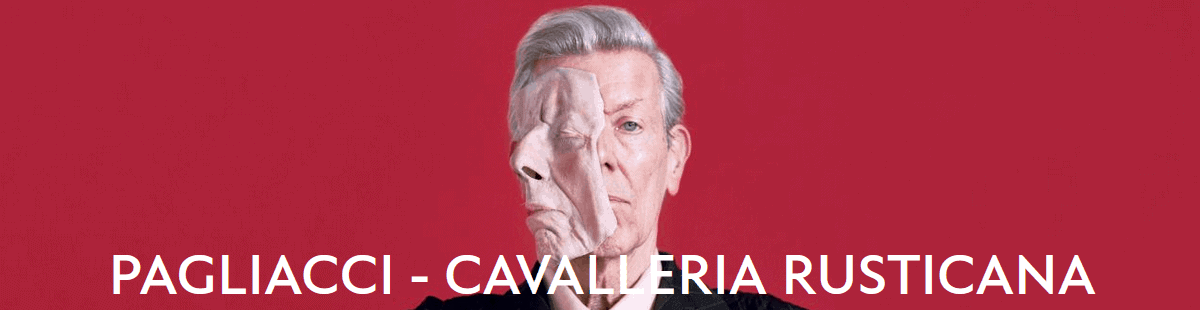
The Dutch National Opera in Amsterdam opens the season with the sure-fire double bill consisting of Leoncavallo's Pagliacci and Mascagni's Cavalleria Rusticana. An attractive programme for the opera enthusiast, certainly with Robert Carsen as director and the young conductor Lorenzo Viotti who immediately gets an early baptism by fire as chief conductor of the opera house.
You could even say: once again a masterstroke by Robert Carsen, for the director always finds an interesting and especially original angle to turn an opera into a successful and moving experience. In his production, he does not take the route of the local colour of southern Italy, as for instance Damiano Michieletto did in his equally fine staging of the double bill at De Munt in Brussels in March 2018. Carsen opts fully for the aspect of theatre within theatre. His starting point is that what takes place on stage is parallel to what happens in real life. In that sense it is logical that the performance begins with Pagliacci by Ruggero Leoncavallo (1857-1919), in which the Prologue alludes to the role of theatre that will be performed: the characters in the piece are real people, people who are like those who will soon sit in the audience to watch the piece. Carsen has the Prologue declaimed in front of the red stage curtain and not by Tonio, the "Pagliaccio" in the opera, but by a "prologue singer" who warns the audience that they will watch actors performing the relationships of real people. When he has finished his prologue, the curtain rises and there is another stage curtain: that of the scene on which the theatrical piece will be performed by the group of theatre players – with Canio and Nedda as Pagliaccio and Colombina. The group of theatre players enters from the auditorium, which is already surprising. But the greatest surprise effect consists of Carsen having the audience that comes to watch, cheering from the front rows of the auditorium, storm onto the stage. In this way Carsen identifies the "real" audience with the audience of the piece and reinforces the idea further with a mirror at the back of the stage that reflects the auditorium at crucial moments. He also plays creatively with the light in the auditorium, which runs parallel to the lighting for "the piece". The idea of "mirroring" the audience in the auditorium on stage has been applied more than once in opera, but rarely has it been used as efficiently and meaningfully as here.
The first part of Pagliacci takes place in the "real life" of the actors. In the second part the intrigue becomes the subject of the performed piece. Canio is the leader of a travelling theatre troupe and husband of Nedda. Tonio, himself in love with Nedda, suggests that Nedda is unfaithful to her husband. Canio swears he would kill her lover. Tonio attempts to seduce Nedda, but without success. As revenge, Tonio tries to have her caught. Nedda refuses to reveal the name of her lover and, completely distraught, Canio stabs his wife to death. He then also kills Silvio, who reveals himself as the lover by coming to her aid. The famous closing line of the one-act La commedia è finita is here then, as Leoncavallo wrote it, declaimed by Tonio – with an ironic clown mask. A biting ending that fits with the ominous prologue.
Carsen would not be Carsen if his invention were not only ingeniously performed, but moreover applied with brilliant timing. The comic elements in the second part with the foolish servant Taddeo (the role of Tonio) he gives such a burlesque expression without at the same time subtly allowing the threatening menace to be felt. Play and reality blend together in this story of love and jealousy, passion and revenge.
Emotion stirred to the utmost
In Cavalleria Rusticana by Pietro Mascagni (1863-1945) the story of infidelity, passion and betrayal is, if anything, even rawer. Direct emotion is paramount and the orchestra heightens the feelings further, for instance in the orchestral reprise of the prelude after the central duet between Santuzza and Turiddu – which begins with Tu qui, Santuzza. The hymn Regina Coeli sung by the chorus and the symphonic intermezzo mark the serenity of village life in contrast with all the inflamed passions. Here too Carsen opts for a framing that suggests a theatrical performance, with make-up and dressing tables on stage instead of a rural Sicilian location. The abstraction works less self-evidently here and the characters sometimes seem lost in the story. The grey, sombre stage backdrop behind which the villagers disappear to go to the service in the church does demand much of "the imagination of the spectator" which Carsen wants to give "free rein" to (background article in magazine Odeon). It is original, however, to have the choir conductor Ching-Lien Wu play her role on stage during the performance of the delightful Regina Coeli chorus.
Fortunately there are the excellent singer-actors, who here too stir the spectator's emotion to the utmost. Carsen guides them through the outbursts of eroticism and violence in a vital but nowhere shocking manner. The Georgian soprano Anita Rachvelishvili, who was also seen at the Dutch National Opera in Khovanshchina, plays a Santuzza who not only acts intensely in every fibre, but also sings with full commitment without ever doing violence to her full, lush voice.
The performance is carried in any case by a fantastic cast. Already the first minutes of Pagliacci with the Prologue by Gevorg Hakobyan give you goosebumps. At the same time Lorenzo Viotti lets all the details of the thematic material sound in the prelude, which from the outset of the opera creates shivers. The baritone returns in Cavalleria as the deceived Alfio, who, goaded by his rival Turiddu, can no longer control his revenge with fatal consequences. With a charming and perfectly controlled voice, the singer performs both parts. The prologue with informative detachment, the role of Alfio with suppressed anger. The role of Nedda in Pagliacci is played by Ailyn Pérez, who indulges in her character of Colombina with typical "actress-like airs". Her high soprano does come across somewhat shrill when she has to belt out forcefully. In Stridono lassu, her beautiful aria about freedom, she comes across somewhat indifferent. Although she offers a nice interpretation, she certainly does not have the convincing power of Anita Rachvelishvili as Santuzza in Cavalleria. The rest of the cast is very well filled, and in Cavalleria the performance of Elena Zilio as Lucia is certainly also worth mentioning. With a tender voice and full involvement she experiences the events. A beautiful and modest Mamma Lucia.
Lorenzo Viotti is a young Swiss-French conductor who from the 2021-2022 season becomes the new chief conductor of the National Opera and the Dutch Philharmonic Orchestra, succeeding Marc Albrecht. He takes over the production from Mark Elder, who had to withdraw for health reasons. With cautious and precise gestures, he conducts the orchestra into an expressive and detailed ensemble that brings the veristic score to life in all its nuances. Not only does he bring the dramatic and narrative passages to life, but also the serene and soft intermezzi that in both operas form the transition between the sections. His performance in this veristic diptych by Leoncavallo and Mascagni promises a beautiful musical future for the National Opera.
A performance of a top-tier work from the repertoire that, in the words of Robert Carsen in the programme notes, invites you to "look at the world anew through the eyes of theatre and ask ourselves how life and art imitate and reflect each other."
- WHAT: Pagliacci/Cavalleria Rusticana by Ruggero Leoncavallo/Pietro Mascagni
- DIRECTION: Robert Carsen
- VOICES: Gevorg Hakobyan, Ailyn Pérez, Brandon Jovanovich, Roman Burdenko, Marco Ciapponi, Mattia Olivieri, Anita Rachvelishvili, Rihab Chaieb, Brian Jagde, Elena Zilio
- ORCHESTRA: Dutch Philharmonic Orchestra conducted by Lorenzo Viotti and Choir of the National Opera (choir rehearsal: Ching-Lien Wu)
- WHERE: National Opera Amsterdam
- WHEN: Sunday 8 September 2019 (performances until 28 September)