
With Don Giovanni, Tom Goossens presents his second Mozart opera, again one from the Da Ponte trilogy. The director is well-versed in opera stories. I remember that from the engaging conversation he had in "De Liefhebber", the weekly highly praised Saturday program of my (former) colleague Katelijne Boon. He has proven that on stage more than once. In the great opera repertoire, the other Da Ponte Mozart opera was to be seen in June 2023 at OBV, Le Nozze di Figaro.
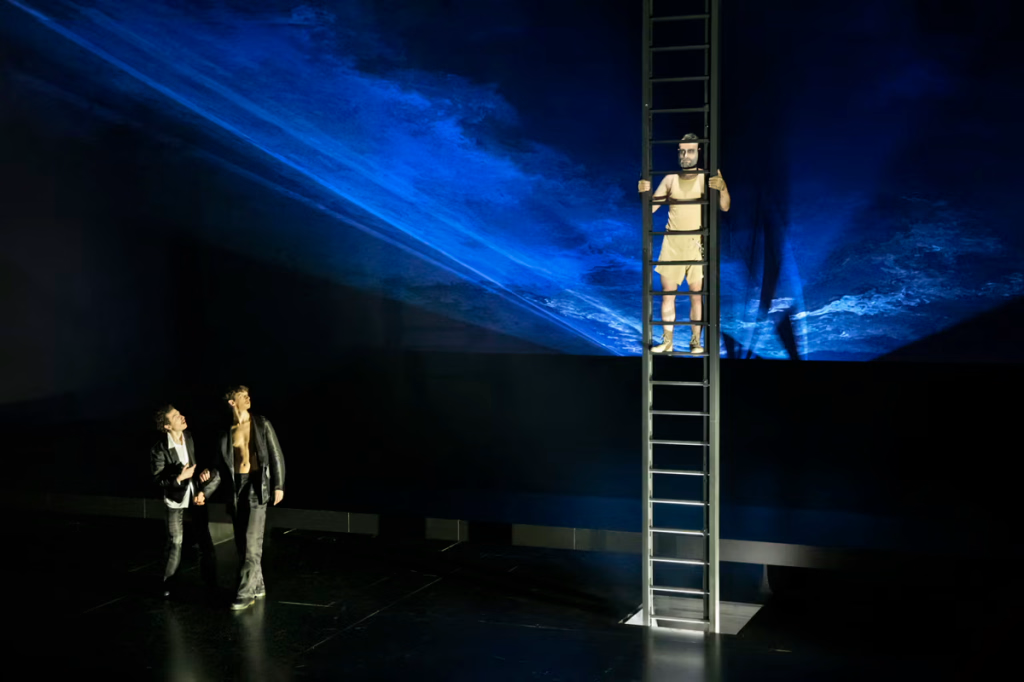
Nachtstück with ladder
The beginning is certainly striking: the performance seems to be over! The chorus comes to greet during the overture. Does the director want to subtly point out that what we are about to see is a story that can always repeat itself? In any case, the framework of the performance is completely undefined and timeless. The choreography that the choir members perform during the telling overture is superfluous. Such pointless choreography occurs more frequently throughout the piece. That they are standing in their underwear is ugly and ridiculous and is also a kind of "hallmark" of the performance. Glad that Donna Elvira appears with her aria Ah chi mi dice mai in a beautiful red dress.
There is barely any set design. The sparse stage is a large dark undefined space, with clouds drifting past here and there and lighting effects. The singers move around only by stepping up and down a long plateau. A long strip featuring the catalogue aria is hardly visible from the stalls. As nice as the chickens on Masetto's (imaginary) farmyard may be (he is after all a farmer!), it is still a pitiful sight to see the animals scurrying across the stage….It becomes sad moreover when, during the wedding feast, servants pass by with (imitation) roasted chickens on a stick. Certainly meant to be funny, we are after all in a dramma giocoso, but still somewhat bitter….
There is little character direction. Don Giovanni's seductive capacity is lost among the barely recognizable peasant couple Zerlina-Masetto as bride and groom. That poor Zerlina appears at her wedding feast also in a colorless underwear-like outfit is at the very least bizarre. Fortunately, her bridegroom Masetto has a beautiful voile skirt that he can have her put on. One waits for the scene in which Don Giovanni exchanges clothes with Leporello for the serenade at Donna Elvira's window Deh vieni alla finestra to see a successful attempt at seduction/deception. The amusing accompanying movement of Leporello to Don Giovanni's gestures characterizes Leporello as the servant who wants to be Don Giovanni's equal, but is also mocked by him and yet cannot break free from him. A pity that this good idea is repeated shortly after and thus loses its effect. Just like the smashing of wine bottles when Don Giovanni becomes furious. But the sharp balance between lust and love, freedom and respect, life and death, this direction misses out on. The interweaving of comedy and tragedy remains superficial.
Commendatore
There is one striking and lasting attribute in the set design: a long ladder. This ladder places the character of the Commendatore at the center. In several decisive passages, the Commendatore climbs up and down the ladder, as the spirit who appears not only at the end, but has kept an eye on Don Giovanni's debauched adventures. With his penetrating gaze, he is the most sharply psychologically drawn character of the opera. The father of Donna Anna (killed by Don Giovanni), will ultimately punish the criminal woman-seducer with death, but he has followed him throughout the entire opera.
The music says it all
The big winner of the performance is conductor Francesco Corti with the Symfonisch Orkest Opera Ballet Vlaanderen. He has filtered all the nuances of seduction, drama, and irony from Mozart's score and supports with the orchestra the emotional impact of the singers who as actors display little expressivity. Vocally they generally perform well: Michael Arivony as Don Giovanni, Arianna Vanditelli as Donna Elvira are certainly acceptable, which does not apply to Kateryna Kasper as Donna Anna, who especially in her aria Or sai chi l'onore shrieks ugly high notes. Michael Mofidian steals the show as Leporello, exuberant and witty. The members of the Jong Ensemble Opera Ballet Vlaanderen certainly deserve mention. Sawako Kayaki was quite a decent Zerlina, while Emanuel Tomljenovic sang a commendable Don Ottavio, a role with a difficult balance between whiny and dramatic.
[embed]https://youtu.be/NZQnHo5FFzo[/embed]