
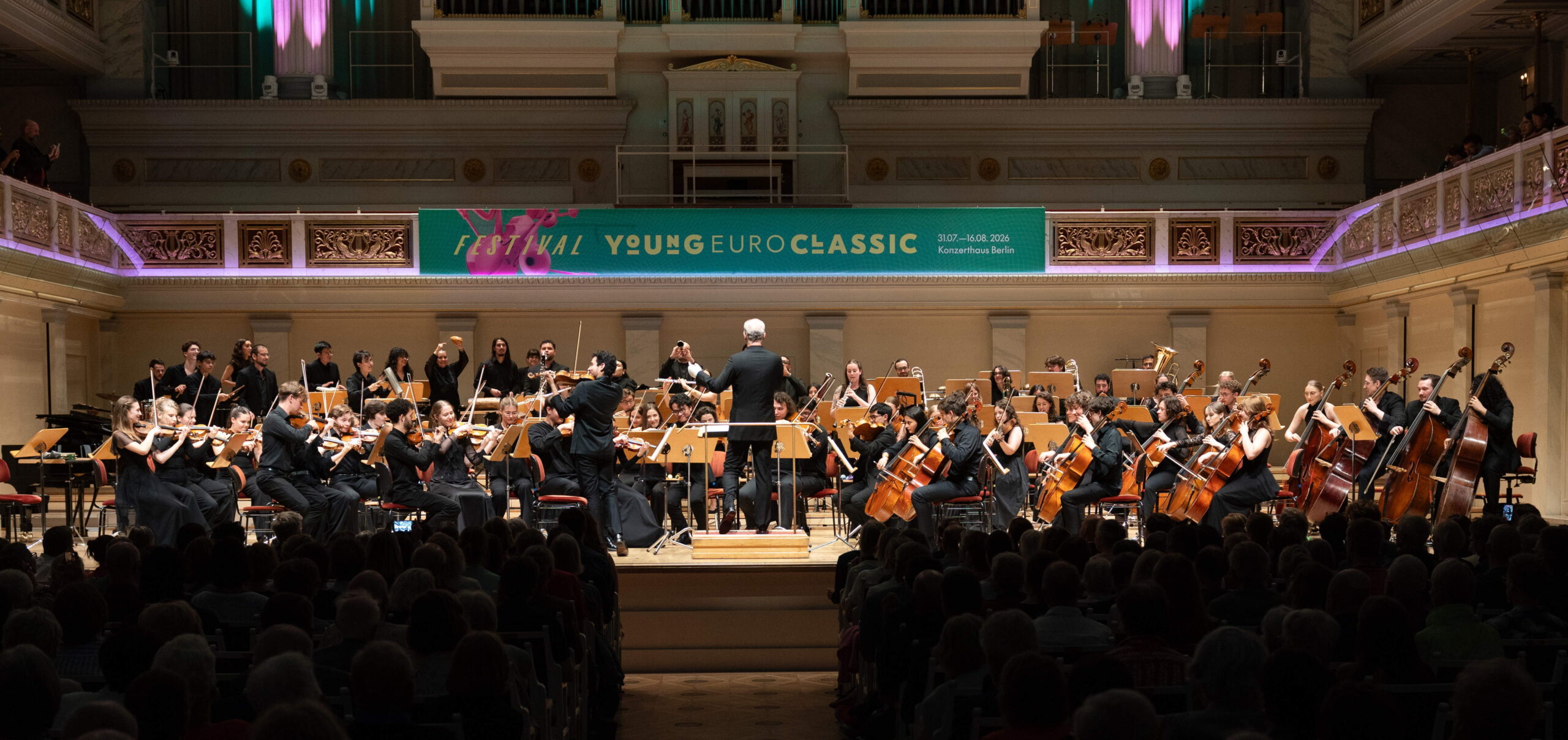
Two youth orchestras, musicians from across the Americas and Europe – and yet, after a few rehearsals, one musical energy. For their joint concert at Young Euro Classic, the Orchestra of the Americas and the Penderecki Youth Orchestra join forces in a program that brings together Penderecki, Brahms and Mexican music by Gabriela Ortiz and Silvestre Revueltas.
Prior to the dress rehearsal, I had the opportunity to speak extensively with four enthusiastic young musicians from both orchestras: American horn player Tori Boell and Panamanian double bassist Joel Vargas Zaldaña, both associated with the Orchestra of the Americas and the OA Academy, and Polish cellist Piotr Olesc and violinist Marta Kubów from the Penderecki Youth Orchestra (PYO). Their stories go beyond music alone and show how two ensembles with different backgrounds get to know each other as people as well.
From screen to stage
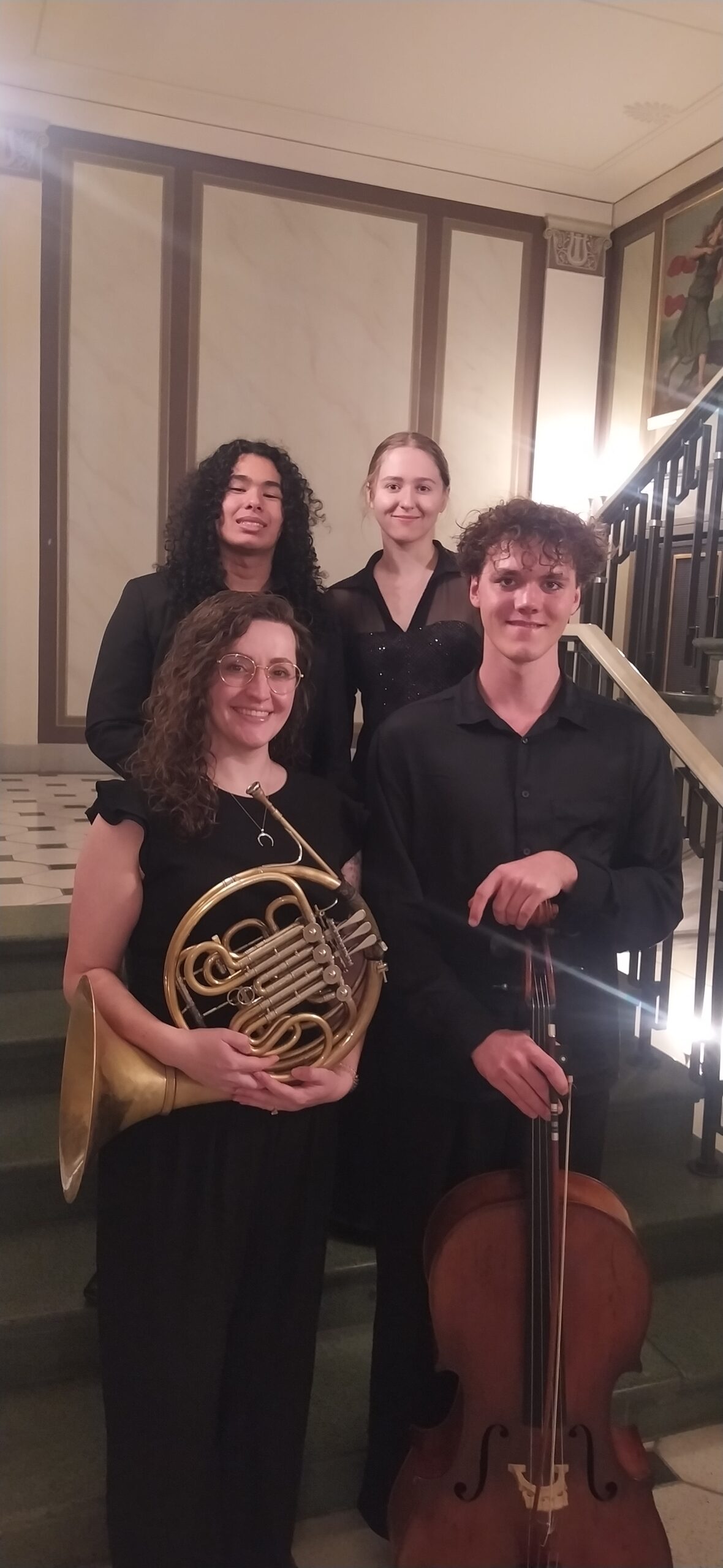 For Tori, the adventure didn't begin in the rehearsal room, but online. As a participant in the OA Academy, she spent six months studying orchestral works, attending masterclasses and taking lessons with her colleagues from the Orchestra of the Americas, even before they met in person. They recognized each other's faces, learned each other's playing and watched each other perform during masterclasses. Yet playing together live turned out to be something completely different. Precisely because they had already gotten to know each other somewhat as a person and as a musician, they were able, according to her, to grow together much more quickly as a section.
Joel Vargas recognizes that feeling. He expected a high level from the Polish string players of the PYO – and he got that too. Initially he was nervous, but once playing, he quickly felt at ease. What struck him most was how intensely the Polish musicians listen to each other within the string section. He noticed that at first he tried mainly to hear what was already sounding before adding his own voice.
That way of listening made an impression on him. Not trying to immediately impose your own sound, but first understanding what the group has already built: it became one of the lessons he took from his encounter with the PYO.
A chamber orchestra discovers the full orchestra
For the Polish musicians, the challenge lay elsewhere. Piotr and Marta have been playing together in the PYO for several years and know each other's sound inside and out. For Marta, this project was special because the PYO normally makes music as a chamber orchestra with strings only. For the first time, brass and percussion sections were added. That wasn't easy at first, she says, but ultimately that expansion made the music-making richer and more fun.
Piotr describes how quickly the whole took shape. After the first rehearsal, and certainly after the second, he heard something special emerge. He also saw the collaboration as an opportunity to learn to express emotions in music in a different way. What struck him was how openly, in his view, the American musicians show their emotions. At the same time, he recognized something in it that wasn't entirely unfamiliar to him from Polish culture. After a few days, according to him, both groups had found a similar energy.
For Marta, it was equally about the encounter outside of music. Different cultures and personalities came together, and for her, getting to know those different backgrounds was an important part of the project.
Salsa in the double bass section
One of the most beautiful anecdotes comes from Joel Vargas, who tells about mutual learning between the bass sections. The Polish bass players helped him thoroughly understand the rhythmically complex Ciaccona by Penderecki – a piece he initially feared because of its difficult rhythms. He really wanted to understand the work and found how much he could learn from the Polish bass players about waiting, listening and placing his part within the whole.
In turn, inspired by his background in Panamanian salsa, he taught the other bassists something about dance rhythm and feeling in the pizzicato passages of Gabriela Ortiz's work. He explained to them how they could create more rhythmic flexibility and a more dancing feel with their fingers and movement.
In the bass section, cultural exchange thus took on a very concrete form: not one group teaching the other something, but musicians who mutually influence each other.
A program that moves from familiar to unexpected
The concert program itself – Penderecki, Brahms and then Revueltas and Ortiz – initially surprised the musicians themselves as well. In Europe, Brahms usually appears at the end of a concert, but here he sounds right in the first part. The musicians themselves initially had to get used to that.
Tori explains the structure: the concert deliberately begins with the familiar. Penderecki connects with the repertoire that the musicians of the PYO are very familiar with, while Brahms is a masterpiece with which virtually every audience can form a bond. From there, the program moves toward something more energetic and less known: the work of Revueltas, with unusual percussion instruments and increasingly intense collaboration between the sections. The energy is ramped up from section to section. The final piece by Ortiz, according to Tori, is then "a completely different game." The work was written for conductor Carlos Miguel Prieto, who thus has a particularly personal connection to it. Ultimately, the program culminates in what she almost describes as one great Mexican dance party.
Marta calls the program surprising precisely because the two halves fit together so well. She is particularly impressed by the way conductor Carlos Miguel Prieto approaches all the different repertoire. Whether it's Penderecki and Brahms or the Mexican works, according to her, he approaches everything with the same depth and precision. Piotr adds that the program encompasses an enormous emotional range: from the subdued, death-related emotions of Penderecki's Ciaccona, written in memory of Pope John Paul II, through the romantic, almost heroic love of Brahms, to the exuberant joy of the Mexican works.
Finally, Tori points out that the program also reflects the international composition of the joint orchestra. On stage are countries from across the Americas and Europe represented, while Penderecki, Brahms, Ortiz and Revueltas each bring a different musical and cultural world.
What they want to convey to the audience
Joel Vargas mainly hopes that no one falls asleep during the surprises of Revueltas, and that people smile at the end. He himself often smiles at the audience while playing. While playing, he sometimes looks at the faces in the hall and wonders whether the listeners truly experience the melodies and the energy.
Marta hopes that the audience feels something of the connection and the energy that the two orchestras have built together – not just what sounds, but also the relationships and memories that have emerged during this project.
Tori mainly hopes that the concert will spark curiosity about music outside of familiar cultural boundaries. She would find it nice if someone thought after the performance: I've never heard music from Mexico before: what is salsa anyway, what is merengue, and what are the differences between music from Mexico and Panama? For her, the concert can thus be an occasion to listen further and discover other musical worlds.
And Piotr hopes that the audience, by listening attentively, will go home after the concert with a noticeably changed feeling. That the different emotions the music evokes will change something in the listener, even if only in a small way.
What remains is a program that, in Marta's words, is best summed up with one word: unexpected.
But how does such an encounter sound once the lessons, rehearsals and conversations are over and only the music speaks? You can read that in the review of the concert: https://klassiek-centraal.be/wanneer-twee-jeugdorkesten-een-stem-worden/
An interview with conductor Carlos Miguel Prieto can be read here: https://klassiek-centraal.be/muziek-is-een-absolute-barometer-van-het-leven-in-gesprek-met-dirigent-carlos-miguel-prieto/