
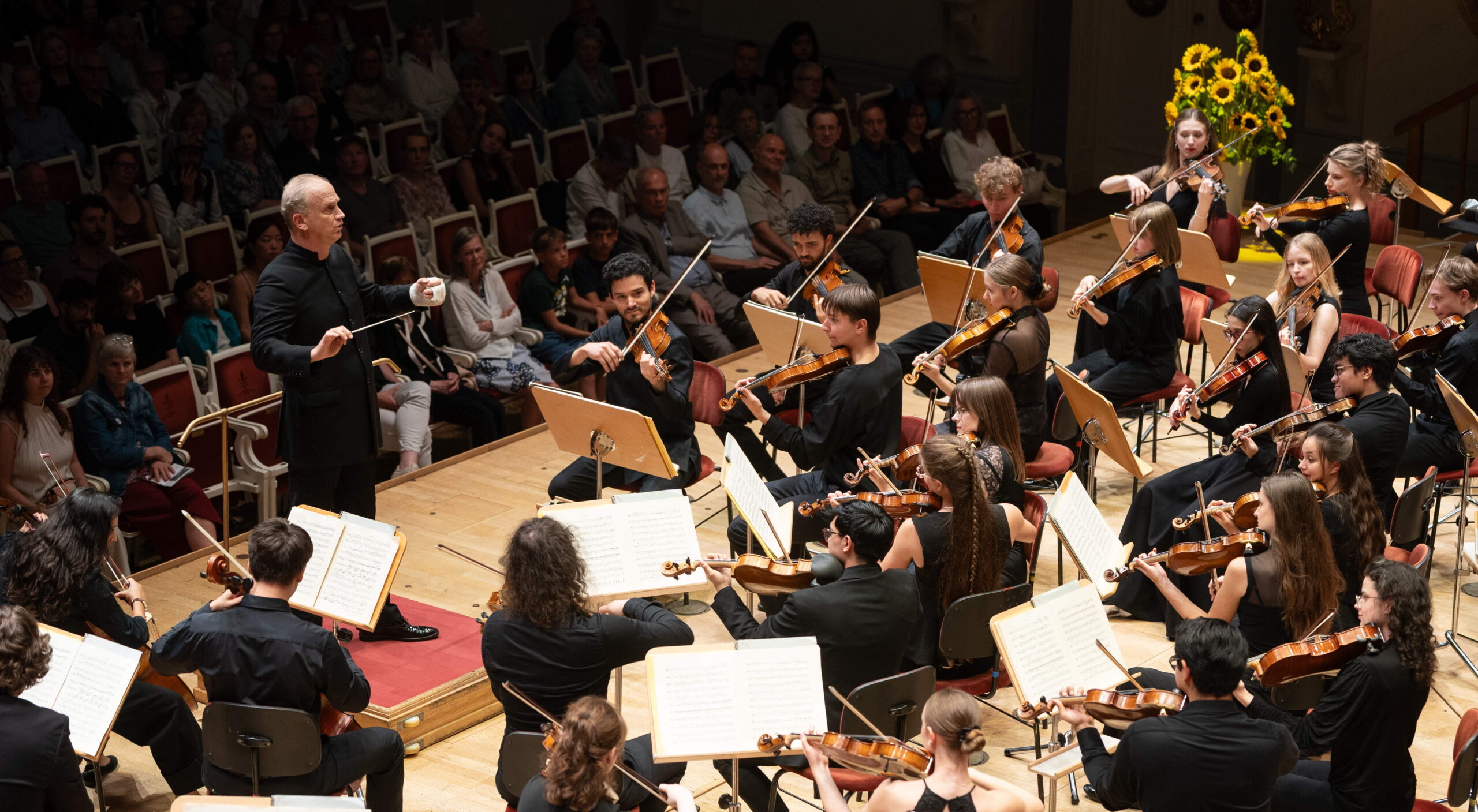
Carlos Miguel Prieto speaks about music as something that reflects much more than just sound. On Monday, August 10, he stood in the Große Saal of the Konzerthaus Berlin conducting a specially assembled orchestra: the Orchestra of the Americas and the Polish Penderecki Youth Orchestra played together during Young Euro Classic. Two continents, different musical traditions, one orchestra. Just before the dress rehearsal, I spoke with Prieto about percussion, programming choices, the richness of Latin American music, unequal access to music education, and above all about what young musicians can learn from each other when they truly meet.
Two traditions, one orchestra
The idea of connecting a youth orchestra from the Americas with a Polish ensemble may seem unusual at first glance, but for Prieto it is a natural connection: "I've been doing this for about thirty years now, and if I've learned anything, it's that bringing different cultures together only yields gains." The Polish musicians bring a strong string tradition; of the approximately fifteen percussionists, twelve come from Mexico. "We need each other. The percussion needs the strings, the strings need the percussion, and also the woodwinds and brass." The project also builds on a previous collaboration.
Prieto has worked with the Penderecki Youth Orchestra several times and recorded, among other things, Copland's Third Symphony and Chávez' Second Symphony in Łusławice. According to him, the fact that the Penderecki Center brings together a concert hall, studio, hotel, and restaurant in one location made it the ideal place for an intensive joint working period. In Berlin, that exchange becomes even more concrete. For the Mexican music in the second half, the Polish musicians had to master a new musical language, while their American colleagues in turn learned how Penderecki should sound from musicians who had worked with the composer himself. Prieto also knew Penderecki personally and worked with him several times.
What both groups bring are different musical experiences that can complement each other within one orchestra. This is precisely where the value of the collaboration lies for Prieto: not pitting two traditions against each other, but giving young musicians the opportunity to bring their own musical background and truly learn to listen to that of another. Yet Prieto does not want to overemphasize the contrast between "Polish" and "Mexican" music: "In reality, music is just music, whether it's Mexican, Polish, or German. I don't think nationality makes that much difference."
According to him, making music means constantly learning new languages. Even when an orchestra plays a work by Bartók, it learns a different musical language. Bringing traditions together is moreover exactly what an orchestra does daily. His own Orchestra of the Americas consists of an estimated seventy percent American musicians and thirty percent musicians from other parts of the world: "So it's a similar experience." But precisely because music can be universal, it is important to learn to know the differences. Prieto does not want to erase cultural traditions, but to prevent them from being reduced to simple labels.
The false unity of "Latin America"
Prieto becomes slightly amused when describing how Europe views Latin America: "A German orchestra sometimes calls me and says: we want to do a Latin American program. No specific country, just 'Latin American'." He then makes a simple comparison: ask the same orchestra to do a "European" program and the reaction would probably be quite different: "Latin America is much, much, much larger than Europe and moreover much more diverse, and yet Europe looks at Latin America as if it were one whole." While Europeans speak without difficulty about the northern and southern German tradition, the Austrian, Polish, or Ukrainian, Latin America according to him is often treated as one musical unity.
That image does not do justice to the enormous richness of the continent. Brazil is according to Prieto musically "a continent in itself," and he says the same about Mexico. Even the same rhythm can take on a different meaning and sound from country to country: "Someone from Colombia experiences a rhythm differently than someone from Chile or Mexico."
He tried to make that richness literally audible during rehearsals. He asked the percussionists to perform different forms of cumbia and other rhythms without sheet music. For them, those rhythms are not notation to be extracted from the score, but music they have known and carried in their bodies since childhood: "Someone had to write them down once, but for them they are still their rhythms. They don't need to look at them."
The Polish musicians, accustomed to orchestras with two or three percussionists, were according to Prieto confronted with a world almost unknown to them. There are different types of güiro and multiple ways to play the same instrument: "We work until we are exhausted to get the right feeling." For him, it's not just about the number of instruments, but about the color, the timbre, and the physical way a rhythm is played.
Where he once had to travel to Brazil to learn a musical tradition firsthand, young musicians today have access to the whole world through their phones. They can immediately hear what is happening in Puerto Rico, Mexico, Brazil, or Colombia. "They have no excuse," he says with a smile. The digital world has radically changed access to other cultures and makes it all the more important, according to Prieto, that young musicians develop an interest in other classical music cultures.
From academic discipline to letting go
The program for the evening – Penderecki's Ciaccona in memoria Giovanni Paolo II, Brahms' Third Symphony, Revueltas' La noche de los Mayas, and Gabriela Ortiz' Antrópolis – was deliberately constructed as a dramaturgical arc according to Prieto. The occasion was La noche de los Mayas, a work requiring a large percussion ensemble. Subsequently, Prieto wanted to place a classical symphony against it. Brahms' Third Symphony turned out to be available. But that meant the traditional concert logic had to be reversed: the Brahms symphony came to the place where normally a concerto would stand. "Because the concerto is really Revueltas with his percussion. But if you put Revueltas in the first half, it's impossible to play Brahms afterwards." The order is therefore also a matter of scale.
Prieto describes the program as a movement from small to large: first the relatively compact world of Penderecki, then Brahms, then the increasingly exuberant sonic worlds of Revueltas and Ortiz: "A concert seems to me like a theatrical experience." The program must not only work musically, but also function as an experience for the audience.
For the young musicians, this means a special education. As a violinist, Prieto knows Brahms from within. He wants the symphony to emerge almost as chamber music: the musicians must stand on their own feet, listen as if they are part of a string quartet, and know the music so deeply that it ultimately "lives in their DNA." After that, the attitude changes completely. In La noche de los Mayas, the musicians must sometimes play with utmost refinement, using techniques such as sul ponticello and sul tasto, only to then let everything go. The contrast between Brahms and Revueltas is enormous. Yet both works are separated by only 45 years: "It seems as if Revueltas is two hundred years away from the symphony. And there are only 45 years between them." According to Prieto, it is precisely that time difference that shows what happened between 1880 and 1930: "a complete breaking through of existing musical forms."
With Gabriela Ortiz, that musical journey ultimately arrives in the present. She is a good friend of Prieto's and according to him one of the most important contemporary Mexican composers. Her Antrópolis, which had its German premiere in Berlin, thus forms the most recent part of the musical journey. For Prieto, the program does not always have to be logical or homogeneous. Sometimes a concert emerges in which everything connects perfectly; sometimes the opposite is interesting. "Do you enjoy dining where everything lies beautifully in the same line, or do you sometimes want to eat something that surprises you?" For a summer festival and a young audience, such an unexpected combination can be refreshing.
For Prieto, music can moreover never be separated from the society in which it arises: "Music is truly an absolute barometer of life." American music, according to him, reflects the reality of migration, for example. A city like Chicago has been shaped by Polish, Mexican, Irish, and many other communities. Those who play Copland, Bernstein, or Revueltas are, according to Prieto, not only playing the music of individual composers, but also the history of the society of which they are part. Copland's parents, for example, were Ukrainian Jews.
He finds this awareness important for young musicians because they will later be not only performers, but also representatives of their own communities. He hopes they take their musical perspective home with them: that the Polish musicians do not remain exclusively with Chopin and the Mexican musicians not exclusively with Revueltas. For Prieto, music is thus simultaneously artistic, cultural, and social. The musical objective is important, but it is not the only one. This is precisely why he finds it important that young musicians not only get to know each other musically, but also discover how different their life worlds can be.
O Academy: a conservatory without walls
This social aspect becomes particularly concrete in O Academy, the online conservatory associated with the Orchestra of the Americas. Students from regions with little access to high-quality music education are matched with teachers from leading orchestras. They work online for most of the year; only during projects like this meeting in Europe do many of them come together physically for the first time.
Prieto tells about young musicians from Panama, the Dominican Republic, Mexico, and other parts of Latin America for whom even a regular music lesson is not taken for granted. Sometimes they have to travel for hours to find a flute teacher. For a harpist in Panama, the situation can be even more fundamental: "There is no harp teacher and there is no harp." This contrasts with the abundance of possibilities in cities like Berlin or Antwerp, where young musicians can choose from dozens of teachers and instruments are readily accessible. O Academy tries to bridge precisely that gap: connecting talent with the education and mentoring it needs.
According to Prieto, teachers and coaches working on the program are active in major orchestras and possess not only musical expertise but also a sense of social responsibility. Sometimes they discover talent that without that guidance would hardly be able to take the next step. Prieto mentions several musicians who came out of the project and have since found professional positions, including in the WDR Sinfonieorchester, the Opernhaus Zürich, the Philadelphia Orchestra, and the Berliner Philharmoniker.
He tells with evident pleasure about an exceptionally gifted tuba player from Colombia: "I guarantee you: he is the best tuba player in Colombia." This is precisely why Prieto gave him a striking piece of advice: he had to go to a conservatory where he would no longer be the best. "You have to leave Colombia. You have to go to a conservatory where you are the worst tuba player." Not only to become technically better, Prieto explains, but to experience what it means not to be the best. "And then discover: they play so well. How can I also play so well?" Only by measuring himself against a higher level can a young musician grow further according to him.
The problem is not a lack of talent; that talent exists. The challenge is to develop sufficient depth in instruments and disciplines that are less traditional in some countries. So violin, cello, double bass, and trumpet are more obvious in Mexico than oboe or certain other orchestral instruments. The meeting between the Polish and Latin American musicians therefore has a purpose that goes beyond the joint concert: "The purpose is musical, but equally social and educational." The young musicians not only learn how to form an orchestra together, but also discover how different the life world of their peers can be.
For Prieto, the ultimate concert is not the most important part of the project: "The most important thing is the process." He cares about the weeks in which young musicians rehearse together, get to know each other, learn to listen to each other, and discover what they can learn from each other. The concert is ultimately the celebration, the place where everything comes together. In Berlin, in a large concert hall and within a festival that puts young musicians at its center, it becomes a celebration of the work that preceded it.
Some musicians from the Orchestra of the Americas knew their colleagues before this tour exclusively from Zoom. Now they sit next to each other in one orchestra, travel together, and share an intensive musical working period. Prieto sees value in this that cannot be captured in a score. He tells how musicians from different countries found each other in earlier projects, formed friendships, and sometimes even started families, for example a Norwegian cellist with a Brazilian partner. For him, that is not incidental. Music is the occasion, but the meeting is an essential part of the human outcome.
"I hope they are moved by the talent"
What he wishes the audience above all after the performance, Prieto does not have to think long about: "I hope they are moved by the talent of these young musicians. That is the most important thing." He then mentions the joy and enthusiasm with which the musicians play. Whether every phrase is perfectly pure, he ultimately finds less important than the question of whether it communicates. And there once again sounds his conviction that music is more than a collection of notes or styles. It is a way in which people meet each other, learn to understand each other, and take something of their own world to that of another: "Because the way they play, there is simply no way it will not communicate."
We also spoke with four young musicians from both orchestras about their collaboration and the program – you can read that interview here: https://klassiek-centraal.be/musici-uit-heel-amerika-en-europa-een-klank-orchestra-of-the-americas-en-penderecki-youth-orchestra-vinden-elkaar-bij-young-euro-classic/
And you can read the concert review itself here: https://klassiek-centraal.be/wanneer-twee-jeugdorkesten-een-stem-worden/