
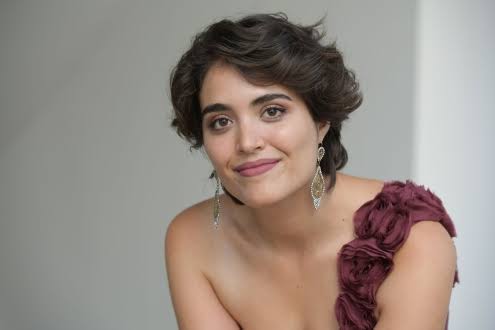
A few hours before her performance with the Jovem Orquestra Portuguesa at the Konzerthaus Berlin, mezzo-soprano Cláudia Ribas takes time for a relaxed conversation. No trace of stage fright – rather the untroubled clarity of someone who knows who she is as a musician, and what she wants to tell the audience on stage. Werner De Smet spoke with her about her versatility, her Portuguese background, the meaning of saudade and her work with a youth orchestra.
A versatile musician
How would she describe herself as a musician? Ribas doesn't hesitate for a moment: as a "well rounded", versatile musician. Classical music, jazz and musical theatre all appeal to her, and she adapts her voice to each genre. She has sung both contemporary work and baroque: "As a classical musician, we must be able to bring a broad range of genres to a high level. That's what I aspire to."
Yet she has a pronounced preference, the Romantic era: "That period suits my voice very well." Baroque can also appeal to her, contemporary music is more challenging. If a piece is well written, she's immediately on board. If it becomes too atonal, it doesn't reach her: "You have to feel a connection. Then it doesn't matter if it's baroque or romantic – you need a feeling."
From Portugal to Frankfurt
Ribas' musical journey took her from Portugal – where she lived from age three to twenty-four – via Amsterdam and Copenhagen to Frankfurt. Each city left its mark. Her Portuguese years shaped her sense of sentiment strongly: Portuguese folk music, not just fado, carries a deep melancholy within it, and she takes that with her in who she is as an artist: "I often hear that people want to hear something melancholic from me. I think that has to do with that."
In Amsterdam, she experienced a period of intense growth, both personal and artistic: the city brought her into contact with musicians from all corners of the world, but the conservatory itself was already a melting pot, from early music to jazz and a touch of pop. She also mentions a typically Dutch concept: tolerance – not as in "I tolerate you", but as genuine openness to every culture and belief. That's exactly the attitude a musician needs according to her: openness to all sounds, to all the other musicians around you.
In Copenhagen, she did a master's at the opera house and came into direct contact with the big stage for the first time. Her voice teacher was herself part of the ensemble and taught her how to follow a conductor – and why as a singer you need to sit just slightly ahead of the orchestra, so your voice doesn't reach the audience too late. A radical shift for someone who had previously mainly done chamber music with a pianist: although she had seen many operas as an audience member in Amsterdam, it was in Copenhagen that she stood on the other side for the first time.
Frankfurt became the place where she honed everything further. The studio had its advantages and disadvantages – as a young singer you have to be front and centre immediately – but it also gave her a genuine insight into how the sector, the agencies and the offices really work: "I learned an enormous amount in those years. It was a fantastic experience."
The breakthrough
An important turning point came with her victory in 2024 at the IVC, the International Vocal Competition in 's-Hertogenbosch. Her name suddenly appeared everywhere – something she hadn't expected. She got a sudden flood of audition opportunities for major opera houses, and even an engagement without having to audition for it. "So that happens too, apparently," she says laughing. She was already working with her agency, but thanks to the competition, everything went a bit more smoothly: as soon as your name sits a bit higher on the radar, it gives you more traction and makes certain aspects of your career a bit easier.
Saudade, a feeling without translation
The programme at the Konzerthaus Berlin revolves around saudade, that Portuguese feeling that is difficult to capture in another language. For Ribas, "longing" comes closest, but the word also means "missing something" – a double, perhaps even triple layer of meaning. According to her, saudade is a lasting part of Portuguese identity: the saudade of the voyages of discovery and colonial past, of mothers whose sons went to sea and never returned, of lovers. For her it is a feeling with many facets.
Words sometimes fall short, music doesn't, she thinks. It's not just a minor chord – that sounds sad in itself – but something with just that touch of jazz in it, like a blues, or the slow ballads from bossa nova, which for her are permeated with that same feeling.
Berlioz appears twice. In the aria Adieu, fière cité from Les Troyens, Dido remains behind while Aeneas departs. It is fate, she shouldn't blame him for it, and yet she does. Ultimately, she decides to take her own life – a choice that Ribas finds particularly tragic and with which she disagrees. In Sur les lagunes, the song opens with the realization that a good friend has died and then slides away into a wave of melancholy and grief, felt in the music itself.
The rest of the programme also seems to circle around that feeling: the world premiere Saudades, só portugueses by twenty-five-year-old composer César Rafael, inspired by the poetry of Fernando Pessoa, and after the interval Tchaikovsky's Pathétique.
Working with a young orchestra
Tonight, Ribas takes to the stage with a youth orchestra: the Jovem Orquestra Portuguesa (JOP), under the direction of Pedro Carneiro. As a more experienced musician – she has now been working in the field for five or six years – she notices a big difference with established orchestras: "You have to go there with an open heart and the awareness that the musicians are still young and relatively inexperienced." Precisely because of this, unexpectedly beautiful moments arise: the sound that such a young orchestra produces, she calls fresh and sparkling.
What awaits tonight is something different, she explains: these young musicians do not yet have a clearly defined image of how the piece should sound. That gives the music a certain candor and at the same time creates more space. There is no expectation that romantic music must simply be played in that one way, no rigidity like with established conductors or orchestras who think they know exactly how it should be done: "That's a bit how I feel working with the youth orchestra."
What she wishes for the audience
What does she hope the audience takes home with them tonight? Above all, that they have a wonderful evening, says Ribas – and that whoever attends a classical concert for the first time will want to come back. She calls the program a strong, well-considered program: "I hope it stays with them."