
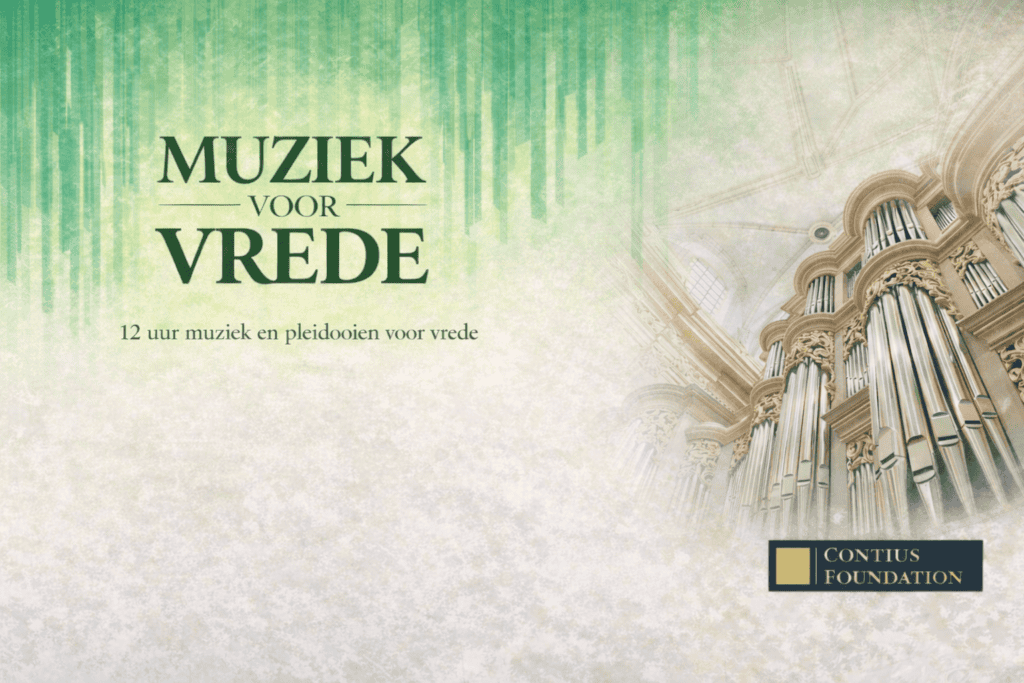
On Saturday 25 April, silence has no chance. In Sint-Michielskerk in Leuven, the Peace Marathon unfolds in collaboration with the Contius Foundation: twelve hours of music and words that do not seek to convince, but to invite – to listen, to reflect, to the beginning of understanding.
The point of departure is clear and layered at once. From afternoon to midnight, organ music, vocal contributions and artistic interventions form a continuous course, alternating with pleas and reflections. Each hour sheds a different light on a question that sounds more urgent than ever today: what does peace still mean? No ready-made answers, but rather a carefully constructed dialogue between sound and thought, between emotion and engagement.
At the centre stands the organ – an instrument that not only fills space, but also carries time. It is a sonic body that has endured centuries of conflict and reconciliation and thus brings with it a particular layeredness. In this context, it becomes not a museum piece, but a living witness: of what has been, and of what remains possible.
The power of the Peace Marathon lies in the interplay. Music here becomes not an aesthetic endpoint, but a form of speaking. And words, carried by sound, take on a different intensity. Speakers from diverse social domains bring their perspectives, not as a conclusion, but as an invitation to further reflection and dialogue.
New this year is the move outward. For the first time, the initiative explicitly steps outside the walls of the church. On the Grote Markt, a musical intervention by the Leuven University Choir creates a moment of collective attention. What exactly will happen remains a secret for now, but the symbolism is clear: peace does not belong only in the seclusion of a church space, but wants to show itself in the heart of the city, in the midst of everyday life.
Furthermore, the day also offers space for stillness and confrontation. With Ook de engelen treuren, Ingrid Dewit presents a participatory art project that commemorates what is hardly comprehensible: children who died through war and violence in the Israeli-Palestinian conflict. It is a restrained, yet striking presence that makes the abstraction of the concept of 'peace' tangible.
The Peace Marathon, moreover, does not stand alone. Within the framework of the European network of historic organ cities, a joint call for peace sounds that same weekend in different cities. From Alkmaar to Trondheim, concerts are organised in which music, reflection and encounter are central. The initiative emphasises no solutions, but something equally necessary: attention. In a time of growing polarisation and hardened positions, it forms a cultural gesture that invests in listening and connectedness across boundaries.
Perhaps therein lies the essence of this day. Not in the pretence that music can change the world, but in the realisation that it can create space. Space to fall silent, to hear the other, to experience anew that peace is not an abstract ideal, but a choice that must be made again and again.
And so music sounds. Twelve hours long. Not as background, but as a question – one that continues to resonate, even when the final note fades into silence.