
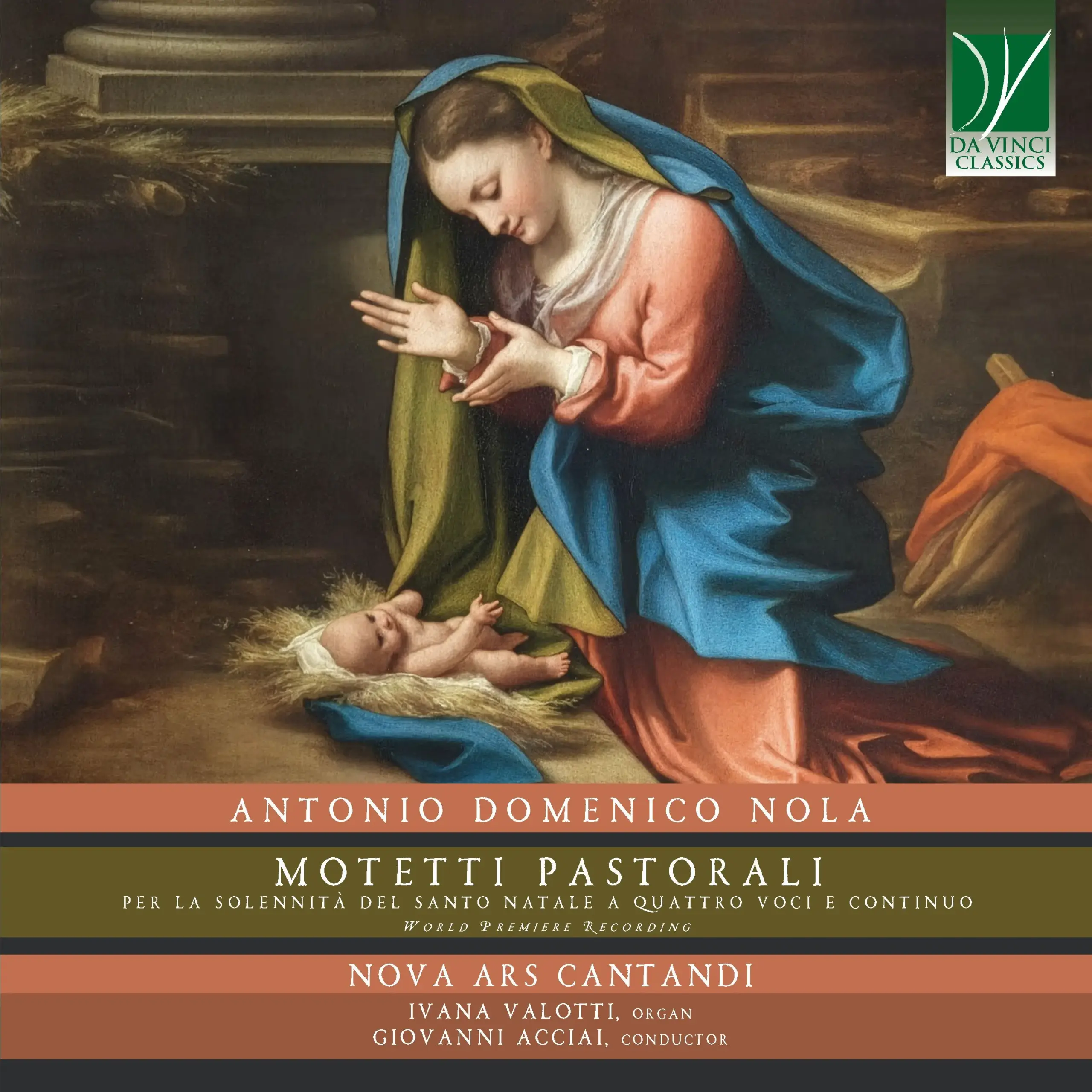
Discussing a Christmas music CD during a heat wave may seem odd, but this release provided more than a welcome musical refreshment.
There are recordings that are primarily of interest to musicologists, and there are recordings that bring forgotten music truly back to life. Nola: Motetti Pastorali per la solennità del Santo Natale happily belongs to that second category. With this release on Davinci Edition, Giovanni Acciai proves his talent for presenting obscure Italian repertoire not as a historical document, but as living music.
Antonio Domenico Nola (1642 – after 1715) is today little more than a footnote in Neapolitan music history, but these Christmas motets reveal a composer with a fine sense of melody, colour and theatrical devotion. From the very first bars of Annuncio vobis gaudium magnum, the tone is immediately set: warm pastoral sounds, natural vocal fluency and restrained festiveness draw the listener directly into the Neapolitan Christmas idiom. This makes clear how deeply rooted this music is in the South Italian Christmas tradition: swaying pastoral rhythms, gentle folk-music accents and a religious intimacy that never becomes ponderous. Nola rarely seeks grand effect. His music derives its power from a natural melodic flow, clear musical notation and a fine balance between contemplation and festiveness. The harmonic language remains deliberately accessible, yet manages to move precisely through its simplicity. This artless directness is perhaps its greatest charm.
Acciai wisely avoids excessive drama. He lets the music breathe, keeps the lines supple and trusts in the natural charm of the material. That works excellently. The members of Nova Ars Cantandi sing with a clear, flexible tone that perfectly matches the intimate character of these motets. The ensemble's transparency is particularly impressive. The diction is careful and the phrasing breathes a natural musicality, without ever sounding contrived or excessively historicizing. Organist Ivana Valotti also contributes significantly to the contemplative atmosphere of the recording with her restrained, tasteful playing. Nowhere does attention stray from the vocal lines; everything serves the music.
The alternation with organ pastorales by contemporaries such as Zingarelli and Furno moreover provides resting points that strengthen the liturgical atmosphere of the recording. This gives the CD a fine dramatic arc and avoids the risk of stylistic monotony. These instrumental interludes function not as arbitrary filler, but deepen the atmosphere and place the vocal works in their original liturgical context.
Perhaps the greatest achievement of this recording lies in its naturalness. Nothing sounds forced "authentic", nothing seeks to rehabilitate a forgotten master at any cost. It is precisely because of this that this music convinces. Not as a great Baroque monument, but as a collection of warm, refined miniatures in which faith, folk culture and Neapolitan melodic elegance meet. Although the motets vary in scope and ambition, the inspiration remains remarkably consistent. The listener is thus effortlessly drawn into an atmosphere that is both hushed and heart-warming.
The recording itself supports this atmosphere excellently: warm, spacious and natural, with sufficient detail without becoming analytical. The carefully compiled notes (with English translation of the Latin texts) in the accompanying booklet also help the listener better situate this little-known repertoire.
Antonio Domenico Nola may not be a forgotten genius of the calibre of Pergolesi or Scarlatti, but this release convincingly demonstrates that he is much more than a historical footnote. Thanks to the stylish performance by Giovanni Acciai and Nova Ars Cantandi, his music finds a voice again – and that makes this CD a particularly valuable discovery.