
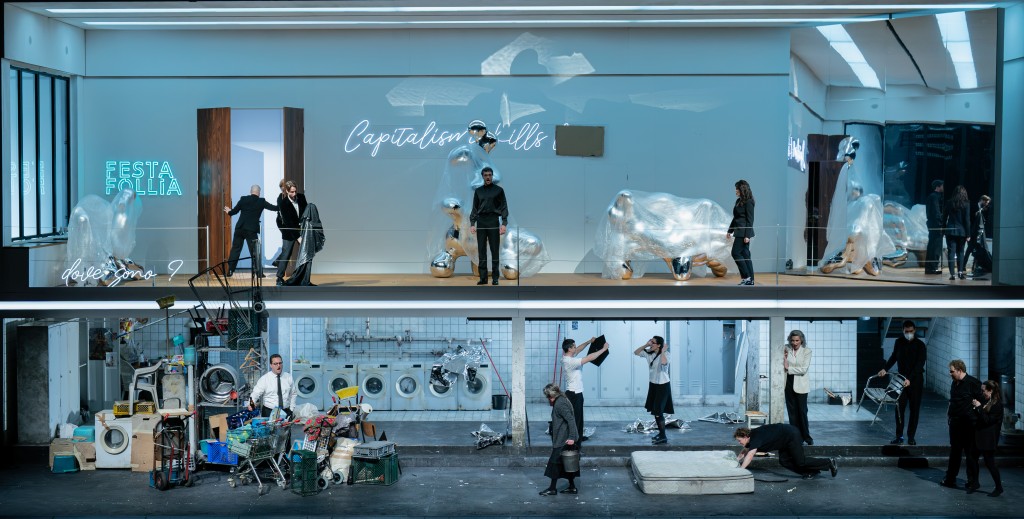
In Amsterdam Mozart's Nozze di Figaro became an 'Upstairs Downstairs' setting... Above a spacious, light, modernly sparse space with walls of what appears to be expensive wood. It turns out to be an art gallery a moment later, where a vernissage takes place that day.
It is the space in which the lives of the aristocratic characters of Mozart and librettist Da Ponte's Le Nozze di Figaro unfold. Below is a kind of basement combined with laundry room and storage space, where the life and work of the staff, i.e. the lower class, takes place. The lower you are on the social ladder, the less often you have any business upstairs. It is also here that the Count had assumed the soon-to-be married couple, his barber Figaro and his fiancée the maid Susanna, would live. So that, and Susanna immediately grasps this, Susanna is conveniently nearby when Figaro is away. All this with a clearly visible and sometimes specially highlighted thick floor between them. So thick that wifi reception below is poor and the unfortunates below constantly have to stand on chairs and tables to be able to text and message. And yes, Serebrennikov moves the plot of the opera into this time with it. Again, you might say. But in this case it has an extra meaning. The director himself remembers all too well the time, in 2018, when he was placed under house arrest in Moscow while he was supposed to direct the first installment of a Mozart/Da Ponte trilogy, Così fan Tutte, in Zurich and that from home via computer screen, if the connection was strong enough, and otherwise via text and app messages. In Le Nozze di Figaro the characters are constantly communicating with each other, and why wouldn't they do so with text and app messages in a modern production? Which we as an audience often see neatly projected into the set. Back then in Zurich, there was an assistant of Serebrennikov on site, his long-standing collaborator, choreographer and right-hand Evgeny Kulagin (who took charge of the Dutch staging of this Figaro production previously performed in Berlin). During his house arrest at that time, Serebrennikov communicated through him. Perhaps another directorial intervention in this Figaro production also refers to that time. Such an 'avatar' also appears in this production as the Count, described in the program as an accomplice (the phenomenally moving actor/dancer Nikita Kukushkin), also appearing as a double, alter ego, the embodiment of his will, but when the Count needs to vent his anger on someone, regularly also as a doormat and scapegoat. Serebrennikov makes use of another important added acting role, namely for Cherubino, normally a male role performed by a female mezzo-soprano. I don't know if it's true that Serebrennikov wanted the role to be sung by a man with a high voice, but that the Komische Oper in Berlin, where this production was first performed, had already engaged a mezzo-soprano. The vocal part is now assigned to an added character, 'Cherubina', a female friend of Cherubino. Cherubino is now performed by Georgy Kudrenko, who plays Cherubino as a deaf-mute boy who expresses himself in sign language, upon which Cherubina (the excellent Cecilia Molinari) acts as an interpreter for the deaf, singing Cherubino's text in the third person. This way Serebrennikov could have a Cherubino who looks convincingly like a young, hot-headed teenager, and regularly does half or full striptease, only to then play the murdered innocence of a minor. In all this he is assisted by Cherubina. Thus it is also credible when Cherubino tries to turn the head of almost all the women in the household, upstairs and downstairs. 'Almost all the women', because there is another female character invented in the plot, an 'old woman' (Marieke Reuten), an elderly housekeeper who spends all day in the underground doing laundry, taking out the trash and cleaning up everyone's mess, the outcast of outcasts, who is ignored by no one. Even Cherubino doesn't notice her. When he jumps out the window in the second act and subsequently comes to the lower floor whimpering in pain so the women can tend to his bruises, he doesn't even realize it's her who is trying to catch him most lovingly. Even when she offers him something to drink, he refuses, whereupon it finally becomes too much for her and she pours the contents of the cup over him: a small close-up moment of silent protest that could come straight out of a film. Yes, Serebrennikov is a film director. Downstairs there are indeed significant differences among themselves and Serebrennikov amplifies them considerably further. Figaro and Susanna can afford freedoms that the others shouldn't even think about. Perhaps this is Serebrennikov's own vision of social systems that preach égalité. Like the former Soviet Union, where he was born. Serebrennikov is indeed also an excellent film director, a film director that most opera lovers don't know. Well, he's also an opera director that most film connoisseurs are unfamiliar with. I'm thinking about which of his films comes closest to this Nozze. Perhaps Leto from 2018, about the alternative pop scene in Leningrad at the time when the thaw in the Soviet Union seemed to be continuing. Petrov's Flu then deals—in short—with the failure that followed. In Tchaikovsky's Wife the restrictive norms of bourgeois society come into view, through the doomed and indeed failed marriage of composer Tchaikovsky. Although Serebrennikov doesn't create a particularly sympathetic image of the wife, he has an eye particularly in that film for the social straitjacket in which not only Tchaikovsky but also his wife lived. But in that film nobody wins. With his most recent film, The Disappearance of Josef Mengele, about the attempts of Nazi camp doctor Mengele to hide anonymously in Paraguay and Brazil, this Nozze had considerably fewer points of contact. The 'Count' supposedly has a large art gallery and artworks are constantly coming in and constantly going out again. Buying and selling. The taste of the Count and his clientele is not particularly original. We see semi-abstract, shiny chrome torsos, paintings that seem to be based on an increasingly mutilated version of Ingres' La Grande Odalisque (an iconic painting from the time when the successor to the French Revolution, namely the Napoleonic empire, was collapsing) and pop-art-like works with neon letter texts displaying often rather pretentious and often essentially meaningless texts. All mass-produced art. Okay, one such text is La folle journée, the mad day, and that refers to the original title of Beaumarchais' play, La folle journée, ou le Mariage de Figaro, which refers to the fact that the story indeed takes place within one morning, afternoon, evening and night. A slogan like Capitalism kills love contains a kernel of truth, but there are few worlds less capitalist than that of art galleries (and perhaps also the opera world). And yes, the phrase "The whole world is merely an illusion of the senses and the sensory trace of that disappearance," comes from French philosopher Baudrillard. Serebrennikov seems to be saying that the art-loving public will surely find such a statement (which seems deeper than it perhaps is) interesting sounding, will probably draw no consequences from it. The texts disappear then repeatedly. As gallery owner we see Marcellina, who in the embodiment of Veronique Gens is a perfect parody of an art manager type.Below they have to make do with "arte povera" (the name of a movement from the sixties and seventies), scaffolding made of discarded shopping carts, an old mattress (also the wedding gift from the Count to Susanna), discarded washing machines (during the opening symphony we saw the elderly maid worker, exhausted, operating a large number of washing machines needed for the household, but those washing machines, like the society being depicted, don't have eternal life), beer crates (upstairs at the opening of a new exhibition one seems to drink fine wine, at one point the Count spills it on the floor to show Figaro his place, who has to sweep everything up), broken chairs, and worn kitchen utensils.
It is well known how in Mozart and Da Ponte's opera version, Figaro's tirade against class differences from Beaumarchais' play is omitted. Perhaps because the opera would otherwise have been too political for Vienna? Yet the underlying class struggle that would lead to revolution in France is also clearly discernible in Mozart and Da Ponte's opera. Incidentally, although Figaro and the rest of the top layer of personnel may engage in this class struggle, we see them in turn behaving just as authoritatively towards the 'lower' staff below them on the social ladder. Something Serebrennikov does not fail to emphasize.
Meanwhile, Figaro is indeed cast as a good-natured clown, in the person of the still boyish-looking Michael Nagl. He possesses a fine, flexible bass voice. I also watched with great pleasure how he worked out his role in every detail while acting, with (clearly visible from row 11) mime and gestures.
The other characters are all beautifully cast in their roles. Björn Bürger, as Il Conte di Almaviva, was already a charming Wolfram von Eschenbach in Tannhäuser and a delightful Gabriel von Eisenstein in Die Fledermaus in Amsterdam. Olga Kulchynska's Countess Almaviva doesn't have that ripeness, that 'Marschallin-like' quality with which the role is often portrayed, but rather something uncertain, a bit Ivana Trump-like, who never seems quite sure of her place. Kulchynska does give the character a character development, and in her arias towards the end, in which Serebrennikov even gives her an extra one from Così fan tutte, Kulchynska has the sovereign quality of the sadder and wiser countess and expresses it flawlessly with the music. Susanna is Emily Pogorelc, for whom the role is written perfectly both vocally and dramatically, and while she is only just 29, she looks younger on stage.
Incidentally, one must bear in mind that the characters in 'reality' were most likely all around 20 years old, Susanna younger and Figaro perhaps just slightly older, as is the Count. The Countess is, as mentioned, younger than usually portrayed. She is older than Susanna, perhaps that is why the Count had already tired of his wife.
I had to ascertain whether we were dealing with an orchestra playing on authentic instruments. It turned out to be 'just' the Nederlands Kamerorkest. That in any case played 'historically informed', undoubtedly due to the efforts of conductor and harpsichord player Francesco Corti, a keyboard player and organist by training, resident guest conductor of the authentic music ensemble Il Pomo d'Oro and having worked with Les Musiciens du Louvre, the Dutch Bach Society and musical director of the opera theater in Drottningholm, an authentic rococo building.
The score has been tinkered with. Corti himself improvises freely in some recitatives, even mimicking ringtones when characters on stage call and text. A joke: when Cherubino has jumped out the window, the clarinet hears the opening notes of 'E lucevan le stelle' and Peter Franken figured out why: "Cherubina takes a run-up and dives after her Cherubino like an accomplished Tosca."
In addition to that extra opera aria for the Countess, there are more musical pieces inserted. For instance, in the third act, Susanna, the Countess and the Count sing the trio "Soave sia il vento" from Così fan tutte on the dirty mattress (a 'wedding gift' from the Count). Furthermore, a wonderfully beautiful, sustained arrangement of a lament from Mozart's Dissonance Quartet as an introduction to the Count's plea to the Countess: "Contessa, perdono!" Furthermore, unlike usual, Marcellina's aria "Il capro e la capretta" is not omitted. Not only to give star singer Veronique Gens an extra beautiful moment, but also because, as David Cairns is quoted in the program booklet, its message - a plea for more respect for women (if not for equal rights) - beautifully aligns with the core of the opera's finale: it is the women in the opera who are needed to set things right.
[embed]https://www.youtube.com/watch?v=-eYwBgeRRxM[/embed]