
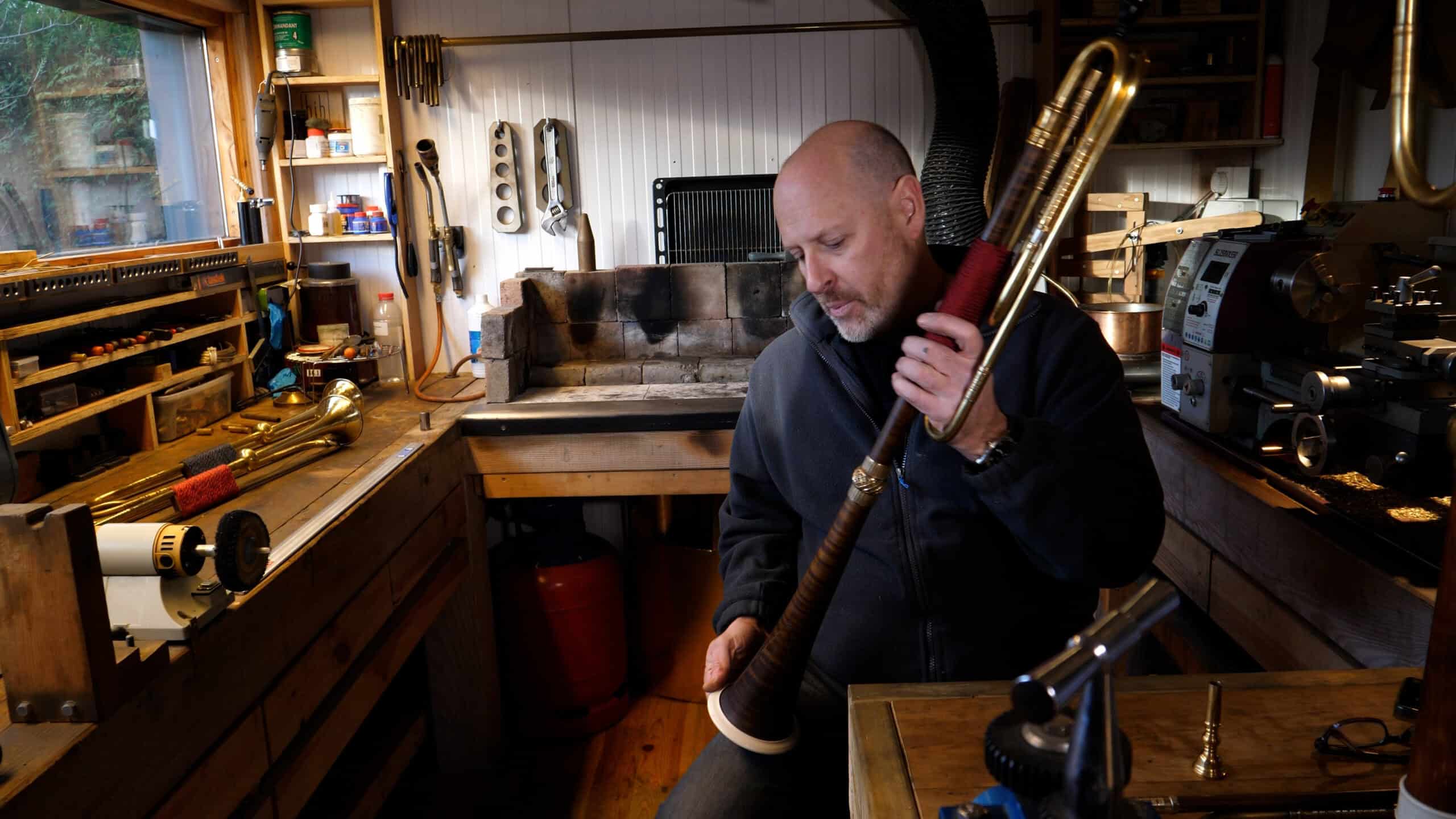
It will be a world premiere that will only last a few minutes. Opera Ballet Vlaanderen had a natural trumpet built according to instructions by Richard Wagner used in his opera Tristan und Isolde. It is the first time an opera house has built this trumpet.
In the third act of the opera Tristan und Isolde by German composer Richard Wagner from 1865, the arrival of Isolde's ship is announced by a cheerful trumpet melody that sounds from the side stage. In the story, the tune is played by a shepherd. It is a short melody but Wagner wanted it to have a certain sound. In his original score he wrote some instructions. The trumpet had to sound "like an alphorn" with "a wooden bell" and "within the natural scale".
This trumpet did not exist when the opera premiered in Munich. We have no indication that it ever existed. Usually opera houses use a hunting horn or another wind instrument with valves for this short melody. Until today. OBV had the instrument Wagner had in mind built and specifically for the upcoming production of Tristan und Isolde which will premiere on March 22.
According to our information, it is a world premiere in music history and we will be able to hear for the first time what Wagner meant.
The initiator of the venture is Serge Rigaumont, trumpeter in the Symphony Orchestra Opera Ballet Vlaanderen. He delved into the Wagner trumpet and convinced music director Alejo Pérez to have the trumpet built. OBV agreed.
"This is an incredibly exciting project. Although the passage seems like just a detail, nothing is a detail in Wagner," ⎯ artistic director Jan Vandenhouwe
To build the instrument, OBV turned to Gunther Cogen last year, an instrument maker specializing in historical trumpets. He took on the challenge of investigating exactly what Wagner wanted based on the sparse information the composer left us. For this project, Gunther Cogen worked together with Daniël Vernooij, builder of historical clarinets, with extensive expertise in making wooden bells.
Ultimately, and based on research following the latest views on historical practice, it was decided to build a natural trumpet. A natural trumpet is a wind instrument without valves or keys and in which the tones are determined by the lip tension of the trumpet player. Think for example like a clarino.
For those in the know: the trumpet was built in an eight-foot configuration as was also the case in the eighteenth century, but with a completely wooden bell made from flamed maple wood. The measurements were adjusted somewhat so that the wooden bell could be as long as possible, which contributes to the typical sound. A cord binding holds the bell and the brass together.


There are orchestras that in the past have built trumpets for this particular musical passage, but they always built a valve instrument or a variant thereof. Never was a trumpet built within the natural scale and that is according to our research the most plausible and responsible choice.
The trumpet will not be visible in the orchestra pit because it will be played from the side stage during the scene in question. It will also be a challenge for the musician because they can only produce this melody through the use of their lips.
The result already received the approval of maestro Pérez and on March 22 we will be able to hear it for the first time.
Artistic director Jan Vandenhouwe: "This is an incredibly exciting project. Although the passage seems like just a detail, nothing is a detail in Wagner. That's why he was looking for a specific sound. Investigating that sound and putting it into practice is also a task for a house like ours. What will we do with the trumpet later? Perhaps we can rent it to other opera houses that perform Tristan und Isolde and want to approach the score historically.'
The upcoming production of Tristan und Isolde is anything but historicizing. French director Philippe Grandrieux, known for his physical visual language, approaches the saga as a descent into Isolde's body. He will immerse the audience in a dark, sensual experience where the scorching desire that simmers in Wagner's music can come fully into its own.